

Home
Class 11
CHEMISTRY
Suggest reasons why the B–F bond lengths...

Suggest reasons why the B–F bond lengths in `BF_(3)` (130 pm) and `BF_(4 )^(– )`(143 pm) differ.

Text Solution

Verified by Experts

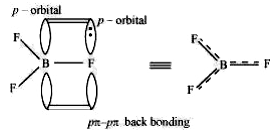
The B–F bond length in `BF_(3)` is shorter than the B–F bond length in . `BF_(3)BF_(4)^(-)` is an electron-deficient species. With a vacant p-orbital on boron, the fluorine and boron atoms undergo `ppi–ppi` back-bonding to remove this deficiency. This imparts a double- bond character to the B–F bond.

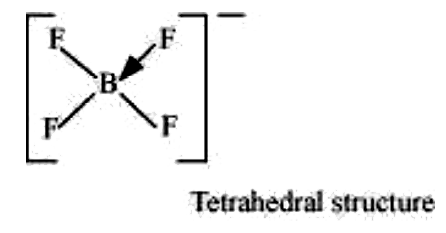
This double-bond character causes the bond length to shorten in `BF_(3)` (130 pm). However, when `BF_(3)` coordinates with the fluoride ion, a change in hybridisation from `sp^(2)`
`("in" BF_(3))` to `sp^(3)` `("in" BF_(4)^(-))` occurs. Boron now forms `4sigma` bonds and the double-bond character is lost. This accounts for a B–F bond length of 143 pm in `overset(BF_(4)^(-))(ion)`.
Promotional Banner

Topper's Solved these Questions

  • THE P-BLOCK ELEMENTS

    NCERT|Exercise EXERCISE|38 Videos
  • STRUCTURE OF ATOM

    NCERT|Exercise EXERCISE|67 Videos
  • THE S-BLOCK ELEMENTS

    NCERT|Exercise EXERCISE|32 Videos

Similar Questions

Explore conceptually related problems

(a) Explain why BF_(3) exists whereas BH_(3) does not. (b) Compare the B-F bond length in BF_(3) and BF_(4)^(-)

B — F bond length in BF_3 and [BF_4]^- are respectively -

How many dative bonds are present in BF_(4)^-

Why is BF_(3) a Lewis acid?

The decreasing order oof bond angles in BF_(2), NH_(3), PF_(3) and I_(3)^(-) is:

Statement-1 : The B-F bond length in BF_(3) is not identical with that in BF_(4)^(-) because Statement-2 : Back bonding is involved in BF_(4)^(-) but not in BF_(3)

In diamond, the C - C bond lengths are ______ pm.

Covalent radius of fluorine is 64 pm but the bond length is not equal to 128 pm and that is 143 pm and bond energy is found to be comparable to I_(2) .

NCERT-THE P-BLOCK ELEMENTS -EXERCISE
  1. Explain the difference in properties of diamond and graphite on the ba...

    Text Solution

    |

  2. Rationalise the given statements and give chemical reactions. a. Lea...

    Text Solution

    |

  3. Suggest reasons why the B–F bond lengths in BF(3) (130 pm) and BF(4 )^...

    Text Solution

    |

  4. If B-Cl bond has a dipole moment, explain why BCl(3) molecule has zero...

    Text Solution

    |

  5. AlF(3) is insoluble in anhydrous HF but dissolves on addition of NaF. ...

    Text Solution

    |

  6. Suggest a reason as to why CO is poisonous.

    Text Solution

    |

  7. How is excessive content of CO(2) responsible for global warming?

    Text Solution

    |

  8. Explain structures of diborane and boric acid.

    Text Solution

    |

  9. What happens when (a) Borax is heated strongly, (b) Boric acid is ...

    Text Solution

    |

  10. Explain the following reactions (a) Silicon is heated with methyl ch...

    Text Solution

    |

  11. Give reasons : (i) Conc. HNO(3) can be transported in aluminium con...

    Text Solution

    |

  12. Explain why is there a phenomenal decrease in ionisation enthalpy from...

    Text Solution

    |

  13. How would you explain the lower atomic radii of Ga as compared to Al?

    Text Solution

    |

  14. What are allotropes? Sketch the structure of two allotropes of carbon ...

    Text Solution

    |

  15. a. Classify following oxides as neutral, acidic, basic or amphoteric: ...

    Text Solution

    |

  16. In some of the reactions, thallium resembles aluminium whereas in othe...

    Text Solution

    |

  17. When metal X is treated with sodium hydroxide, a white precipitate (A)...

    Text Solution

    |

  18. What do you understand by (a) inert pair effect (b) allotropy and (c...

    Text Solution

    |

  19. A certain salt (X) gives the following tests : (a) Its aqueous solut...

    Text Solution

    |

  20. Write balanced equations for: a.BF(3)+LiHto b.B(2)H(6)+H(2)Oto c...

    Text Solution

    |