Home
Class 11
CHEMISTRY
Explain the following reactions (a) Si...

Explain the following reactions
(a) Silicon is heated with methyl chloride at high temperature in the presence of copper,
(b) Silicon dioxide is treated with hydrogen fluoride,
(c) CO is heated with ZnO,
(d) Hydrated alumina is treated with aqueous NaOH solution.

Text Solution

Verified by Experts
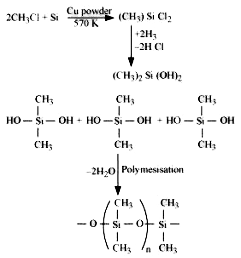
(a) When silicon reacts with methyl chloride in the presence of copper (catalyst) and at a temperature of about 537 K, a class of organosilicon polymers called methyl- substituted chlorosilanes `(MeSiCl_(3), Me_(2)SiCl_(2), Me_(3)SiCl," and "Me_(4)Si)` are formed.

(b) When silicon dioxide `(SiO_(2))` is heated with hydrogen fluoride (HF), it forms silicon tetrafluoride `(SiF_(4))`. Usually, the Si–O bond is a strong bond and it resists any attack by halogens and most acids, even at a high temperature. However, it is attacked by HF.
`SiO_(2)+4HFrarrSiF_(4)+2H_(2)O`
The `SiF_(4)` formed in this reaction can further react with HF to form hydrofluorosilicic acid.
`SiF_(4)+2HFrarrH_(2)SiF_(6)`
(c) When CO reacts with ZnO, it reduces ZnO to Zn. CO acts as a reducing agent.
`ZnO_((s))+CO_((g))overset(Delta)rarrZn_((s))+CO_(2(g))`
(d) When hydrated alumina is added to sodium hydroxide, the former dissolves in the latter because of the formation of sodium meta-aluminate.
`Al_(2)O_(3).2H_(2)O+2NaOHrarr2NaAlO_(2)+3H_(2)O`
Promotional Banner

Topper's Solved these Questions

  • THE P-BLOCK ELEMENTS

    NCERT|Exercise EXERCISE|38 Videos
  • STRUCTURE OF ATOM

    NCERT|Exercise EXERCISE|67 Videos
  • THE S-BLOCK ELEMENTS

    NCERT|Exercise EXERCISE|32 Videos

Similar Questions

Explore conceptually related problems

Explain the following reactions : (i) CO is heated with ZnO. (ii) Hydrated alumina is heated with aqueous NaOH.

Complete the following reactions (a) An alkaline solution of potassium ferricyanide is treated with hydrogen peroxide. (b) Chromium hydroxide is treated with hydrogen peroxide in the presence of NaOH.

Write the balanced chemical equations for the following reactions and identify the type of reaction in each case. (a) Nitrogen gas is treated with hydrogen gas in the presence of a catalyst at 773 K to form ammonia gas. (b) Sodium hydroxide solution is treated with acetic acid to form sodium acetate and water. (c) Ethanol is warmed with ethanoic acid to form ethyl acetate in the presence of concentrated H_2SO_(4) . (d) Ethane is burnt in the presence of oxygen to form carbon dioxide, water and releases heat and light.

(i) What happens when: (a) Borax is heated strongly (b) Boric acid is added to water ( c) Aluminium is treated with dilute NaOH . (d) BF_(3) is reacted with ammonia. (ii) Explain the following reaction. CO is heated with ZnO .

What happens when (a) Borax is heated strongly, (b) Boric acid is added to water, (c) Aluminium is treated with dilute NaOH, (d) BF_(3) is reacted with ammonia ?

NCERT-THE P-BLOCK ELEMENTS -EXERCISE
  1. Explain structures of diborane and boric acid.

    Text Solution

    |

  2. What happens when (a) Borax is heated strongly, (b) Boric acid is ...

    Text Solution

    |

  3. Explain the following reactions (a) Silicon is heated with methyl ch...

    Text Solution

    |

  4. Give reasons : (i) Conc. HNO(3) can be transported in aluminium con...

    Text Solution

    |

  5. Explain why is there a phenomenal decrease in ionisation enthalpy from...

    Text Solution

    |

  6. How would you explain the lower atomic radii of Ga as compared to Al?

    Text Solution

    |

  7. What are allotropes? Sketch the structure of two allotropes of carbon ...

    Text Solution

    |

  8. a. Classify following oxides as neutral, acidic, basic or amphoteric: ...

    Text Solution

    |

  9. In some of the reactions, thallium resembles aluminium whereas in othe...

    Text Solution

    |

  10. When metal X is treated with sodium hydroxide, a white precipitate (A)...

    Text Solution

    |

  11. What do you understand by (a) inert pair effect (b) allotropy and (c...

    Text Solution

    |

  12. A certain salt (X) gives the following tests : (a) Its aqueous solut...

    Text Solution

    |

  13. Write balanced equations for: a.BF(3)+LiHto b.B(2)H(6)+H(2)Oto c...

    Text Solution

    |

  14. Give one method for industrial preparation and one for laboratory prep...

    Text Solution

    |

  15. Oxides formed by p-block elements may be (i) basic (ii) acidic (...

    Text Solution

    |

  16. Boric acid is polymeric due to

    Text Solution

    |

  17. The type of hybridisation of boron in diborane is (a) sp , (b) sp^(...

    Text Solution

    |

  18. Thermodynamically the most stable form of carbon is (a) diamond , (b...

    Text Solution

    |

  19. Elements of group 14 (a) exhibit oxidation state of +4 only (b) ex...

    Text Solution

    |

  20. If the starting material for the manufacture of silicone is RSiCl(3), ...

    Text Solution

    |

