

Home
Class 12
PHYSICS
A mercury lamp is a convenient source fo...

A mercury lamp is a convenient source for studying frequency dependence of photoelectric emission, since it gives a number of spectral lines ranging from the UV to the end of the red visible spectrum. In our experiment with rubidium photocell, the following lines from a mercury source were used: `lambda_(1)=3650A^(@), lambda_(2)=4047A^(@), lambda_(3)=4358A^(@), lambda_(4)=5461A^(@), lambda_(5)=6907A^(@)` The stopping voltages, respectively were measured to be:
`V_(01)=1.28V, V_(02)=0.95V, V_(03)=0.74V, V_(04)=0.16V, V_(05)=0V`.
(a) Determine the value of Planck's constant h.
(b) Estimate the threshold frequency and work function for the material.

Text Solution

Verified by Experts

Einstein's photoelectric equation is given as:
`eV_(0) = hv-phi_(0)`
`V_(0) = (h)/(e)v - ((phi)_(0))/(e)" ....(1)`
Where,
`V_(0)` = Stopping potential
`h = ` planck's constant
`e = ` Charge on an electron
`v =` Frequency of radiation
`phi_(0)` = work function of a material
It can be concluded from equation (1) that potential `V_(0)` is directly proportional to frequency v.
Frequency is also given by the relation:
`v = ("Speed of light"(c))/("Wavelength"(lambda))`
This relation can be used to obtain the frequencies of the various lines for the given wavelengths.
`v_(1) = (c)/((lambda)_(1)) = (3xx10^(8))/(3650xx10^(-10)) = 8.219xx10^(14) Hz`
`v_(2) = (c)/((lambda)_(2)) = (3xx10^(8))/(4047xx10^(-10)) = 7.412xx10^(14) Hz`
`v_(3) = (c)/((lambda)_(3)) = (3xx10^(8))/(4358xx10^(-10)) = 6.884xx10^(14)Hz`
`v_(4) = (c)/((lambda)_(4)) = (3xx10^(8))/(5461xx10^(-10)) = 5.493xx10^(14) Hz`
`v_(5) = (c)/((lambda)_(5)) = (3xx10^(8))/(6907xx10^(-10)) = 4.343xx10^(14) Hz`
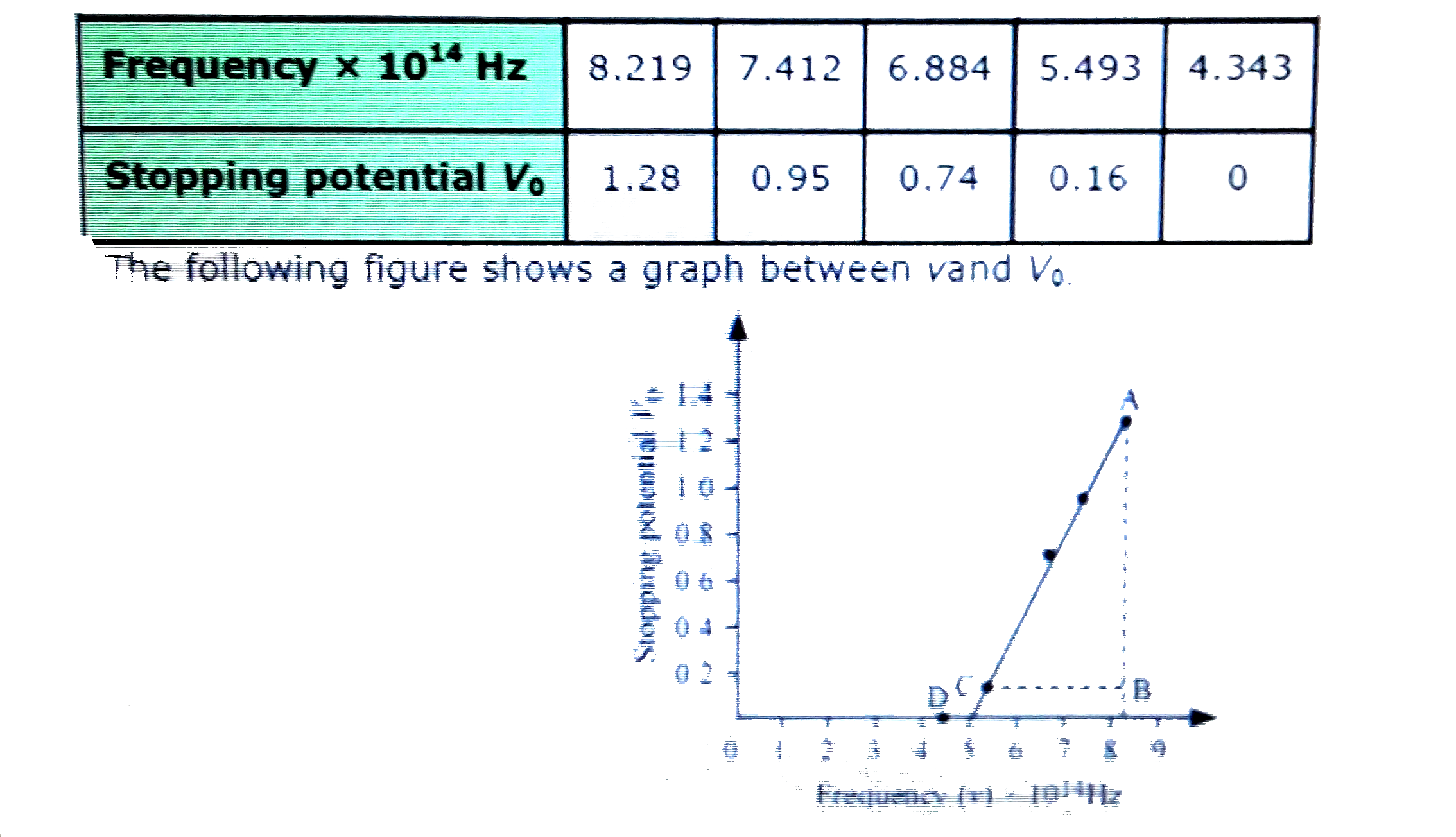
The given quantities can be listed in tabular form as:

The following figures shows a graph between v and `V_(0)`.
It can be observed that the obtained curve is a stright line. It intersects the v-axis at `5xx10^(14)Hz`, which is the threshold frequency `(v_(0))` of the material. Point D corresponds to a frequency less than the threshold frequency. Hence, there is no photoelectric emission for the `lambda_(5)` line, and therefore, no stopping voltages is required to stop the current.
Slope of the straight line `= (AB)/(CB) = (1.28-0.16)/((8.214-5.493)xx10^(14))`
From equation (1), the slope `(h)/(e)` can be written as:
`(h)/(v) = (1.28-0.16)/((8.214-5.493)xx10^(14))`
`:. h = (1.12xx1.6xx10^(-19))/(2.726xx10^(14))`
`= 6.573xx10^(-34) Js`
The work fuction of the metal is given as:
`phi_(0) = hv_(0)`
`= 6.573xx10^(-34)xx5xx10^(14)`
`= 3.286xx10^(-19)J`
`= (3.286xx10^(-19))/(1.6xx10^(-18)) = 2.054 eV`
Promotional Banner

Topper's Solved these Questions

  • DUAL NATURE OF RADIATION AND MATTER

    NCERT|Exercise Exercise|37 Videos
  • CURRENT ELECTRICITY

    NCERT|Exercise EXERCISE|23 Videos
  • ELECTRIC CHARGES AND FIELDS

    NCERT|Exercise EXERCISE|34 Videos

Similar Questions

Explore conceptually related problems

A photon of frequency v causes photo electric emission from a surface with threshold frequency v_(0) . The de-Broglies wavelength (lambda) of the photo electron emitted is given by:

The stopping potential are V_(1) and V_(2) . Calculate the (V_(1)-V_(2)) , if the lambda_(1) and lambda_(2) are wavelength of incident lights, respectively.

Derive the equations v = n lambda , where n and lambda are frequency and wavelength .

If V_(1) and V_(2) are veloctities of light in two different media, then the ratio of wavelength of light in the same media (lambda_(1))/(lambda_(2))=

If lambda_v, lambda_x and lambda_m represents the wavelength of visible light X-ray and microwave respectively then :

NCERT-DUAL NATURE OF RADIATION AND MATTER-Exercise
  1. Show that the wavelength of electromagnetic radiation is equal to the ...

    Text Solution

    |

  2. What is the de-Broglie wavelength of nitrogen molecule in air at 300K ...

    Text Solution

    |

  3. (a) Estimate the speed with which electrons emitted from a heated cath...

    Text Solution

    |

  4. (a) A monoenergetic electron beam with electron speed of 5.20xx10^(6)m...

    Text Solution

    |

  5. An electron gun with its anode at a potential of 100V fires out electr...

    Text Solution

    |

  6. (a) An X-ray tube produces a continuous spectrum of radiation with its...

    Text Solution

    |

  7. In an accelerator experiment on high energy collision of electrons wit...

    Text Solution

    |

  8. Estimate the following the following two numbers should be interesting...

    Text Solution

    |

  9. Ultraviolet light of wavelength 2271Å from a 100W mercury source irrad...

    Text Solution

    |

  10. Monochromatic radiation of wave length 640.2 nm (1nm=10^(-9)m) from a ...

    Text Solution

    |

  11. A mercury lamp is a convenient source for studying frequency dependenc...

    Text Solution

    |

  12. The work function for the following metals is given Na: 2.75 eV, K:2.3...

    Text Solution

    |

  13. Light of intensity 10^(-5)Wm^(-2) falls on a sodium photocell of surfa...

    Text Solution

    |

  14. Crystal diffraction experiments can be performed using X-rays, or elec...

    Text Solution

    |

  15. (a) Obtain the de-Broglie wavelength of a neutron of kinetic energy 15...

    Text Solution

    |

  16. An electron microscope uses electrons accelerated by a voltage of 50kV...

    Text Solution

    |

  17. The wavelength of a probe is roughly a measure of the size of structu...

    Text Solution

    |

  18. Find the typical de-Broglie wavelength associated with a H-atom in he...

    Text Solution

    |

  19. Compute the typical de-Broglie wavelength of an electrons in a metal a...

    Text Solution

    |

  20. Answer the following questions: (a) Quarks inside protons and neutro...

    Text Solution

    |