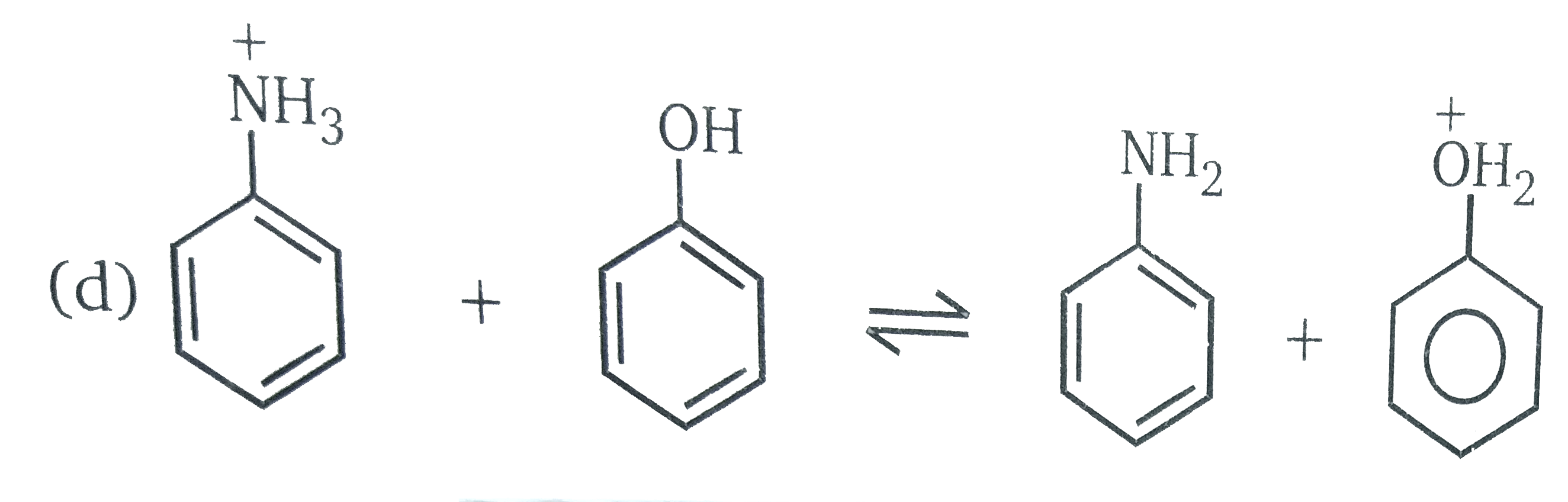
To determine in which of the following reactions the backward reaction is favored, we need to analyze the nature of the acids and bases involved in each reaction. The backward reaction is favored when we have weak acids and weak bases because they do not readily dissociate to form ions.
### Step-by-Step Solution:
1. **Identify the Nature of Acids and Bases**:
- Review the given reactions and identify whether the acids are strong or weak and whether the bases are strong or weak.
- Strong acids dissociate completely in solution, while weak acids do not.
2. **Analyze the Reaction Conditions**:
- In acid-base reactions, the backward reaction (the reverse of the forward reaction) is favored when both the acid and base are weak. This is because weak acids do not easily release protons (H⁺), and weak bases do not easily accept protons.
3. **Examine Each Reaction**:
- For each reaction provided in the options, determine if the acid is weak and if the base is weak.
- For example, if one of the options involves a weak acid reacting with a weak base, this would favor the backward reaction.
4. **Determine the Correct Option**:
- After analyzing all the reactions, identify which reaction involves a weak acid and a weak base. This will be the reaction where the backward reaction is favored.
5. **Conclusion**:
- Based on the analysis, conclude that the correct answer is the option where a weak acid and a weak base are present, which is option D.
To determine in which of the following reactions the backward reaction is favored, we need to analyze the nature of the acids and bases involved in each reaction. The backward reaction is favored when we have weak acids and weak bases because they do not readily dissociate to form ions.
### Step-by-Step Solution:
1. **Identify the Nature of Acids and Bases**:
- Review the given reactions and identify whether the acids are strong or weak and whether the bases are strong or weak.
- Strong acids dissociate completely in solution, while weak acids do not.
...
Topper's Solved these Questions
GENERAL ORGANIC CHEMISTRY
MS CHOUHAN|Exercise LEVEL- 1|1 Videos
FAMILIES OF CARBON COMPOUNDS: FUNCTIONAL GROUPS AND INTERMOLECULAR FORCES
MS CHOUHAN|Exercise ADDITIONAL OBJECTIVE QUESTIONS ( Matrix Match Type ) |4 Videos
GRIGNARD REAGENTS
MS CHOUHAN|Exercise Level 1 (Q.61 To Q.66)|1 Videos
Similar Questions
Explore conceptually related problems
Which of the following reactions favour backward direction ?
In which of the following, E_(a) for backward reaction is greater than E_(a) for forward reaction?
Which of the following reaction is ammonolysis reaction?
B(OH)_(3)+NaOH to Na[B(OH)_(4)](aq). Then addition of which of the following shifts the reaction in the backward direction.
Which of the following reactions is an example of a redox reaction? Hint: In above reaction. xenon is oxidised while oxygen is reduced i.e .. it is redox reaction.)
Int the following acid-base reaction, in which can backward reaction if favoured ?
K_(p) for an endothermic chemical reaction is 10 atm. Then backward reaction is favoured at