Home
Class 12
CHEMISTRY
During an experimental workup procedure,...

During an experimental workup procedure, a chemist treated a starting material with NaoH in the solvent acetone `[(CH_(3))_(2)C=O]`, however, the starting material was recovered unreacted. Instead, the chemist isolated a small amount of product A (shown below).
Product A
1. Elemental analysis of product A indicated that it consisted only of carbon, hydrogen, and oxygen.
2. Product A had a molecular weight of 116 g/mol.
3. Product A was a methyl ketone because it gave a positive iodoform test.
4. When product A was treated with `Br_(2)` in `C Cl_(4)`, the red bromine colour persisted, because no carbon-carbon double bonds were present to react with the bromine.
The structure of product A was further confirmed when treatment with hot sulfuric acid resulted in the corresponding dehydration product, product (B)gt
Q. Wihch of the following compounds from the passage will give a positive iodoform test.?

A

Product A only

B

Product A and product B

C

Product A and acetone only

D

Product A, product B, and acetone.

Text Solution

Verified by Experts

The correct Answer is:
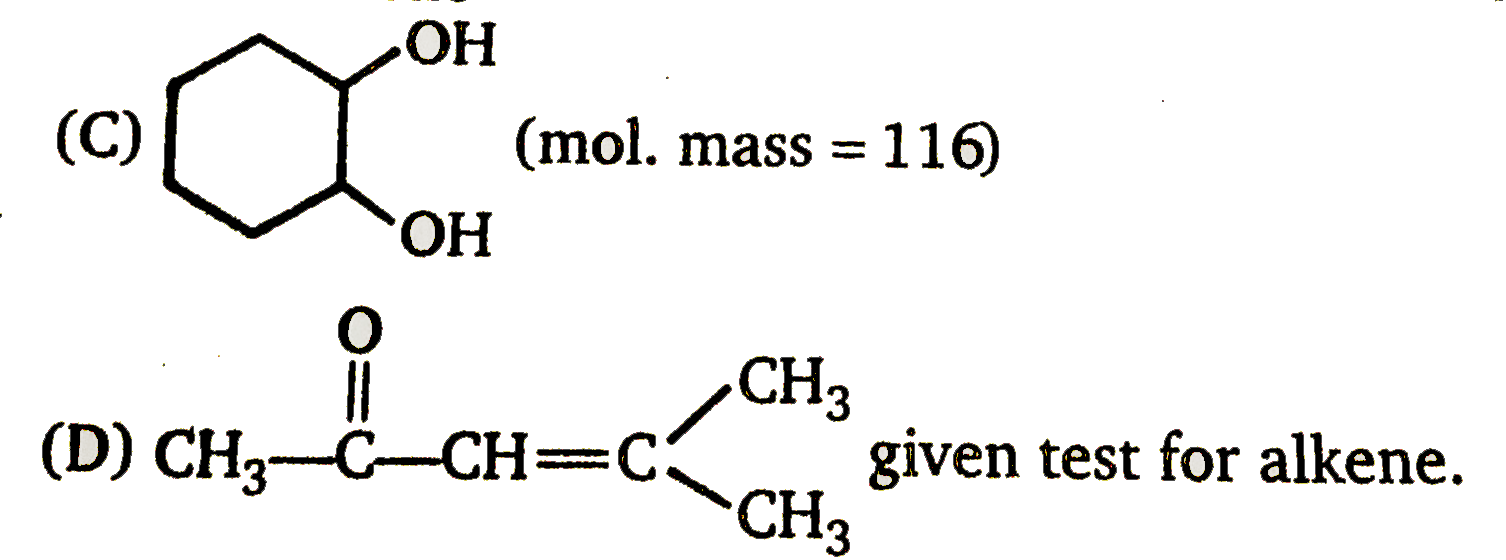
D

.
Promotional Banner

Topper's Solved these Questions

  • ALDOL AND CANNIZARO REACTION

    MS CHOUHAN|Exercise Level 1 (Q.1 To Q.30)|6 Videos
  • ALDOL AND CANNIZARO REACTION

    MS CHOUHAN|Exercise Level 1 (Q.31 To Q.48)|3 Videos
  • ALDEHYDES AND KETONES II. ALDOL REACTIONS

    MS CHOUHAN|Exercise ADDITIONAL OBJECTIVE QUESTIONS (LINKED COMPREHENSION TYPE )|6 Videos
  • ALKENES AND ALKYNES II

    MS CHOUHAN|Exercise ADDITIONAL OBJECTIVE QUESTIONS (Matrix Match Type)|2 Videos

Similar Questions

Explore conceptually related problems

During an experimental workup procedure, a chemist treated a starting material with NaoH in the solvent acetone [(CH_(3))_(2)C=O] , however, the starting material was recovered unreacted. Instead, the chemist isolated a small amount of product A (shown below). Product A 1. Elemental analysis of product A indicated that it consisted only of carbon, hydrogen, and oxygen. 2. Product A had a molecular weight of 116 g/mol. 3. Product A was a methyl ketone because it gave a positive iodoform test. 4. When product A was treated with Br_(2) in C Cl_(4) , the red bromine colour persisted, because no carbon-carbon double bonds were present to react with the bromine. The structure of product A was further confirmed when treatment with hot sulfuric acid resulted in the corresponding dehydration product, product (B)gt Q. What is the molecular weight of a compound that undergoes an aldol self-condensation reaction to result in a beta -hydroxy ketone with a molecular weight of 144?

During an experimental workup procedure, a chemist treated a starting material with NaoH in the solvent acetone [(CH_(3))_(2)C=O] , however, the starting material was recovered unreacted. Instead, the chemist isolated a small amount of product A (shown below). Product A 1. Elemental analysis of product A indicated that it consisted only of carbon, hydrogen, and oxygen. 2. Product A had a molecular weight of 116 g/mol. 3. Product A was a methyl ketone because it gave a positive iodoform test. 4. When product A was treated with Br_(2) in C Cl_(4) , the red bromine colour persisted, because no carbon-carbon double bonds were present to react with the bromine. The structure of product A was further confirmed when treatment with hot sulfuric acid resulted in the corresponding dehydration product, product (B)gt Q. Based only on observation 1 and 2, which of the following compounds could have been product A?

During an experimental workup procedure, a chemist treated a starting material with NaoH in the solvent acetone [(CH_(3))_(2)C=O] , however, the starting material was recovered unreacted. Instead, the chemist isolated a small amount of product A (shown below). Product A 1. Elemental analysis of product A indicated that it consisted only of carbon, hydrogen, and oxygen. 2. Product A had a molecular weight of 116 g/mol. 3. Product A was a methyl ketone because it gave a positive iodoform test. 4. When product A was treated with Br_(2) in C Cl_(4) , the red bromine colour persisted, because no carbon-carbon double bonds were present to react with the bromine. The structure of product A was further confirmed when treatment with hot sulfuric acid resulted in the corresponding dehydration product, product (B). Q. When a drop of Br_(2) in C Cl_(4) is added to product B, the resulting solution will ew

During an experimental workup procedure, a chemist treated a starting material with NaoH in the solvent acetone [(CH_(3))_(2)C=O] , however, the starting material was recovered unreacted. Instead, the chemist isolated a small amount of product A (shown below). Product A 1. Elemental analysis of product A indicated that it consisted only of carbon, hydrogen, and oxygen. 2. Product A had a molecular weight of 116 g/mol. 3. Product A was a methyl ketone because it gave a positive iodoform test. 4. When product A was treated with Br_(2) in C Cl_(4) , the red bromine colour persisted, because no carbon-carbon double bonds were present to react with the bromine. The structure of product A was further confirmed when treatment with hot sulfuric acid resulted in the corresponding dehydration product, product (B)gt Q. The aldol self-condensation of acetone is an equilibrium that favours acetone over its condensation product. which of the following experimental modifications is most likely to shift the position of equilibrium towards product A?

What are the starting materials to get 2-methylpropene as the major product?

Suggest a synthesis of given product from the indicated starting material.

If the starting material for the manufacture of silicone is RSiCl_(3) , write the structure of the product formed.

When glycerol is treated with a small amount of HI or PI_(3) , the product obtained is:

When ethylamine is treated with CH_(3)MgBr , the product is:

