Home
Class 12
PHYSICS
A ball is dropped from a height h on to ...

A ball is dropped from a height h on to a floor. If in each collision its speed becomes e times of its striking value (a) find the time taken by ball to stop rebounding (b) find the total change in momentum in this time (c) find the average force exerted by the ball on the floor using results of part (a) and (b).

Text Solution

Verified by Experts
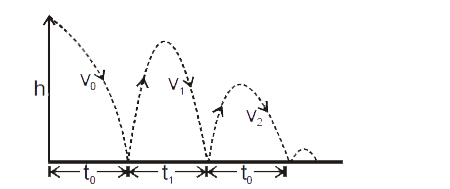
(a) When the ball is dropped from a height h, time taken by it to reach the ground will be
`t_(0)=sqrt((2h)/g)` and its speed `v_(0)=sqrt(2gh)`

Now after collision its speed will becomes e times, i.e., `v_(1)=ev_(0)=esqrt(2gh)` and so, it will take time to go up till its speed becomes zero `=(v_(1)//g)`. The same time it will take to come down. So total time between I and II collision will be `t_(1)=2v_(1)//g.` Similarly, total time between II and III collision `t_(2)=2v_(2)//g`.
So total time of motion
`DeltaT=t_(0)+t_(1)+t_(2)+`.......
or `DeltaT=t_(0)+(2v_(1))/g+(2v_(2))/g` .....
or `DeltaT=t_(0)+(2ev_(0))/g+(2e^(2)v_(0))/g` .......
[as `v_(2)=ev_(1)=e^(2)v_(0)`]
or `DeltaT=sqrt((2h)/g)[1+2e(1+e+e^(2)+.....)]`
`=sqrt((2h)/g)[1+2e(1/(1-e))]=sqrt((2h)/g)[(1+e)/(1-e)]`
(b) Change in momentum in I collision
`=mv_(1)-(-mv_(0))=m(v_(1)+v_(0))`
Change in momentum in II collision = `m(v_(2)+v_(1))`
Change in momentum in nth collision `=m(v_(n)+v_(n-1))`
Adding these all total change in momentum
`Deltap=m[v_(0)+2v_(1)+.....+2v_(n-1)+v_(n)]`
or `Deltap=mv_(0)[1+2e+e^(2)+......]`
or `Deltap=mv_(0)[1+2e(1/(1-e))]=msqrt(2gh)[(1+e)/(1-e)]`
....(2)
(c) Now as `vecF=(dvecp)/(dt)` so, `F_(av)=(Deltap)/(DeltaT)`
Substituting the value of `DeltaT` and `Deltap` from Eqns. (1) and (2)
`F_(av)=msqrt(2gh)[(1+e)/(1-e)]xxsqrt(g/(2h))[(1-e)/(1+e)]=mg` ...(3)
Promotional Banner

Topper's Solved these Questions

  • CENTRE OF MASS

    MOTION|Exercise Exercise - 1|71 Videos
  • CENTRE OF MASS

    MOTION|Exercise Exercise - 2 (Level-I)|40 Videos
  • Capacitance

    MOTION|Exercise EXERCISE -4 LEVEL II|19 Videos
  • CIRCULAR MOTION

    MOTION|Exercise EXERCISE - 4|16 Videos

Similar Questions

Explore conceptually related problems

A ball is dropped from a height h on to a floor . If the cofficient of restitution is e, calculate the height the ball first rebounds ?

A ball is dropped from a height of 20 m in the floor and rebounds to 1.25 m after second collision, then coefficient of restitution e is

A ball is dropped from a height of 20 m in the floor and rebounds to 1.25 m after second collision, then coefficient of restitution e is

A ball is dropped from a height of a height of 90 m on a floor. At each collsion with the floor , the ball loses one - tenth of its speed . Plot the speed -time graph of its motion between t 0 to 12 s.

A ball is dropped from a height 'h' on to a floor of coefficient of restitution 'e'. The total distance covered by the ball just before second hit is

If a ball is dropped from height 2 metre on a smooth eleastic floor, then the time period of oscillation is

A ball of mass m is dropped from height h on a horizontal floor which collides with it with speed u. If coefficient of restitution in floor is e, then impulse imparted to ball by the floor on its second rebounce is

A ball is dropped from a height h on a floor. The coefficient of restitution for the collision between the ball and the floor is e. The total distance covered by the ball before it comes to the rest.

A ball is dropped from some height. After rebound from the floor it ascends to the same height. Draw the velocity-time graph for the given motion.

A ball is dropped from a height h. As it bounces off the floor, its speed is 80 per cent of what it was just before it hit the floor. The ball will then rise to a height of most nearly:

MOTION-CENTRE OF MASS-Exercise - 4 Level-II
  1. A ball is dropped from a height h on to a floor. If in each collision ...

    Text Solution

    |

  2. STATEMENT-l : In an elastic collision between two bodies, the relative...

    Text Solution

    |

  3. A particle moves in the X-Y plane under the influence of a force such ...

    Text Solution

    |

  4. Two balls having linear momenta vecp(1)=phati and vecp(2)=-phati, und...

    Text Solution

    |

  5. A small block of mass M moves on a frictionless surface of an incline...

    Text Solution

    |

  6. A small block of mass M moves on a frictionless surface of an incline...

    Text Solution

    |

  7. A small block of mass M moves on a frictionless surface of an incline...

    Text Solution

    |

  8. If the resultant of all the external forces acting on a system of part...

    Text Solution

    |

  9. Look at the drawing given in the figure which has been drawn with ink ...

    Text Solution

    |

  10. Two small particles of equal masses stant moving in opposite directio...

    Text Solution

    |

  11. There object A ,B and C are kept is a straing line a fritionlas horize...

    Text Solution

    |

  12. A point mass of 1 kg collides elastically with a stationary point mass...

    Text Solution

    |

  13. A ball of mass 0.2 kg rests on a vertical post of height 5 m. A bullet...

    Text Solution

    |

  14. A particle of mass m is projected from the ground with an initial spee...

    Text Solution

    |

  15. A pulse of light of duration 100ns is absorbed completely by a small o...

    Text Solution

    |

  16. A tennis ball dropped on a barizoontal smooth surface , it because bac...

    Text Solution

    |

  17. A block of mass M has a circular cut with a frictionless surface as sh...

    Text Solution

    |

  18. A flat plate is moving normal to its plane through a gas under the act...

    Text Solution

    |

  19. Consider regular polygons with number of sides n = 3, 4, 5 ...... as s...

    Text Solution

    |

  20. A spring-block system is resting on a frictionless floor as shown in t...

    Text Solution

    |

  21. A small particle of mass m moving inside a heavy, hollow and straight ...

    Text Solution

    |

