Home
Class 12
PHYSICS
The spring block system lies on a smooth...

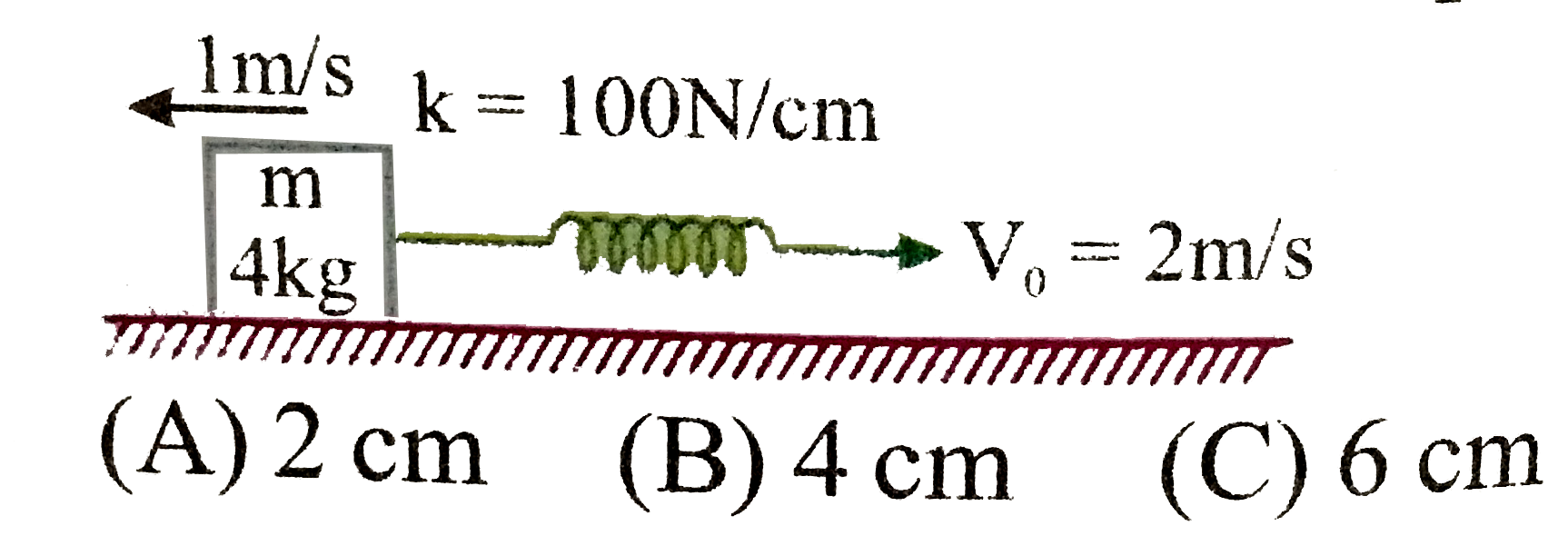
The spring block system lies on a smooth horizontal surface. The free endof the spring is being pulled towards right with constant speed `v_(0) = 2m//s`. At `t = 0 sec`, the spring of constant `k = 100 N//cm` is unsttretched and the block has a speed `1 m//s` to left. The maximum extension of the spring is.
.

A

2cm

B

4 cm

C

6 cm

D

8 cm

Text Solution

Verified by Experts

The correct Answer is:

C
Promotional Banner

Topper's Solved these Questions

  • CENTRE OF MASS

    MOTION|Exercise Exercise - 2 (Level-I)|40 Videos
  • CENTRE OF MASS

    MOTION|Exercise Exercise - 2 (Level-II)|28 Videos
  • CENTRE OF MASS

    MOTION|Exercise Exercise - 4 Level-II|20 Videos
  • Capacitance

    MOTION|Exercise EXERCISE -4 LEVEL II|19 Videos
  • CIRCULAR MOTION

    MOTION|Exercise EXERCISE - 4|16 Videos

Similar Questions

Explore conceptually related problems

A block attached with an ideal spring is kept on a smooth horizontal surface. Now the free end of the spring is pulled with a constant velocity u horizontally. Then the maximum energy stored in the spring and bock system during subsequent motion is :

A block of mass 2 kg is connect to an ideal spring and the system is placed on a smooth horizontal surface. The spring is pulled to move the block and at an instant the speed of end A of the spring and speed of the block were measured to be 6 m/s and 3 m/s respectively. At this moment the potential energy stored in the spring is increasing at a rate of 15 J/s. Find the acceleration of the block at this instant.

Two blocks of masses 3kg and 6kg respectivley are placed on a smooth horizontal surface. They are connected by a light spring of force constant k=200N//m . Initially the spring is unstretched. The indicated velocities are imparted to the blocks. Find the maximum extension of the spring.

A spring block system is placed on a rough horizontal floor. Force constant of the spring is k. The block is pulled to right to give the spring an elongation equal to x_0 and then it is released. The block moves to left and stops at the position where the spring is relaxed. Calculate the maximum kinetic energy of the block during its motion.

A spring has force constant k = 200 N//m and its one end is fixed. There is a block of mass 2 kg attached to its other end and the system lies on a smooth horizontal table. The block is pulled so that the extension in the spring becomes 0.05 m. At this position the block is projected with a speed of 1 m//s in the direction of increasing extension of the spring. Consider time t = 0 at the moment the block is projected and find (a) the extension (or compression) in the spring as a function of time. (b) the maximum extension in the spring and the time at which it occurs for the first time. (c) the time after which the speed of the block becomes maximum for the first time. Given: sin^(-1) (0.446) = 0.46 radian

A block of mass m, attacted to a string of spring constant k, oscillates on a smooth horizontal table. The other end of the spring is fixed to a wall. The block has a speed v when the spring is at its natural length. Before coming to an instantaneous rest. If the block moves a distance x from the mean position, then

A block of mass M is tied to a spring of force constant k and placed on a smooth horizontal surface. The natural length of the spring is L. P is a point on the spring at a distance (L)/(4) from its fixed end. The block is set in oscillations with amplitude A. Find the maximum speed of point P on the spring.

A block of mass m is connect to another block of mass M by a massless spring of spring constant k. The blocks are kept on a smooth horizontal plane. Initially the blocks are at rest and the spring is unsrtretched when a constnt force F starts acting on the block of mass M to pull it. Find the maximum extension of the spring.

In spring constant of the spring is 100 N//m Extension produced in the spring is: (g=10 m//s^(2))

MOTION-CENTRE OF MASS-Exercise - 1
  1. Two masses m and 2m are attached to two ends of an ideal spring as sho...

    Text Solution

    |

  2. Two blocks A(3kg) and B(6kg) are connected by a spring of stiffness 51...

    Text Solution

    |

  3. The spring block system lies on a smooth horizontal surface. The free ...

    Text Solution

    |

  4. A block of mass 'm' is attached to a spring in natural length of sprin...

    Text Solution

    |

  5. A super-ball of mass m is to bounce elastically back and forth between...

    Text Solution

    |

  6. A force exerts an impulse I on a particle changing its speed from u to...

    Text Solution

    |

  7. A boy hits a baseball with a bat and imparts and impulse J to the ball...

    Text Solution

    |

  8. A system of two blocks A and B are connected by an inextensible massle...

    Text Solution

    |

  9. The position-time graph of a particle of mass 0.1 kg is shown. The imp...

    Text Solution

    |

  10. The magnitude of force (in Newtons) acting on a body varies with time ...

    Text Solution

    |

  11. An impulse vec(I) changes the velocity of a particle from vec(v)(1) to...

    Text Solution

    |

  12. Two blocks of masses 10 kg and 4 kg are connected by a spring of negli...

    Text Solution

    |

  13. A ball strikes a smooth horizontal ground at an angle of 45^(@) with t...

    Text Solution

    |

  14. In an inelastic collision-

    Text Solution

    |

  15. Two perfectly elastic balls of same mass m are moving with velocities ...

    Text Solution

    |

  16. When two bodies collide elastically, then

    Text Solution

    |

  17. A ball hits the floor and rebounds after an inelastic collision . In t...

    Text Solution

    |

  18. Six steel balls of identical size are lined up long a straight frictio...

    Text Solution

    |

  19. The bob of a simple pendulum of length l dropped from a horizontal pos...

    Text Solution

    |

  20. Two balls A and B having masses 1 kg and 2 kg, moving with speeds 21 m...

    Text Solution

    |
