Home
Class 12
PHYSICS
Two particle undergoes SHM along paralle...

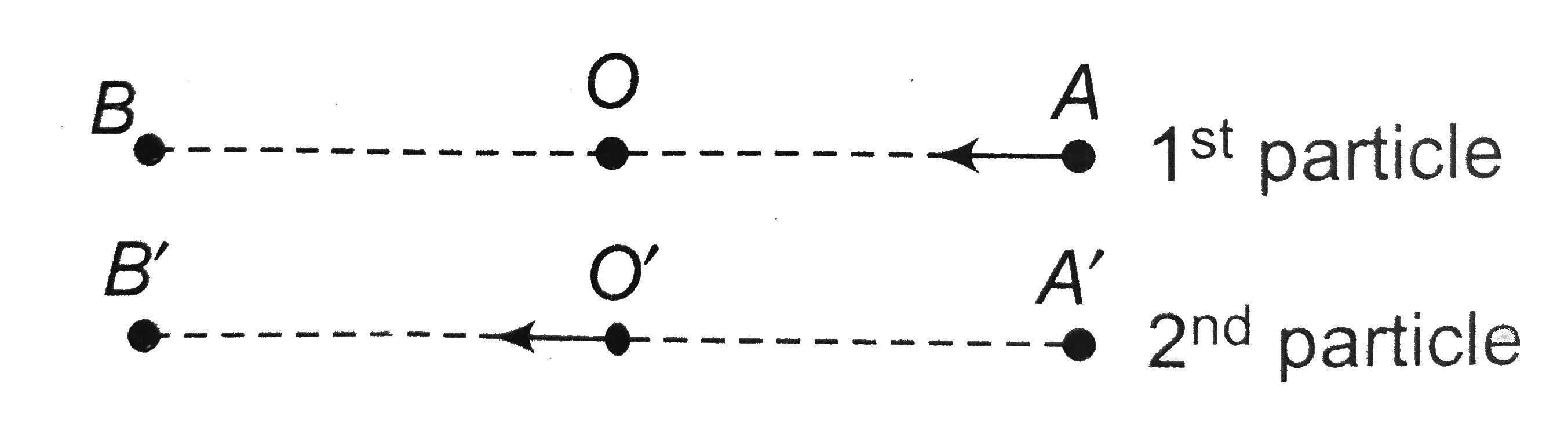
Two particle undergoes `SHM` along parallel line with the same time period `(T)` and equal amplitude At a particular instant , one particle is at its extereme position while the other is at its mean position .They move in the same direction .They will cross each other after a further time

Text Solution

Verified by Experts
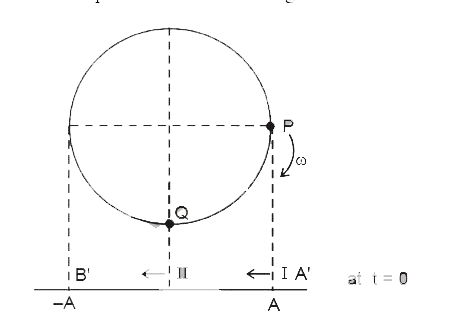
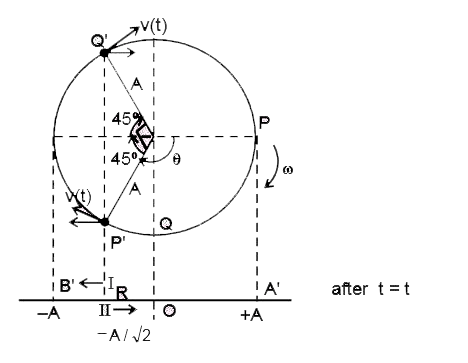
. This problem is easy to solve with the help of phasor diagram. First we draw the initial position of both the particle on the phasor as shown in figure. From above figure phase difference between both the particles is `pi`/2.They will cross each other when their projection from the circle on the horizontal diameter meet at one point. Let after time t both will reach at P'Q' point having phase difference `pi`/2 as shown in figure.
Both will meet at `-A //sqrt(2)`
When they meet angular displacement of P is
`theta = pi //2 +pi//4= 3 pi//4 `
So they will meet after time t `= (3pi)/(4xx omega)`
t = `(3pi)/(4xx2pi) xxT = (3T)/(8) `sec

Promotional Banner

Topper's Solved these Questions

  • SIMPLE HARONIC MOTION

    MOTION|Exercise EXERCISE -1 ( SECTION-A )|8 Videos
  • SIMPLE HARONIC MOTION

    MOTION|Exercise EXERCISE -1 ( SECTION-B ) (Time per iod and angu larfrequency in SHM)|8 Videos
  • SIMPLE HARMONIC MOTION

    MOTION|Exercise EXERCISE -3 Section - B Previous Year Problems | JEE MAIN|23 Videos
  • SOUND WAVES

    MOTION|Exercise Exercise - 3 (Section - B)|14 Videos

Similar Questions

Explore conceptually related problems

Two particles undergo SHM along the same line with the same time period (T) and equal amplitude (A). At a particular instant one is at x = -A and the other is at x = 0. If they start moving in the same direction then they will cross each other at (i) t = (4T)/(3) (ii) t = (3T)/(8) (iii) x = (A)/(2) (iv) x = (A)/(sqrt(2))

Two particles undergo SHM along the same line with the same time period (T) and equal amplitude (A) . At a particular instant one is at x =- A and the other is at x =0 . If they start moving in the same direction then they will cross each other at (i) t = (4T)/(3) (ii) t = (3T)/(8) (iii) x = (A)/(2) (iv) x = (A)/(sqrt(2))

Time period (T) and amplitude (A) are same for two particle which undergoes SHM along the same line. At one particular instant one particle is at phase (3pi)/(2) and the other is at zero,while moving in the same direction. Find the time at which they will cross each other

At a particular position the velocity of a particle in SHM with amplitude a is sqrt3 // 2 that at its mean position. In this position, its displacement is :

Two very small particles are executing SHM along very near parallel lines about the same mean position, same amplitude and the same frequency. At t = 0 both the particle are moving with speed of 1m//sec but on the opposite side of the mean position and having same direction of velocity at a distance of 5cm from the mean position. At t = 4sec they are at the same position moving with speed of 1m//sec but in opposite direction. Assuming that this is the minimum time form t = 0 where they are meeting for the 1st time. If the maximum speed of either particle is (xpi)/(4sqrt(2))cm//sec Find x

A particle performs SHM on a straight line with time period T and amplitude A . The average speed of the particle between two successive instants, when potential energy and kinetic energy become same is

A particle performs SHM with a period T and amplitude a. The mean velocity of particle over the time interval during which it travels a//2 from the extreme position is