Home
Class 12
PHYSICS
A mass m is attached to the free end of ...

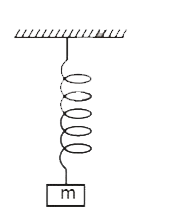
A mass m is attached to the free end of a massless spring of spring constant k with its other end fixed to a rigid support as shown in figure. Find out the time period of the mass, if it is displaced slightly by an amount x downward.

Text Solution

Verified by Experts
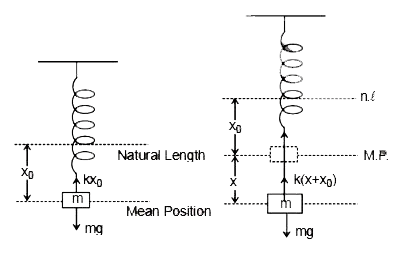
The following steps are usually followed in this method :
Step 1. Find the stable equillibrium position which is usually known as the mean position. Net force or torque on the particle at this position is zero. Potential energy is minimum. In our example initial position is the mean position.
Step 2. Write down the mean position force relation. In above figure at mean position
`kx_(0)= mg " " cdots (1)`
Step 3. Now displace the particle from its mean position by a small displacement x (in linear SHM) or angle `theta` (in case of an angular SHM) as shown in figure.
Step 4. Write down the net force on the particle in the displaced position.
From the above figure.
`F_("net") = mg - k (x-x_(0)) " " cdots (2)`
Step 5. Now try to reduce this net force equation in the form of F = – kx (in linear S.H.M.) or `tau = – k theta ` (in angular SHM) using mean position force relation in step 2 or binomial theorem.
From eq. (2) `F_("net") = mg- kx = kx _(0) `
Usng eq (i) in above equation
`F_("net") = - kx " " cdots (3)`
Equation (3) shows that the net force acting towards mean position and is proportional to x, but in this S.H.M. constant `K_(S.H.M. )` is replaced by spring constant k. So
`T = 2pi sqrt((m)/(K_(S.H.M.)))=2pisqrt((m)/(k))`

Promotional Banner

Topper's Solved these Questions

  • SIMPLE HARONIC MOTION

    MOTION|Exercise EXERCISE -1 ( SECTION-A )|8 Videos
  • SIMPLE HARONIC MOTION

    MOTION|Exercise EXERCISE -1 ( SECTION-B ) (Time per iod and angu larfrequency in SHM)|8 Videos
  • SIMPLE HARMONIC MOTION

    MOTION|Exercise EXERCISE -3 Section - B Previous Year Problems | JEE MAIN|23 Videos
  • SOUND WAVES

    MOTION|Exercise Exercise - 3 (Section - B)|14 Videos

Similar Questions

Explore conceptually related problems

A mass of 0.2 hg is attached to the lower end of a massles spring of force constant 200(N)/(m) the opper end of which is fixed to a rigid support. Study the following statements.

Two identical springs of spring constant k are attached to a block of mass m and to fixed supports as shown in the figure. The time period of oscillation is

A block of mass m is connected to another .block of mass M by a massless spring of spring constant k. A constant force f starts action as shown in figure, then:

A block of mass m is attached to a massless spring of force constant k, the other end of which is fixed from the wall of a truck as shown in figure. The block is placed over a smooth surface and initially the spring is unstretched. Suddenly the truck starts moving towards right with a constant accleration a_(0). As seen from the truck

A particle of mass m is attached to three identical springs of spring constant k as shwon in figure. The time period of vertical oscillation of the particle is

A rod of mass m and length L is kept on a horizontal smooth surface. The rod is hinged at its one end A . There are two springs, perpendicular to the rod, kept in the same horizontal plane. The spring of spring constant k is rigidly attached to the lower end of rod and spring of spring constant 12k just touches the rod at its midpoint C , as shown in the figure. If the rod is slightly displaced leftward and released then, the time period for small osciallation of the rod will be