Home
Class 12
PHYSICS
Block of mass m(2) is in equilibrium and...

Block of mass `m_(2)` is in equilibrium and at rest. The mass `m_(1)` moving with velocity u vertically downwards collides with `m_(2)` and sticks to it. Find the energy of oscillation.

Text Solution

Verified by Experts
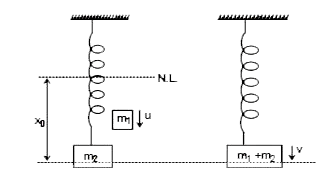
At equilibrium position `m_(2)g = kx_(0)`
`implies x_(0) = (m_(2)g)/(K)`
After collision m2 sticks to `m_(1)`.
`:. " "` By momentum conservation.
`m_(1)u = (m_(1)+m_(2))v`
`v= (m_(1)u)/(m_(1)+m_(2))`
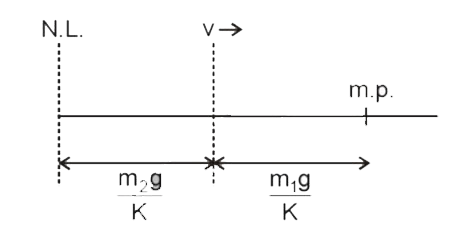
Now both the blocks are executing S.H.M. which can be interpreted as follows:
Now , we know that `v^(2) = omega^(2) (A^(2)-x^(2)) " " cdots (1)`
`omega^(2) = (k)/(m_(1)+m_(2))`
`= > x = (m_(1)g)/(k) `
Put the values of v, `omega^(2)` & x in eq. (1)
`((m_(1)u)/(m_(1)+m_(2)))^(2)=((k)/(m_(1)+m_(2)))[A^(2)-((m_(1)g)/(k))^(2)]`

`implies kA^(2)= [((m_(1)^(2)u^(2))/(m_(1)+m_(2)))+((m_(1)g)/(k))^(2)]`
`implies ` Energy of oscillation =` (1)/(2)kA^(2)`
`=(1)/(2)[((m_(1)^(2)u^(2))/(m_(1)+m_(2)))+((m_(1)^(2)g^(2))/(k))]`

Promotional Banner

Topper's Solved these Questions

  • SIMPLE HARONIC MOTION

    MOTION|Exercise EXERCISE -1 ( SECTION-A )|8 Videos
  • SIMPLE HARONIC MOTION

    MOTION|Exercise EXERCISE -1 ( SECTION-B ) (Time per iod and angu larfrequency in SHM)|8 Videos
  • SIMPLE HARMONIC MOTION

    MOTION|Exercise EXERCISE -3 Section - B Previous Year Problems | JEE MAIN|23 Videos
  • SOUND WAVES

    MOTION|Exercise Exercise - 3 (Section - B)|14 Videos

Similar Questions

Explore conceptually related problems

Block of mass m_(2) is in equilibrium and at rest. The mass m_(1) moving with velocity u vertically downwards collids with m_(2) and sticks to it. Find the energy of oscillation.

A particle of mass m moving with velocity v strikes a stationary particle of mass 2 m and sticks to it. The speed of the system will be.

A particle of mass 2m moving with velocity v strikes a stationary particle of mass 3m and sticks to it . The speed of the system will be

A particle of mass 2m moving with velocity v strikes a stationary particle of mass 3m and sticks to it. The speed of the system will be

An object of mass m_(1) moving with speed v collides with another object of mass m_(2) at rest and stick to it. Find the impulse imparted to the second object.

Block of mass m_(2) is in equilibrium as shown in figure. Anotherblock of mass m_(1) is kept gently on m_(2) . Find the time period of oscillation and amplitude.

A block of mass M is tied to a spring of force constant K and the system is suspended vertically. Consider three situations shown in fig. (a), (b) and (c). (a) In fig. (a), an insect of mass M is clinging to the block and the system is in equilibrium. The insect leaves the block and falls. Find the amplitude of resulting oscillations. (b) In fig. (b), an insect of mass M is resting on the top of the block and the system is in equilibrium. The insect suddenly jumps up with a speed u=gsqrt((M)/(K)) and the block starts oscillating. Find amplitude of oscillation assuming that the insect never falls back on the block (c) In fig. (c), an insect of mass M falls on the block this in equilibrium. The insect hits the block with velocity u=gsqrt((M)/(K)) while moving downwards sticks to the block. Find the amplitude of oscillation.

A bullet of mass m moving with velocity v strikes a block of mass M at rest and gets embedded into it. The kinetic energy of the composite block will be