Home
Class 12
PHYSICS
Two blocks of mass m(1) and m(2) are con...

Two blocks of mass `m_(1)` and `m_(2)` are connected with a spring of natural length `l` and spring constant k. The system is lying on a smooth horizontal surface. Initially spring is compressed by `x_(0)` as shown in figure. Show that the two blocks will perform SHM about their equilibrium position. Also (a) find the time period, (b) find amplitude of each block and (c) length of spring as a function of time.

Text Solution

Verified by Experts
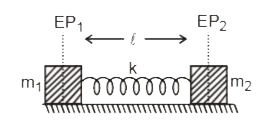
(a) Here both the blocks will be in equilibrium at the same time when spring is in its natural length. Let `EP_(1)` and `EP_(2)` be equilibrium positions of block A and B as shown in figure.
Let at any time during oscillations, blocks are at a distance of `x_(1)` and `x_(2)` from their equilibrium positions.
As no external force is acting on the spring block system
`:. ( m_(1) + m_(2)) Deltax_("cm") = m_(1)x_(1)-m_(2)n_(2)=0`
or `m_(1)x_(1)= m_(2)x_(2)`
For 1st particle, force equation can be written as
`k (x_(1)+(m_(1))/(m_(2))x_(1)) = -m_(1)a_(1)`
or `" " a_(1)=-(k(m_(1)+m_(2)))/(m_(1)m_(2))x_(1)`
`:. " "omega_(1)=-(k(m_(1)+m_(2)))/(m_(1)m_(2))`
Hence T = `2pi sqrt((m_(1)m_(2))/(k(m_(1)+m_(2))))=2pisqrt((mu)/(K))`
were `mu = (m_(1)m_(2))/((m_(1)+m_(2))` which is know as reduced mass
(b) Let the amplitude of blocks be `A_(1)` and `A_(2)`
`m_(1)A_(1)= m_(2)A_(2)`
By energy conservation ,
`(1)/(2)k (A_(1)+A_(2))^(2) = (1)/(2) kx_(0)^(2)`
or `" " A_(1)+A_(2) = x_(0)`
or`" " A_(1) + A_(2)= x_(0)`
or , `" " A_(1) + (m_(1))/(m_(2))A_(1)= x_(0)`
or `" " A_(1)= (m_(2)x_(0))/(m_(1)+m_(2))`
`A_(2)= (m_(1)x_(0))/(m_(1)+m_(2))`
(c) Let equilibrium position of 1st particle be origin, i.e., x = 0.
x co-ordinate of particles can be written as
`x_(1)= A_(1) cos omegat ` and `x_(2) = l -A_(2) cos omegat`
Hence, length of spring can be written as :
length `= x_(2)-x_(1)`
=`l-(A_(1)+A_(2)) cos omega t`


Promotional Banner

Topper's Solved these Questions

  • SIMPLE HARONIC MOTION

    MOTION|Exercise EXERCISE -1 ( SECTION-A )|8 Videos
  • SIMPLE HARONIC MOTION

    MOTION|Exercise EXERCISE -1 ( SECTION-B ) (Time per iod and angu larfrequency in SHM)|8 Videos
  • SIMPLE HARMONIC MOTION

    MOTION|Exercise EXERCISE -3 Section - B Previous Year Problems | JEE MAIN|23 Videos
  • SOUND WAVES

    MOTION|Exercise Exercise - 3 (Section - B)|14 Videos

Similar Questions

Explore conceptually related problems

The block of mass m is released when the spring was in its natrual length. Spring constant is k. Find the maximum elongation of the spring.

Block of mass 2 m is given v_(0) towards the right. If L is the natural length of spring constant k , find the maximum elongation of the spring.

Two blocks A and B of masses m and 2m are connected by a massless spring of natural length L and spring constant k . The blocks are intially resting on a smooth horizontal floor with the spring at its natural length , as shown . A third identical block C of mass m moves on the floor with a speed v_(0) along the line joining A and B and collides elastically with A . FInd (a) the velocity of c.m. of system (block A + B + spri ng) and (b) the minimum compression of spring.

Two blocks A and B of mass m and 2m respectively are connected by a light spring of force constant k. They are placed on a smooth horizontal surface. Spring is stretched by a length x and then released. Find the relative velocity of the blocks when the spring comes to its natural length

Two blocks of masses m_(1) and m_(2) are connected by a massless spring and placed on smooth surface. The spring initially stretched and released. Then :

Two blocks A and B, each of mass m, are connected by a masslesss spring of natural length L and spring constant K. The blocks are initially resting on a smooth horizontal floor with the spring at its natural length, as shown in fig. A third identical block C, also of mass m, moves on the floor with a speed v along the line joining A and B, and collides elastically with A. Then

Two blocks of masses m_(1) and m_(2) are connected by an ideal sprit, of force constant k . The blocks are placed on smooth horizontal surface. A horizontal force F acts on the block m_(1) . Initially spring is relaxed, both the blocks are at rest. What is acceleration of centre of mass of system at the instant of maximum elongation of spring