Home
Class 12
PHYSICS
Figure shows a system consisting of pull...

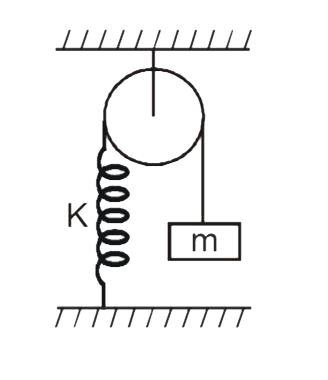
Figure shows a system consisting of pulley having radius R, a spring of force constant k and a block of mass m. Find the period of its vertical oscillation.

Text Solution

Verified by Experts
The following steps are usually followed in this method:
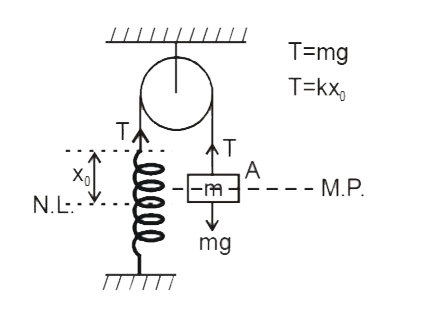
Step 1. Find the mean position. In following figure point A shows mean position.
Step 2. Write down the mean position force relation from figure.
mg = `kx_(0)`
Step 3. Assume that particle is performing SHM with amplitude A. Then displace the particle from its mean position.
Step 4. Find the total mechanical energy (E) in the displaced position since, mechanical energy in SHM remains constant `(dE)/(dt)=0`
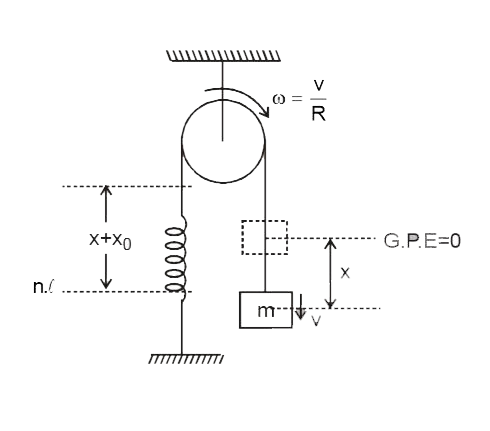
`E= (1)/(2) mv^(2) + (1)/(2) Iomega^(2)+(1)/(2)k (x+x_(0))^(2)` - mgx
`E= (1)/(2) mv^(2) + (1)/(2)1(v^(2))/(R^(2))+(1)/(2)k (x+x_(0))^(2)`-mgx
`(dE)/(dt)= (2mv)/(2) (dv)/(dt)+(2Iv)/(2R^(2))(dv)/(dt)+ (2k(x+x_(0)))/(2) (dx)/(dt)`
`-mg"" (dx)/(dt) " " cdots (1)`
Put `(dx)/(dt) = v " and " (dv)/(dt) = (d^(2)x)/(dt^(2))`
in eq. (1) put
`(dE)/(dt) =0`
`implies mv (d^(2)x)/(dt^(2))+ (Iv)/(R^(2)) (d^(2)x)/(dt^(2))+kxv + kx_(0)v- mgv =0`
Which gives `(m+(1)/(R^(2)))(d^(2)x)/(dt^(2))+kx =0`
`(d^(2)x)/(dt^(2))+(k)/((m+(1)/(R^(2))))x=0 " " cdots (2)`
compare eq. (2) with S.H.M. eq. the
`omega^(2)= (k)/((m+(1)/(R^(2))))implies T = 2pisqrt(((m+1)//R^(2))/(k))`

Promotional Banner

Topper's Solved these Questions

  • SIMPLE HARONIC MOTION

    MOTION|Exercise EXERCISE -1 ( SECTION-A )|8 Videos
  • SIMPLE HARONIC MOTION

    MOTION|Exercise EXERCISE -1 ( SECTION-B ) (Time per iod and angu larfrequency in SHM)|8 Videos
  • SIMPLE HARMONIC MOTION

    MOTION|Exercise EXERCISE -3 Section - B Previous Year Problems | JEE MAIN|23 Videos
  • SOUND WAVES

    MOTION|Exercise Exercise - 3 (Section - B)|14 Videos

Similar Questions

Explore conceptually related problems

Figure shows a system consisting of a massless pulley, a spring of force constant k and a block of mass m. If the block is slightly displaced vertically down from is equilibrium position and then released, the period of its vertical oscillation is

Figure shows a system consisting of a massles pulley, a spring of force constant k and a block of mass m . If the block is sligthtly displaced vertically down from its equilibrium and released, find the period of its vertical oscillation in cases (a) and (b).

Figure shows a system consisting of a massless pulley, a spring of force constant k and ablock of mass m. If the block is slightly displaced vertically down from its equillibrium position and then released, find the period of its vertical oscillation in cases (a) & (b).

The period of oscillation of a mass M, hanging from a spring of force constant k is T. When additional mass m is attached to the spring, the period of oscillation becomes 5T/4. m/M =

As shown in the figure a block of mass m is hung from the ceiling by the system of springs consisting of two layers. The force constant of each of the springs is k. The frequency of the vertical oscillations of the block is

A system shown in the figure consists of a massless pulley, a spring of force constant k displaced vertically downwards from its equilibrium position and released, then the Period of vertical oscillations is

Spring mass system is shown in figure. Find the elastic potential energy stored in each spring when block is at its mean position. Also find the time period of vertical oscillations. The system is in vertical plane.

Spring mass system is shown in figure. Find the elastic potential energy stored in each spring when block is at its mean position. Also find the time period of vertical oscillations. The system is in vertical plane.

A block of mass m can slide along a frictionless inclined plane, is attached to a ideal spring of spring constant as shown in the figure. Find the period of its oscillation. (Frame of reference attached to the wedge is at rest)