


NCERT-THE D AND F BLOCK ELEMENTS-Exercise
- Compare the stability of +2 oxidation state for the elements of the fi...
Text Solution
|
- Compare the chemistry of actinoids with that of the lanthanoids with s...
Text Solution
|
- How would you account for the following: A) Of the d^(4) species Cr^(...
Text Solution
|
- What is meant by 'disproportionation'? Give two examples of disproport...
Text Solution
|
- Which metal in the first series of transition metals exhibits +1 oxida...
Text Solution
|
- Calculate the number of unpaired electrons in the following gaseous io...
Text Solution
|
- Give examples and suggest reason for the following features of the tra...
Text Solution
|
- Indicate the steps in the preparation of: (i). K2Cr2O7 from chromite...
Text Solution
|
- What are alloys? Name an important alloy which contains some of the la...
Text Solution
|
- What are inner-transition elements? Decide which of the following atom...
Text Solution
|
- The chemistry of the actinoid elements is not so smooth as that of the...
Text Solution
|
- Which is the last element in the series of the actinods? Write the ele...
Text Solution
|
- Use Hund's rule to derive the electronic configuration of Ce^(3+) ion,...
Text Solution
|
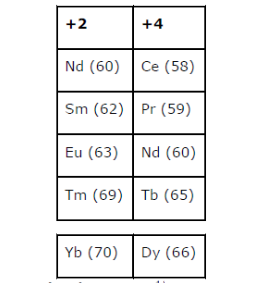
- Name the member of the lanthanoids series which exhibit +4 oxidation s...
Text Solution
|
- Compare the chemistry of actinoids with that of the lanthanoids with s...
Text Solution
|
- Write the electronic configuration of the elements with the atomic num...
Text Solution
|
- Compare the general characteristics of the first series of the transit...
Text Solution
|
- Write down the number of 3d electrons in each of the following ions: T...
Text Solution
|
- Comments on the statement that elements of the first transition serie...
Text Solution
|
- What can be inferred from the magnetic moment values of the following ...
Text Solution
|