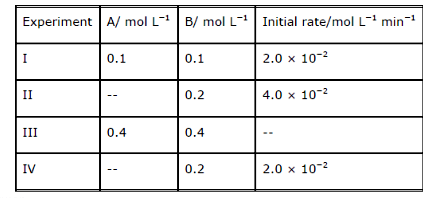
The reaction between A and B is first order with respect to A and zero order with respect to B. Fill in the blanks in the following table:
Text Solution
Verified by Experts
The given reaction is of the first order with respect to A and of zero order with respect to B . Therefore , the rate of the reaction is given by , Rate = `k[A]^(1) [B]^(0)` `implies` Rate = k [A] From experiment l , we obtain `2.0 xx 10^(-2) "mol" L^(-1) "min"^(-1) = k (0.1 "mol" L^(-1))` `implies k = 0.2 "min"^(-1)` From experiment ll , we obtain `4.0 xx 10^(-2) "mol" L^(-1) "min"^(-1) = 0.2 "min"^(-1)[A]` `implies [A] = 0.2 "mol" L^(-1)` From experiment lll , we obtain Rate = `0.2 min^(-1) xx 0.4 "mol" L^(-1)` `= 0.08 "mol" L^(-1) "min"^(-1)` From experiment IV , we obtain `2.0 xx 10^(-2) "mol" L^(-1) "min"^(-1) = 0.2 "min"^(-1)[A]` `implies [A] = 0.1 "mol" L^(-1)`
Topper's Solved these Questions
CHEMICAL KINETICS
NCERT|Exercise Exercise|1 Videos
CHEMICAL KINETICS
NCERT|Exercise SOLVED EXAMPLE|1 Videos
BIOMOLECULES
NCERT|Exercise Exercise|33 Videos
CHEMISTRY IN EVERYDAY LIFE
NCERT|Exercise Exercise|32 Videos
Similar Questions
Explore conceptually related problems
The reaction between A and B is first order with respect to A and zero with respect to B. Fill in tha blanks in the following table: {:("Experiment",,[A]//M,[B]//M,"Initial rate"//"M min"),(I.,,0.1,0.1,2.0xx10^(-2)),(II.,,....,0.2,4.0xx10^(-2)),(II.,,0.4,0.4,.......),(IV.,,....,0.2,2.0xx10^(-2)):}
The reaction v_1A+ v_2B to products is first order with respect to A and zero-order with respect to B. If the reaction is started with [A_0] and [B_0] , then the integrated rate expression of this reaction would be:
Two coins are tossed,then fill in the blanks in the following table respectively:
From the following data for the reaction between A and B Calculate: (i) the order of the reaction with respect to A and with respect to B (ii) the rate constant at 300 K (iii) the pre-exponential factor.
Fill in the balanks in the following table which treats reaction of a compound A with a compound B , that is of the first order with respect to A and zero order with respect to B :