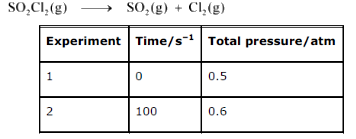
The following data were obtained during the first order thermal decomposition of `SO_(2)Cl_(2)` at a constant volume `SO_(2)Cl_(2)(g)to SO_(2)(g)+Cl_(2)(g)` Calculate the rate of the reaction when total pressure is 0.65 atm
Text Solution
Verified by Experts
The thermal decomposition of `SO_(2)Cl_(2)` at a constant volume is represented by the following equation. `SO_(2)Cl_(2(g)toSO_(2(g)+Cl_(2(g)` `{:("At " t=0,P_(0),0,0),("At " t=t,P_(0)-P,P,P):}` After time , t, total pressure, `p_(1)=(P_(1)-p)+P+P` `rArrP_(1)=P_(0)+P` `rArrP_=P_(1)+P_(0)` Therefore, `P_(0)-P=(P_(1)-P_(0))` =`2P_(0)P_(t)` For a first order reaction, `k=(2,303)/t"log"(P_(0))/(P_(0)-P)` `=(2,303)/t"log"(P_(0))/(2P_(0)-P_(t))` When t=100s, `k=(2,303)/100"log"(0.5)/(2xx0.5-0.6)` `=2.231xx10^(-3) s^(-1)` When `P_(t) = 0.65` atm, `rArrP=0.65-P_(0)` `=.65-0.5` `0.15`atm Therefore, when the total pressure is 0.65 atm, pressure of `SOCl_(2)` is `P_(SOCl_(2)=P_(0)_P` `= 0.5-0.15` `=0.35`atm Therefore, the rate of equation, when total pressure is 0.65 atm, is given by, `"Rate=k^((P_(SOCl_(2))))` `=(2.23xx10^(-3) s^(-1))(0.35 atm)` `=7.5xx10^(-4)"atm" s^(-1)`
Topper's Solved these Questions
CHEMICAL KINETICS
NCERT|Exercise Exercise|1 Videos
CHEMICAL KINETICS
NCERT|Exercise SOLVED EXAMPLE|1 Videos
BIOMOLECULES
NCERT|Exercise Exercise|33 Videos
CHEMISTRY IN EVERYDAY LIFE
NCERT|Exercise Exercise|32 Videos
Similar Questions
Explore conceptually related problems
The following data were obtained during the first order thermal decomposition of SO_(2)Cl_(2) at a constant volume. SO_(2)Cl_(2(g))rarr SO_(2(g))+Cl_(2(g)) What is the rate of reaction when total pressure of 0.65 atm?
The following data were obtained during the first order thermal decompostion of SO_(2)CI_(2) at a constant volume : Calculate rate constant
The following data were obtained during the first order thermal decomposition of SO_(2) Cl_(2) at a constant volume : SO_(2)Cl_(2) (g) to SO_(2)(g)+Cl_(2)(g) {:("Experiment Times"//s^(-1) " Total pressure/atm"),("1 0 0.4" ),("2 100 0.7"):} Calculate the rate constant. Given : log 4 = 0.6021, log 2 = 0.3010)