Home
Class 12
CHEMISTRY
Which of the following compounds would u...

Which of the following compounds would undergo aldol condensation or the Cannizzaro reaction, or neither? Write the structures of expected products of aldol condensation and Cannizzaro reaction.
i. Methanal ii. 2-Methylpentanal
iii. Benzaldehyde iv. Benzophenone
v. Cyclohexanone vi. 1-Phenylpropanone
vii. Phenylacetaldehye viii. Butan-1-ol
ix. 2,2-Dimethylbutanal

Text Solution

Verified by Experts
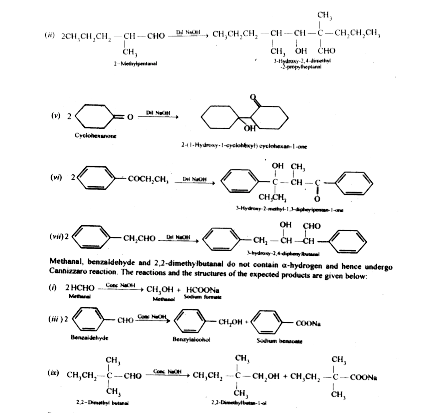
2-Methylpertfanal, cyclohexanon, 1-phenylpropanone and phenylacetaldehyde contain one or more a-hydrogen and hence undergo aldol condensation. The reactions and the structures of the expected products are given below.

Benzophenone (iv) is a ketone having no `alpha`-hydrogen while butan-l-il (viii) is an alcohol. Both of these neigher undergo aldol condensation nor cannizzaro reaction.
Promotional Banner

Topper's Solved these Questions

  • ALDEHYDES, KETONES AND CARBOXYLIC ACIDS

    NCERT|Exercise Exercise|28 Videos
  • ALCOHOLS, PHENOLS AND ETHERS

    NCERT|Exercise EXERCISE|45 Videos
  • AMINES

    NCERT|Exercise Exercise|23 Videos

Similar Questions

Explore conceptually related problems

which of the following compounds would undergo aldol condensation , which the cannizzario's reaction and which neither ? Write the structure of the expected products of aldol condensation and connizzaro's reaction : (a) Benzaldehyde (b ) Benzophenone (c ) cyclohexanone (d ) methanal (e ) 2- methylpentanal ( f ) butan -1-ol ( g ) phenylacetadehyde ( h) 1- phenylproanone (i ) Methanal ( j) 2,2 Dimethylbutanal

Among the following compounds , the one which can undergo both aldol condensation and Cannizzaro reaction is :

Which of the following compounds can undergo both Cannizzaro reaction as well as Aldol condensation ?

Which of the following compoundswould undergo cannizzaro reaction: Benzaldehyde, Cyclohexanone, 2- Methylpentanal.

NCERT-ALDEHYDES, KETONES AND CARBOXYLIC ACIDS-Exercise
  1. What is meant by the following terms ? Give an example of the reaction...

    Text Solution

    |

  2. Name the following compounds according to the IUPAC system of nomencla...

    Text Solution

    |

  3. Draw the structures of following compound: i. 3-Methylbutanal ii. ...

    Text Solution

    |

  4. Write the IUPAC names of following ketones and aldehydes. Wherever pos...

    Text Solution

    |

  5. Draw the structure of following derivatives: i. 2,4-Dinitrophenylhyd...

    Text Solution

    |

  6. Predict the products formed when cyclohexane carbaldehyde reacts with ...

    Text Solution

    |

  7. Which of the following compounds would undergo aldol condensation or t...

    Text Solution

    |

  8. How will you convert ethanal into the following compounds ? i. Butan...

    Text Solution

    |

  9. Write structure formulae and names of four possible aldol condensation...

    Text Solution

    |

  10. An organic compound with the molecular folmula C(9)H(10)O form 2,4-DNP...

    Text Solution

    |

  11. An organic compound (A) (molecular formula C(8)H(16)O(2)) was hydrolys...

    Text Solution

    |

  12. Arrange the following compounds in the increasing order of their prope...

    Text Solution

    |

  13. Give simple chemical test to distinguish between the following pairs o...

    Text Solution

    |

  14. How will you prepare the following compounds from benzene ? You may us...

    Text Solution

    |

  15. How will you bring about the following conversions in not more than tw...

    Text Solution

    |

  16. Describe the following i. Acetylation ii. Cannizzaro reaction i...

    Text Solution

    |

  17. Complete each synthesis by giving missing starting material, reagent o...

    Text Solution

    |

  18. Giving plausible explanation for each of the following: i. Cyclohexa...

    Text Solution

    |

  19. An organic compound contains 69.77% carbon, 11.63% hydrogen, and rest ...

    Text Solution

    |

  20. Although phenoxide ion has more number of resonating structures than c...

    Text Solution

    |

