Home
Class 12
CHEMISTRY
An organic compound (A) (molecular formu...

An organic compound (A) (molecular formula `C_(8)H_(16)O_(2))` was hydrolysed with dilute sulphuric acid to give a carboxylic acid (B) and an alcohol (C ). Oxidation of (C ) with chromic acid produced (B). (C ) on dehydration gives but-1-ene. Write equations for the reactions involved.

Text Solution

Verified by Experts
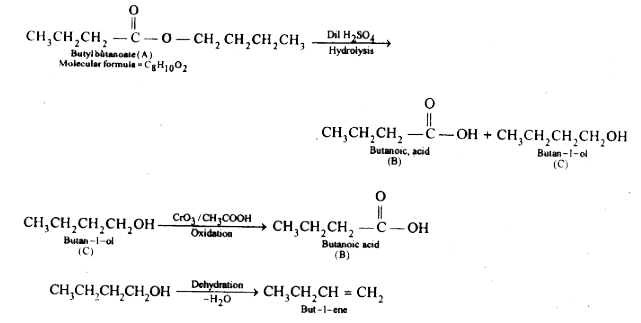
Since as ester A with molecular formula `C_(8)H_(16)O_(2)` upon hydrolysis gives carboxylic acid B and the alcohoc C and oxidation of C with chromic acid produces the acid B, therefore, both the carboxylic acid B and alcohol C must contain the same number of carbon atoms.
Further, since ester A contains eight carbon atoms, therefore, both the carboxylic acid B and the alcohol C much contain four carbon atoms each .
Since the alcohol C on dehydration gives but-l-ene, therefore, C must be a straight chain alcohol, i.e., buten-l-ol.
If C is butan-l-ol, then the acid B must be butanoic acid and the ester A must be butyl butanoate. The chemical equations are as follows:
Promotional Banner

Topper's Solved these Questions

  • ALDEHYDES, KETONES AND CARBOXYLIC ACIDS

    NCERT|Exercise Exercise|28 Videos
  • ALCOHOLS, PHENOLS AND ETHERS

    NCERT|Exercise EXERCISE|45 Videos
  • AMINES

    NCERT|Exercise Exercise|23 Videos

Similar Questions

Explore conceptually related problems

(a) How will you bring about the following conversions : (i) Ethanol to 3- hydroxybutanal (ii) Benzaldehyde to Benzophenone (b) An organic compound A has the molecular formula C_(8)H_(16)O_(2) . It gets hydrolysed with dilute sulphuric acid and gives a carboxylic acid B and an alcohol C. Oxidation of C with chromic acid also produced B . C on dehydration reaction gives but - l - ene . write equations for the reactions involved.

An organic compound [A], molecular formula C_(10)H_(20)O_(2) was hydrolyzed with dilute sulphuric acid to give a carboxylic acid [B] and an alcohol [C]. Oxidation of [C] with CrO_(3) - H_(2)SO_(4) produced [B]. Which of the following strucutres are not possible for [A]?

A liquid (X) having a molecular formula C_(6) H_(12) O_(2) is hydrolysed with water in the presence of an acid to give a carboxylic acid (Y) and an alcohol (Z) . Oxidation of (Z) with chrome acid gives (Y) . What are the structures of (X), (Y) , and (Z) ?

An organic compound (A) (molecular formula C_6H_(12)O_2) was hydrolysed with dil . H_2SO_4 to give carboxylic acid (B) and an alcohol (C). 'C' gives white turbidity immediately when treated with anhydrous ZnCl_2 and conc. HCl . The organic compound (A) is

A compound A with molecular formula C_(6)H_(10) on oxidation with hot KMnO_(4) gives hexandioic acid. A is

NCERT-ALDEHYDES, KETONES AND CARBOXYLIC ACIDS-Exercise
  1. What is meant by the following terms ? Give an example of the reaction...

    Text Solution

    |

  2. Name the following compounds according to the IUPAC system of nomencla...

    Text Solution

    |

  3. Draw the structures of following compound: i. 3-Methylbutanal ii. ...

    Text Solution

    |

  4. Write the IUPAC names of following ketones and aldehydes. Wherever pos...

    Text Solution

    |

  5. Draw the structure of following derivatives: i. 2,4-Dinitrophenylhyd...

    Text Solution

    |

  6. Predict the products formed when cyclohexane carbaldehyde reacts with ...

    Text Solution

    |

  7. Which of the following compounds would undergo aldol condensation or t...

    Text Solution

    |

  8. How will you convert ethanal into the following compounds ? i. Butan...

    Text Solution

    |

  9. Write structure formulae and names of four possible aldol condensation...

    Text Solution

    |

  10. An organic compound with the molecular folmula C(9)H(10)O form 2,4-DNP...

    Text Solution

    |

  11. An organic compound (A) (molecular formula C(8)H(16)O(2)) was hydrolys...

    Text Solution

    |

  12. Arrange the following compounds in the increasing order of their prope...

    Text Solution

    |

  13. Give simple chemical test to distinguish between the following pairs o...

    Text Solution

    |

  14. How will you prepare the following compounds from benzene ? You may us...

    Text Solution

    |

  15. How will you bring about the following conversions in not more than tw...

    Text Solution

    |

  16. Describe the following i. Acetylation ii. Cannizzaro reaction i...

    Text Solution

    |

  17. Complete each synthesis by giving missing starting material, reagent o...

    Text Solution

    |

  18. Giving plausible explanation for each of the following: i. Cyclohexa...

    Text Solution

    |

  19. An organic compound contains 69.77% carbon, 11.63% hydrogen, and rest ...

    Text Solution

    |

  20. Although phenoxide ion has more number of resonating structures than c...

    Text Solution

    |

