

Home
Class 12
CHEMISTRY
Describe a method for the identification...

Describe a method for the identification of primary , secondary and tertiary amines . Also write the chemical equations for the reactions involved .

Text Solution

Verified by Experts

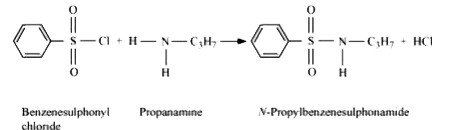
Primary, secondary aand tertiary amines can be identified and distinguished by Hinsberg's test. In this test, the amines are allowed to react with Hinsberg's reagent, benzenesulphonyl chloride `(C_(6)H_(5)SO_(2)Cl_(2))`. The three types of amines react differently with Hinsberg's reagent. Therefore, they can be easily indentified using Hinsberg's reagent. Primary amines react with benzenesulphonyl chloride to form N-alkylbenzenesulphonly amide wihich is solubel in alkali.

Due to the presence of a strong electron- withdrawing sulphonyl group in the sulphonamide, the H-atom attached t nitrogen can be easily released as proton. So,it is acidic and dissolves in alkali.
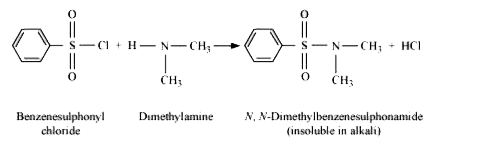
Secondary amines react with Hinsberg's reagent to give a sulphonamide which is insoluble in alkali.

There is no H-atom attached to the N-atom in the sulphonamide. Therefore, it is not acidic and insoluble in alkali.
On the other hand, tertiaryf amines do not react with Hinsberg's reagent at all.
Promotional Banner

Topper's Solved these Questions

  • AMINES

    NCERT|Exercise Exercise|23 Videos
  • ALDEHYDES, KETONES AND CARBOXYLIC ACIDS

    NCERT|Exercise Exercise|28 Videos
  • BIOMOLECULES

    NCERT|Exercise Exercise|33 Videos

Similar Questions

Explore conceptually related problems

(a) How does benzene diazonium chloride react with (i) phenol (ii) aniline (b) Describe the method for the identification of primary, secondary and tertiary amines. Also write chemical equations for the reactions involved.

Primary, secondary and tertiary amines are

Primary, secondary and teritaru amines are

What are primary, secondary and tertiary roots ?

The test to distinguish primary, secondary and tertiary amine is

NCERT-AMINES-Exercise
  1. Arrange the following in increasing order of their basic strength: (...

    Text Solution

    |

  2. Complete the following acid-base reactions and name the products: (i...

    Text Solution

    |

  3. Write reactions of the final alkylation product of aniline with excess...

    Text Solution

    |

  4. Write chemical reaction of aniline with benzoyl chloride and write the...

    Text Solution

    |

  5. Write structures of different isomers corresponding to the molecular f...

    Text Solution

    |

  6. Convert (i) 3-Methylaniline into 3-nitrotoluene. (ii) Aniline into...

    Text Solution

    |

  7. Write IUPAC names of the following compounds and classify them into pr...

    Text Solution

    |

  8. Give one chemical test to distinguish between the following pairs of c...

    Text Solution

    |

  9. Account for the following: (i) pK(b) of aniline is more than that of...

    Text Solution

    |

  10. Arrange the following: (i) In decreasing order of the pK(b) values: ...

    Text Solution

    |

  11. Convert : i. Ethanoic acid into methylamine ii. Hexanenitrile int...

    Text Solution

    |

  12. Describe a method for the identification of primary , secondary and te...

    Text Solution

    |

  13. Write short notes on the following : i. Carbylamine reaction ii....

    Text Solution

    |

  14. Accomplish the following conversions : i. Nitrobenzene to benzoic ac...

    Text Solution

    |

  15. Give the structures of A, B and C in the following reactions: (i) CH...

    Text Solution

    |

  16. An aromatic compound (A) on treatment with aqueous ammonia and heating...

    Text Solution

    |

  17. Complete the following reactions: (i) C(6)H(5)NH(2)+CHCl(3)+alc.KOHt...

    Text Solution

    |

  18. Why cannot aromatic primary amines be prepared by Gabriel phthalimide ...

    Text Solution

    |

  19. Write the reaction of (i) aromatic and (ii) aliphatic primary amines w...

    Text Solution

    |

  20. Give explanation for each of the following : (i) Why are amines les...

    Text Solution

    |