


Home
Class 12
CHEMISTRY
Write short notes on the following : i...

Write short notes on the following :
i. Carbylamine reaction
ii. Diazotisation
iii . Hofmann bromamide reaction
iv.Coupling reaction
v. Ammonolysis
iv. Acetylation
vii. gabriel phthalimide synthesis

Text Solution

Verified by Experts

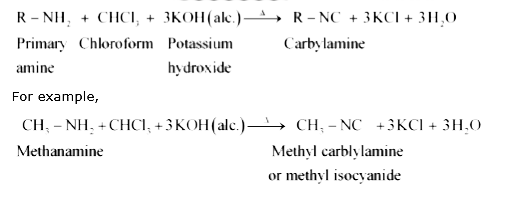
(i) Carbylamine reaction
Carbylamine reaction is used as a test for the identification of primary amines. When aliphatic and aromatic primary amines are heated with chloroform and ethanoic potassium hydroxide, carbylamines (or isocyanides) are formed. These carbylamines have very unpleasant odours. Secondary and tertiary amines do not respond to this test.

For example,
(ii) Diazotisation
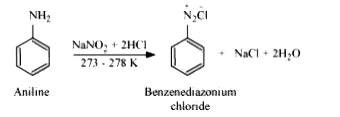
Aromatic primary amines react with nitrous acid (prepared in situ from `NaNO_(2)` and a mineral acid such as HCl) at low temperature (273-278K) to form diazonium salts. This conversion of aromatic primary amines into diazonium salt is known as diazotization.
For example, on treatment with `NaNO_(2)` and HCl at 273+278 K, aniline produces benzenediazonium chloride, with NaCl and `H_(2)O` as by products.

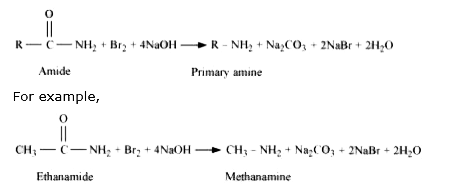
(iii) Hoffmann bromamide reaction
When an amide is treated with bromine in an aqueous or ethanolic solution of sodium hydroxide, a primary amine with one carbon atom less than the original amide is produced. This degradation reaction is known as Hoff man bromamide reaction. This reaction involves the migration of an alkyl or aryl group from the carbonyl carbon atom of the amide to the nitrogen atom.

For example,

(iv) Coupling reaction
Coupling reaction
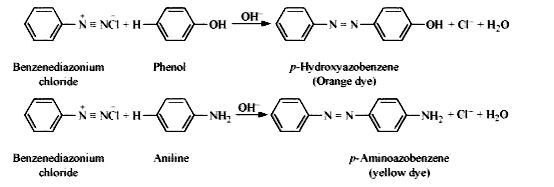
The reaction of joining two aromatic rings through the `-N=N-` bond is known as coupling reaction. Arenediazonium salts such as benzene,diazonium slats react with phenol or aromatic amine to form coloured azo compounds.

It can be observed that, the para-position of phenol aniline are coupled with the diazonium salt. This reaction proceeds through electrophilic substitution.
(v) Ammonolysis
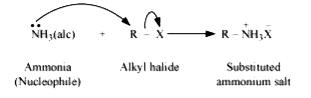
When an alkyl or benzyl halide is allowd to react with an ethanolic solution of ammonia it undergoes nucleophilic substitution reaction in which the halogen atom is replaced by an amino `(-NH_(2))` group. This process of cleavage of the carbon-halogen bond is known as ammonolysis.

When this substituted ammonium salt is trated with a strong base such as sodium hydroxide, amine is obtained.
`R-overset(+)NH_(3) overset(-)(X)NaOH rarr underset("Amine")(R-NH_(2))+H_(2)O+NaX`
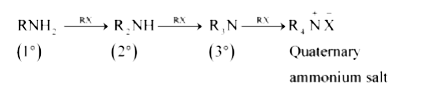
Though primary amine is produced as the major product, this process produces a mixture of primary, secondary and tertiary amines, and also a quaternary ammonium salt as shown

(vi) Acetylation
Acetylation ( or ethanoylation ) is the process of introducing an acetyl group into a molecule .

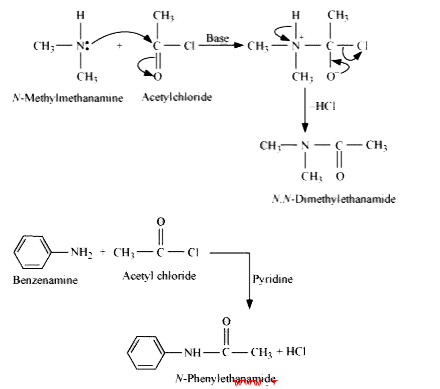
Aliphatic and aromatic primary and secondary amines undergo acetylation reaction by nucleophilic substitution when treated with acid chlorides, anhydrides or esters. This reaction involves the replacement of the hydrogen atom of `-NH_(2) " or " gt NH` group by the acetyl group, which in turn leads to production of amides. To shift the equilibrium to the right hand side, the HCl formed during the reaction is removed as soon as it is formed . This reaction is carried out in the presence of a base ( such as pyridine ) which is stronger than the amines.

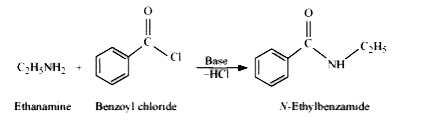
When amines react with benzoyl chloride, the reaction is also known as benzoylation For example,

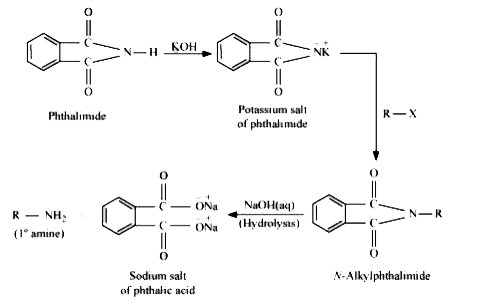
(vii) Gabriel phthalimide synthesis
Gabriel phthalimede synthesis is a very useful method for the preparation of aliphatic primary amines. It involves the treatment of phtalimide with ethanolic potassium hydroxide to form potassium salt of phtalimide. This salt is further heated with alkyl halide, followed by alkaline hydrolysis to yield the corresponding primary amine.
Promotional Banner

Topper's Solved these Questions

  • AMINES

    NCERT|Exercise Exercise|23 Videos
  • ALDEHYDES, KETONES AND CARBOXYLIC ACIDS

    NCERT|Exercise Exercise|28 Videos
  • BIOMOLECULES

    NCERT|Exercise Exercise|33 Videos

Similar Questions

Explore conceptually related problems

Write short notes on the following : i. Carbylamine reaction ii. Diazotisation iii . Hofmann bromamide reaction iv.Coupling reaction v. Ammonolusis iv. Acetylation vii. gabriel phthalimide synthesis

NCERT-AMINES-Exercise
  1. Arrange the following in increasing order of their basic strength: (...

    Text Solution

    |

  2. Complete the following acid-base reactions and name the products: (i...

    Text Solution

    |

  3. Write reactions of the final alkylation product of aniline with excess...

    Text Solution

    |

  4. Write chemical reaction of aniline with benzoyl chloride and write the...

    Text Solution

    |

  5. Write structures of different isomers corresponding to the molecular f...

    Text Solution

    |

  6. Convert (i) 3-Methylaniline into 3-nitrotoluene. (ii) Aniline into...

    Text Solution

    |

  7. Write IUPAC names of the following compounds and classify them into pr...

    Text Solution

    |

  8. Give one chemical test to distinguish between the following pairs of c...

    Text Solution

    |

  9. Account for the following: (i) pK(b) of aniline is more than that of...

    Text Solution

    |

  10. Arrange the following: (i) In decreasing order of the pK(b) values: ...

    Text Solution

    |

  11. Convert : i. Ethanoic acid into methylamine ii. Hexanenitrile int...

    Text Solution

    |

  12. Describe a method for the identification of primary , secondary and te...

    Text Solution

    |

  13. Write short notes on the following : i. Carbylamine reaction ii....

    Text Solution

    |

  14. Accomplish the following conversions : i. Nitrobenzene to benzoic ac...

    Text Solution

    |

  15. Give the structures of A, B and C in the following reactions: (i) CH...

    Text Solution

    |

  16. An aromatic compound (A) on treatment with aqueous ammonia and heating...

    Text Solution

    |

  17. Complete the following reactions: (i) C(6)H(5)NH(2)+CHCl(3)+alc.KOHt...

    Text Solution

    |

  18. Why cannot aromatic primary amines be prepared by Gabriel phthalimide ...

    Text Solution

    |

  19. Write the reaction of (i) aromatic and (ii) aliphatic primary amines w...

    Text Solution

    |

  20. Give explanation for each of the following : (i) Why are amines les...

    Text Solution

    |