Home
Class 11
PHYSICS
(a) Prove the theorem of perpendicular a...

(a) Prove the theorem of perpendicular axes.
(Hint : Square of the distance of a point (x, y) in the x-y plane from an axis through the origin and perpendicular to the plane is `^(x2)+y^(2))`.
(b) Prove the theorem of parallel axes.
(Hint : If the centre of mass of a system of n particles is chosen to be the origin `summ_(i)r_(i)=0`).

Text Solution

Verified by Experts
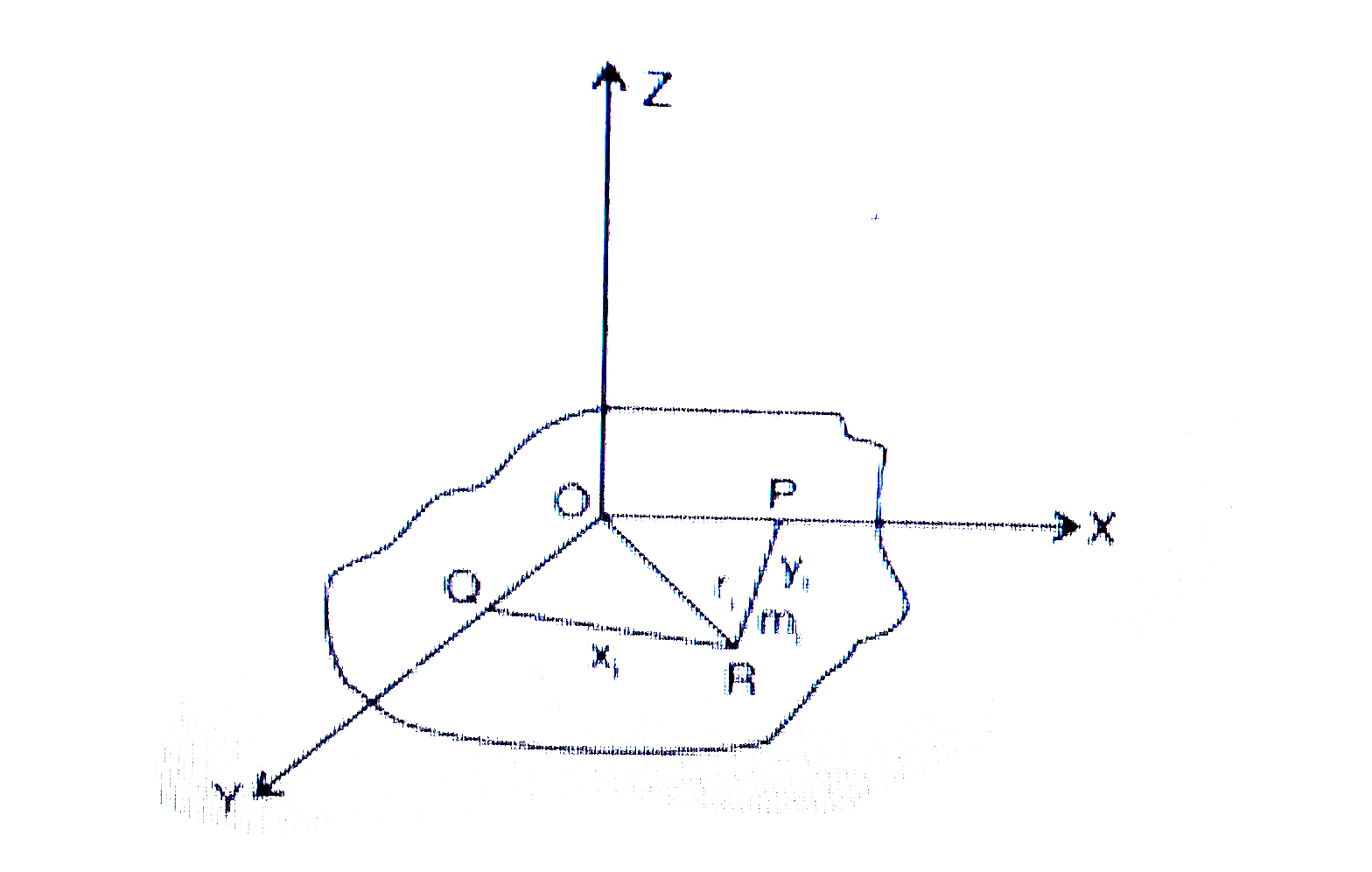
(a) The theorem of perpendicular axes : According to this theorem, the moment of inertia of a plane lamina (i.e., a two dimensional body of any shape`//` size) about any axis OZ perpendicular to the plane of the lamina is equal to sum of the moments of inertia of the lamina about any two mutually perpendicular axes OX and OY in the plane of lamina, meeting at a point where the given axis OZ passes through the lamina. Suppose at the point R m {particle is situated moment of inertia about Z axis of lamina
=moment of inertia of body about r-axis
=moment of inertia of body about y-axis.

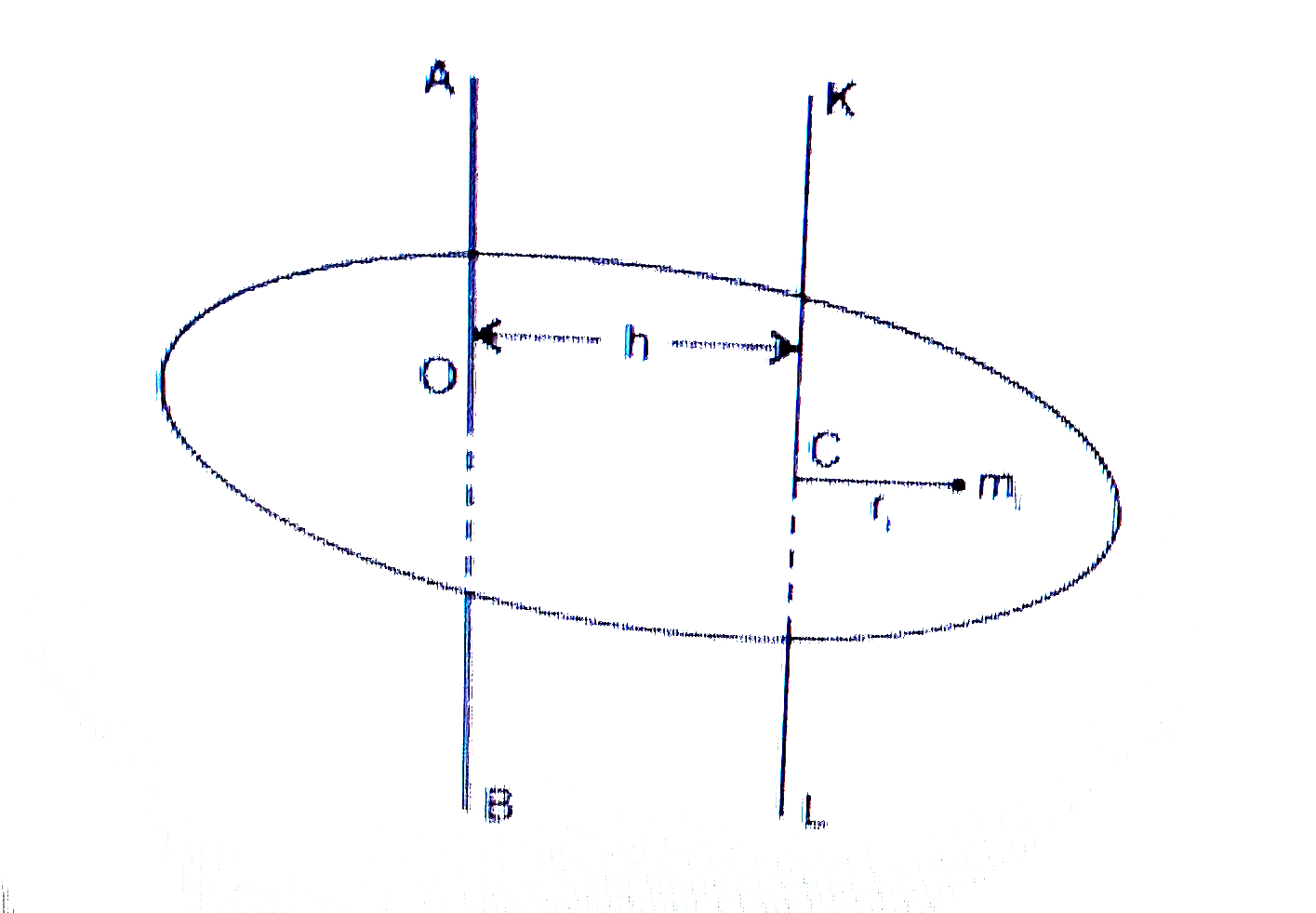
(b) Theorem of parallel axes : According to this theorem, moment of inertia of a rigid body about any axis AB is equal to moment of inertia of the body about another axis KL passing through centre of mass C of the body in a direction parallel to AB, plus the product of total mass M of the body and square of the perpendicular distance between the two parallel axes. If h is perpendicular distance between the axes AB and KL, then Suppose rigid body is made up of n particles m1, m2, __mn, mn at perpendicular distance `r_(1),r_(2),r_(1) r_(n)` respectively from the axis KL passing through centre of mass C of the body.
If h is the perpendicular distance of the particle of mass m from KL, then

The perpendicular distance of `i^(th)` particle from the axis
`AB=(r_(i)+n)`
or `I_(AB)=underset(i)sum m_(i)(r_(i)+h)^(2)`
`=underset(i)sum m_(i)(r_(i)^(2)+h^(2)+2r_(i)h)`
`=underset(i)sum m_(i)r_(i)^(2)+underset(i)sum m_(i)h^(2)+2h underset(i)sum m_(i)r_(i)`
As the body is balanced about the centre of mass, the algebraic sum of the moments of the weights of all particles about an axis passing through C must be zero.
`underset(i)sum (m_(i)g)r_(i)=0 " or " g underset(i)sum m_(i)r_(i)`
or `" " underset(i)sum m_(i)r_(i)=0`
From equation (ii), we have
`I_(AB)=underset(i)sum m_(i)r_(i)^(2)+(sum m_(i))h^(2)+0`
or `I_(AB)=I_(KL)+Mh^(2)`
where `I_(KL)=underset(i)sum m_(i)r_(i)^(2) " and " M=sum m_(i)`
Promotional Banner

Topper's Solved these Questions

  • SYSTEMS OF PARTICLES AND ROTATIONAL MOTION

    NCERT|Exercise EXERCISE|33 Videos
  • PHYSICAL WORLD

    NCERT|Exercise EXERCISE|16 Videos
  • THERMAL PROPERTIES OF MATTER

    NCERT|Exercise EXERCISE|22 Videos

Similar Questions

Explore conceptually related problems

Equation of the passing through the origin and perpendicular to the planes x+2y+z=1 , 3x-4y+z=5 is

The distance of the point (1,-2,4) from the plane passing through the point (1,2,2) perpendicular to the planes x-y+2z=3 and 2x-2y+z+12=0 is

The point of intersection of the plane 3x-5y+2z=6 with the straight line passing through the origin and perpendicular to the plane 2x-y-z=4 is

If the point of intersection of the plane 4x - 5y + 2z - 6 = 0 with the line through the origin and perpendicular to the plane x- 2y - 4z = 4 is P, then the distance of the point P from (1, 2,3) is

If plane passes through the point (1,1,1) and is perpendicular to the line,(x-1)/(3)=(y-1)/(0)=(z-1)/(4), then its perpendicular distance from the origin is

Let the plane passing through the point (-1,0,-2) and perpendicular to each of the planes 2x+y-z=2 and x-y-z=3 be ax+by+cz+8=0 . Then the value of a+b+c is equal to

NCERT-SYSTEMS OF PARTICLES AND ROTATIONAL MOTION-EXERCISE
  1. A rope of negligible mass is wound around a hollow cylinder of mass 3 ...

    Text Solution

    |

  2. To maintain a rotor at a uniform angular speed of 200 "rad s"^(-1), an...

    Text Solution

    |

  3. From a uniform disc of radius R, a circular section of radius R//2 is ...

    Text Solution

    |

  4. A metre stick is balanced on a knife edge at its centre. When two coin...

    Text Solution

    |

  5. A solid wooden sphere rolls down two different inclined planes of the ...

    Text Solution

    |

  6. A hoop of radius 2 m weight 100 kg.It rolls along a horizontal floor s...

    Text Solution

    |

  7. The oxygen molecule has a mass of 5.30 xx 10^(-26) kg and a moment of ...

    Text Solution

    |

  8. A solid cylinder rolls up an inclined plane of angle of inclination 30...

    Text Solution

    |

  9. As shown in Fig. the two sides of a step ladder BA and CA are 1.6 m lo...

    Text Solution

    |

  10. A man stands on a rotating platform, with his arms stretched horizonta...

    Text Solution

    |

  11. A bullet of mass 10 g and speed 500 m//s is fired into a door and gets...

    Text Solution

    |

  12. Two discs of moments of inertia I(1) and I(2) about their respective a...

    Text Solution

    |

  13. (a) Prove the theorem of perpendicular axes. (Hint : Square of the d...

    Text Solution

    |

  14. Prove the result that the velocity v of translation of a rolling body ...

    Text Solution

    |

  15. A disc rotating about its axis with angular speed omega(0) is placed l...

    Text Solution

    |

  16. (i) Explain why friction is necessary to make the disc to roll in the ...

    Text Solution

    |

  17. A solid disc and a ring, both of radius 10 cm are placed on a horizont...

    Text Solution

    |

  18. A cylinder of mass 10 kg and radius 15 cm is rolling perfectly on a pl...

    Text Solution

    |

  19. Read each statement below carefully and state with reasons, if it is t...

    Text Solution

    |

  20. Separation of Motion of a system of particles into motion of the centr...

    Text Solution

    |