Home
Class 11
PHYSICS
An iron bar (L(1) = 0.1 m, A(1) = 0.02 m...

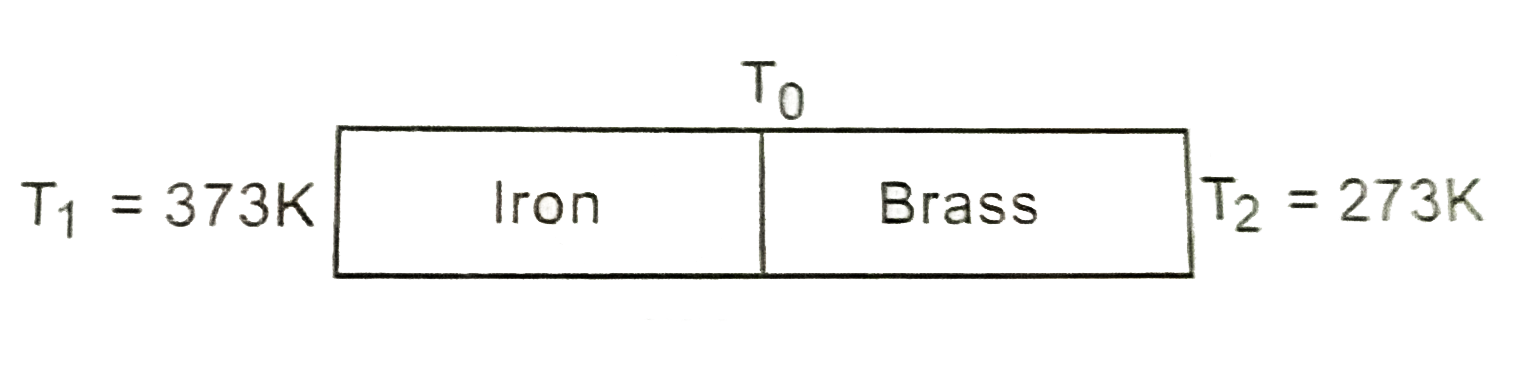
An iron bar (`L_(1) = 0.1 m, A_(1) = 0.02 m^(2) , K_(1) = 79 Wm^(-1) K^(-1)`) and a brass bar `(L_(2)=0.1 m , A_(2) = 0.02 m^(2), K_(2) = 109 Wm^(-1)K^(-1)`) are soldered end to end as shown in fig. the free ends of iron bar and brass bar are maintained at 373 K and 273 K respectively. Obtain expressions for and hence compute (i) the temperature of the junction of the two bars, (ii) the equivalent thermal conductivity of the compound bar and (iii) the heat current through the compound bar.
.

Text Solution

Verified by Experts

Given, `L_(1) = L_(2)= L = 0.1 m, A_(1) = A_(2)= A= 0.02 m^(2) K_(1) = 79 W m^(–1) K^(–1), K_(2) = 109 W m^(–1) K^(–1), T_(1) = 373 K, and T_(2) = 273 K.`
Under steady state condition, the heat current (H1) through iron bar is equal to the heat current (H2) through brass bar.
So, `H=H_(1)=H_(2)`
`(K_(1)A_(1)T_(1)-T_(0))/(L_(1))=(K_(2)A_(2)T_(0)-T_(2))/(L_(2))`
For `A_(1) = A_(2) = A" and "L_(1) = L_(2) = L`, this equation leads to `K_(1)(T_(1)-T_(0))=K_(2)(T_(0)-T_(2))`
Thus the junction temperature `T_(0)` of the two bars is
`T_(0)=((K_(1)T_(1)+K_(2)T_(2))/((K_(1)+K_(2))))`
Using this equation, the heat current H through either bar is
`H=(K_(1)A(T_(1)-T_(0)))/(L)=(K_(2)A(T_(0)-T_(2)))/(L)`
`((K_(1)K_(2))/(K_(1)+K_(2)))(A(T_(1)T_(2)))/(L)=(A(T_(1)-T_(2)))/(L((1)/(K_(1))+(1)/(K_(2))))`
Using these equations, the heat current H′ through the compound bar of length `L_(1) + L_(2) = 2L` and the equivalent thermal conductivity K′, of the compound bar are given by
`H'=(K'A(T_(1)-T_(2)))/(2L)=H`
`K'=(2K_(1)K_(2))/(K_(1)+K_(2))`
(i) `T_(0)=((K_(1)T_(1)+K_(2)T_(2)))/((K_(1)+K_(2)))`
` ((79Wm^(-1)K^(-1))(373K)+(109 W m^(-1)K^(-1))(273K))/(79W m^(-1)K^(-1)+109 W m^(-1) K_(-1))`
=315 K
(ii) `K'=(2K_(1)K_(2))/(K_(1)+K_(2))`
`=(2xx(79WM^(-1)K^(-1))xx(109W m^(-1)K^(-1)))/(79W m^(-1)K^(-1)+109W m^(-1)K^(-1)) `
` =91.6 W m^(-1)K^(-1)`
(iii) `H'=H=(K'A(T_(1)-T_(2)))/(2L)`
`=((91.6W m^(-1) K^(-1))xx(0.02m^(2))xx(373K-273K))/(2xx(0.1m))`
916.1 W
Promotional Banner

Topper's Solved these Questions

  • THERMAL PROPERTIES OF MATTER

    NCERT|Exercise EXERCISE|22 Videos
  • SYSTEMS OF PARTICLES AND ROTATIONAL MOTION

    NCERT|Exercise EXERCISE|33 Videos
  • THERMODYNAMICS

    NCERT|Exercise EXERCISE|10 Videos

Similar Questions

Explore conceptually related problems

The outer face of a rectangular slab of equal thickness of iron and brass are maintained at 100^(@)C and 0^(@)C , respectively. Find the temperature of the interface. The conductivities of iron and brass are 14 and 126 Wm^(-1) K^(-1) respectively.

Two bars of same length and same cross-sectional area but of different thermal conductivites K_(1) and K_(2) are joined end to end as shown in the figure. One end of the compound bar it is at temperature T_(1) and the opposite end at temperature T_(2) (where T_(1) gt T_(2) ). The temperature of the junction is

Equal volume of 0.1 M H_(2)CO_(3) (K_(a_(1)) = 10^(-7), K_(a_(2)) = 10^(-11)) and 0.1 M H_(2)S (K_(a_(1)) = 10^(-7), K_(a_(2)) = 10^(-14)) are mixed together. Calculate value of pOH - pH for resulting solution.

A steel bar 10.0 cm long is welded end to end to a copper bae 20.0 cm long. Both bars are insulated perfectly on their sides . Each bar has a separate cross-section, 2.00 cm on a side . The free end of the steel bar is maintained at 100^(@)C by placing it in contact with ice . find the temperature at the junction of the two bars and the total rate of heat flow . thermal conductivity of steel = 50.2 Wm^(-1)K^(-1) .thermal conductivity of copper =385 Wm^(-1)K^(-1) .

If L_(1) = (2.02 +- 0.01)m and L_(2) = (1.02 +- 0.01)m then L_(1) + 2L_(2) is (in m)

Two bars of thermal conductivities K and 3K and lengths 1 cm and 2 cm respectively have equal cross-sectional area, they are joined lengths wise as shown in the figure. If the temperature at the ends of this composite br is 0^(@)C and K^(2)//l respectively (see figure), then the temperature phi of the interface is

A bar of copper of length 75 cm and a bar of steel of length 125 cm are joined together end to end . Both are of circular cross - section with diameter 2 cm . The free ends of the copper and steel bars are maintained at 100^(@)C and 0^(@)C respectively . The surface of the bars are thermally insulted . What is the temperature of the copper - steel junction ? What is the heat transmitted per unit time across the junction ? Thermal conductivty of copper 9.2 xx 10^(-2) k cal m^(-1) ""^(@)C^(-1)s^(-1) and that of steel is 1.1 xx 10^(-2)k cal m^(-1)s^(-1) (@)C^(-1) .

Calculate Q and w for the isothermal reversible expansion of one mole an ideal gas from an initial pressure of 1.0 bar to a final pressure of 0.1 bar at a constant temperature of 273 K respectively.

Two bars, A and B, each of length 2.0 m and cross-sectional area 10m^(2) , are placed and to end as shown in the figure. The thermal conductivities of the bars are k_(A) = 339 (J //s. m.K) and k_(B) = 837 J//(s.m.K) , respectively. The left end of bar A is maintained at 373 K while the right end of B is maintained at 273 K Wha tis the temperature at the interface between A and B?

NCERT-THERMAL PROPERTIES OF MATTER-EXERCISE
  1. An iron bar (L(1) = 0.1 m, A(1) = 0.02 m^(2) , K(1) = 79 Wm^(-1) K^(-1...

    Text Solution

    |

  2. The triple point of neon and carbon dioxide are 24.57K and 216.55K res...

    Text Solution

    |

  3. Two absolute scales A and B have triple points of water defined to be ...

    Text Solution

    |

  4. The electrical resistance in ohms of a certain thermometer varies with...

    Text Solution

    |

  5. Answer the following : (a) The triple-point of water is a standard...

    Text Solution

    |

  6. Two ideal gas thermometer A and B use oxygen and hydrogen respectively...

    Text Solution

    |

  7. A steel tape 1m long is correctly calibrated for a temperature of 27^(...

    Text Solution

    |

  8. a large steel wheel is to be fitted on to a shaft of the same material...

    Text Solution

    |

  9. A hole is drilled in a copper sheet. The diameter of the hole is 4.24 ...

    Text Solution

    |

  10. A brass wire 1.8 m long at 27^(@)C is held taut with little tension be...

    Text Solution

    |

  11. A brass rod of length 50 cm and diameter 3.0 cm is joined to a steel r...

    Text Solution

    |

  12. The coefficient of volume expansion of glycerine is 49 xx 10^(-5)//^(@...

    Text Solution

    |

  13. A 10 kW drilling machine is used to drill a bore in a small aluminium ...

    Text Solution

    |

  14. A copper block of mass 2.5 kg is heated in a furnace to a temperature ...

    Text Solution

    |

  15. In an experiment on the specific heat of a metal a 0.20 kg block of th...

    Text Solution

    |

  16. Given below are observations on molar specific heats at room temperatu...

    Text Solution

    |

  17. A child running a temperature of 101^F is given and antipyrin (i.e. a ...

    Text Solution

    |

  18. A thermocole cubical icebox of side 30 cm has a thickness of 5.0 cm if...

    Text Solution

    |

  19. A brass boiler has a base area of 0.15m^2 and thickness 1.0 cm it boil...

    Text Solution

    |

  20. Explain why : (a) A body with large reflectivity is a poor emitter. (...

    Text Solution

    |

  21. A body cools from 80^(@)C to 50^(@)C in 5 min-utes Calculate the time ...

    Text Solution

    |

