Home
Class 12
PHYSICS
According to early model of an atom,the ...

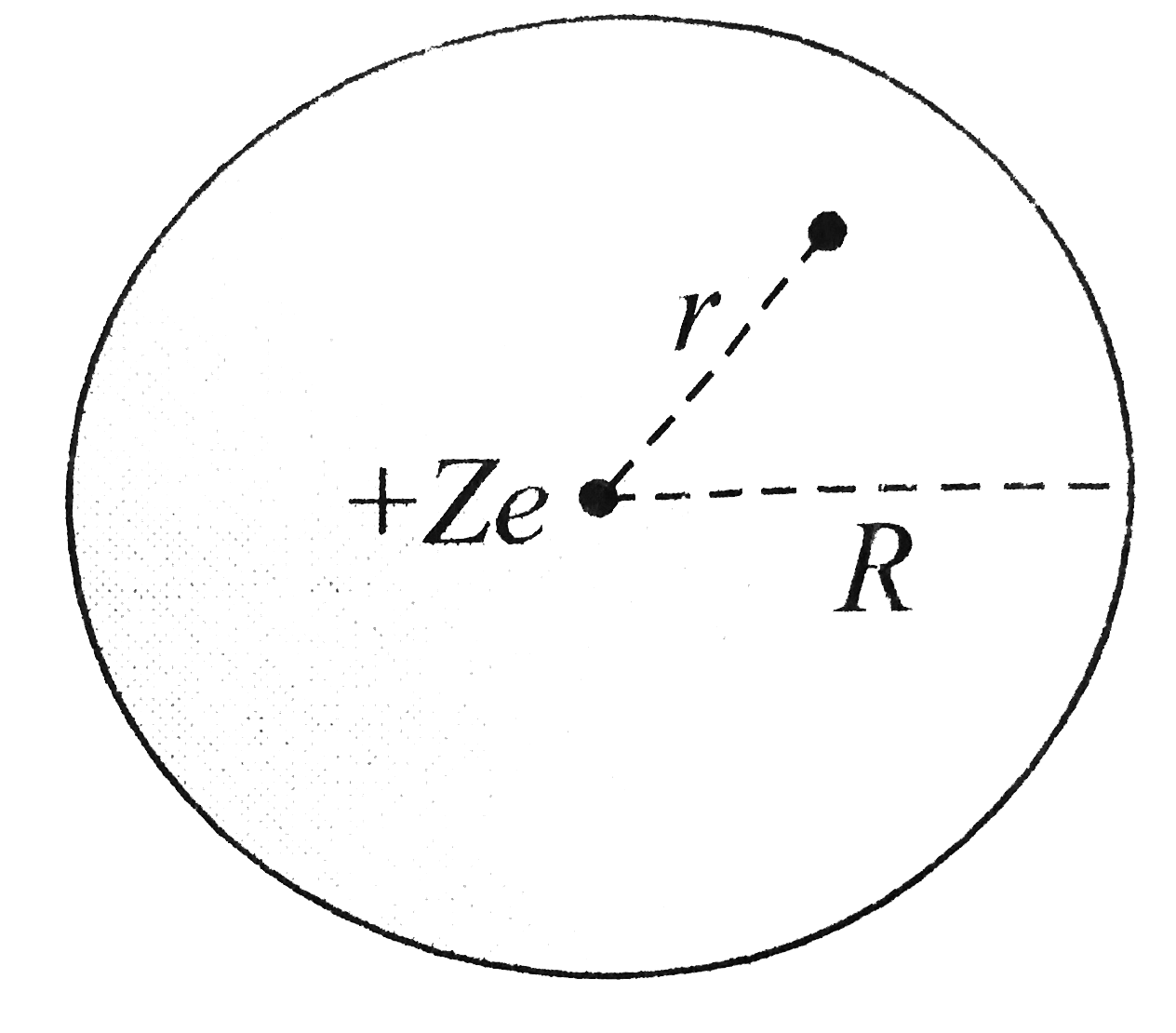
According to early model of an atom,the atom is considered it to have a positively charged point nucleus of charge `Ze` surrounded by a uniform density of negative charge up to a radius `R`. The atom as a whole is neutral. The electric field at a distance`r` from the nucleus is `(r lt R)`

Text Solution

Verified by Experts

The charge distribution for this model of the atom is as shown in Fig. 1.32. The total negative charge in the uniform spherical charge distribution of radius R must be –Z e, since the atom (nucleus) of charge Z e + negative charge) is neutral. This immediately gives us the negative charge density r, since we must have
`(4piR^(2))/(3)rho=0-Ze`
`or rho=-(3Ze)/(4piR^(2))` To find the electric field E(r) at a point P which is a distance r away from the nucleus, we use Gauss’s law. Because of the spherical symmetry of the charge distribution, the magnitude of the electric field E(r) depends only on the radial distance, no matter what the direction of r. Its direction is along (or opposite to) the radius vector r from the origin to the point P. The obvious Gaussian surface is a spherical surface centred at the nucleus. We consider two situations, namely, `r lt R and r gt R`.
(i) `r lt R`: The electric flux f enclosed by the spherical surface is
`phi=E(r)xx4pir^(2)`
where E(r)is the magnitude of the electric field at r. This is beacuse the field at any point on the spherical Gaussian surface has the same direction as the normal to the surface there, and has the same magnitude at all points on the surface. The charge q enclosed by the Gaussian surface is the positive nuclear charge and the negative charge within the sphere of radius r, `i.e. q=ze+(4pir^(3))/(3)rho`
Substituting for the charge density `rho` obtained earlier, we have
`q=Ze-Ze (r^(3))/(R^(3))`
Gauss's law then gives.
`E(r)=(Ze)/(4piepsilon_(0)) (1)/(r^(2))-(r)/(R^(3)):r lt Ra`
The electric field is directed radially outward.
(ii) `r gt R`: In this case, the total charge enclosed by the Gaussian spherical surface is zero since the atom is neutral. Thus, from Gauss’s law,
`E(r)xx4 pi r^(2)=0 or E(r)=0: r gt R`
At r=R, both cases give the same result E=0`
Promotional Banner

Topper's Solved these Questions

  • ELECTRIC CHARGES AND FIELDS

    NCERT|Exercise EXERCISE|34 Videos
  • DUAL NATURE OF RADIATION AND MATTER

    NCERT|Exercise Exercise|37 Videos
  • ELECTROMAGNETIC INDUCTION

    NCERT|Exercise Exercise|17 Videos

Similar Questions

Explore conceptually related problems

An early model for an atom considered to have a positively charged point nucleus of charge Ze surrounded by a uniform density of negative charge up to a radius R. The atom as a whole is neutral. For this model, what is the electric field a distance r from the nucleus, where r gt R ?

What is the positive charge on the nucleus of an atom due to ?

A sphere of radius R has a charge density sigma . The electric intensity at a point at a distance r from its centre is

If the potential at the center of a uniformly charged sphere of radius R is V then electric field at a distance r from the center of sphere will be ( r lt R ) : -

The existence of a positively charged nucleus in an atom was discovered by

According to Rutherford, the positively charged nucleus of the atom has a radius of about

NCERT-ELECTRIC CHARGES AND FIELDS-EXERCISE
  1. According to early model of an atom,the atom is considered it to have ...

    Text Solution

    |

  2. What is the force between two small charged spheres having charges of...

    Text Solution

    |

  3. The electrostatic force on a small sphere of charge 0.4 muC due to ano...

    Text Solution

    |

  4. Check that the ratio ke2/G memp is dimensionless. Look up a Table of P...

    Text Solution

    |

  5. (a) Explain the meaning of the statement ‘electric charge of a body is...

    Text Solution

    |

  6. When a glass rod is rubbed with a silk cloth, charges appear on both. ...

    Text Solution

    |

  7. Four point charges q(A) = 2 mu C , q(B) = -5 mu C, q(C) = 2 mu C and ...

    Text Solution

    |

  8. (a) An electrostaic field line is a continous curve. That is a field l...

    Text Solution

    |

  9. Two point charges q(A) = 3 mu C and q(B) = -3 muC are located 20 cm ...

    Text Solution

    |

  10. A system has two charges q(A)= +2.5xx10^(-7)C and q(B)= -2.5xx10^(-7)C...

    Text Solution

    |

  11. An electrtic dipole with dipole moment 4xx10^(-9) C m is aligned at ...

    Text Solution

    |

  12. A polythene piece rubbed with wool is found to have a negative charge ...

    Text Solution

    |

  13. (a) Two insulated charged copper spheres A and B have their center...

    Text Solution

    |

  14. Suppose the spheres A and B in the above question have identical sizes...

    Text Solution

    |

  15. Figure shows tracks of three charged particles crossing a uniform elec...

    Text Solution

    |

  16. Consider a uniform electric field E = 3xx10^(3) hat(i) N//C. (a) What...

    Text Solution

    |

  17. What is the net flux of the uniform electric field of the above questi...

    Text Solution

    |

  18. Careful measurement of the electric field at the surface of a black...

    Text Solution

    |

  19. A point charge +10 mu C is at distance of 5cm directly above the cente...

    Text Solution

    |

  20. A point charge of 2.0 muC is at center of a cublic Gaussian surface 9...

    Text Solution

    |

  21. A point charge causes an electric flux of -1.0xx10^(3) N m^(2)//C to p...

    Text Solution

    |
