Home
Class 11
PHYSICS
Two inclined frictionless tracks, one gr...

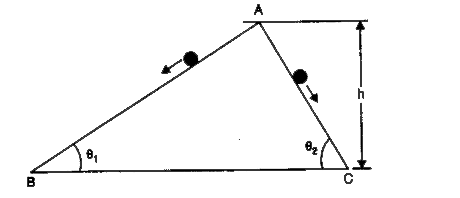
Two inclined frictionless tracks, one gradual and the other steep meet at A from where to stones are allowed to slide down from rest, one on each track (fig.) Will hte stones reach the bottom at the same time? Will they reach there with the same speed? Explain, given `theta_(1)=30^(@)`, `theta_92)=60^(@)` and h=10m. What are the speeds and time taken by the two stones?

Text Solution

Verified by Experts

`1/2 mv^(2) = mgh, v=sqrt(2gh)`
`=sqrt(2 xx 10 xx 10) ms^(-1) = 14.4 ms^(-1)`
`v_(B) = v_(C) = 14.14ms^(-1), l=1/2(gsintheta)t^(2)`
`sintheta = h/l, l=h/sintheta)`
`h/sintheta = 1/2gsinthetat^(2)` or `t=sqrt((2h)/g.1/sintheta`
`t_(B) = sqrt((2 xx 10)/10 1/(sin30^(@)) = 2sqrt(2)s`
`t_(C) = sqrt((2 xx 10)/(10) . 1/(sin60^(@)) = (2sqrt(2))/(sqrt(3))s`
Promotional Banner

Topper's Solved these Questions

Similar Questions

Explore conceptually related problems

Two inclined frictionless tracks, one gradual and the other steep meet at O, from where two stones are allowed to slide down from rest, one on each track. Will the stones reach the bottom at the same time ? Will they reach there with the same speed ? Explain.

Two inclined frictionless tracks, one gradual and the other steep meet at a from where two stones are allowed to slide down from rest, one on each track as shown in Figure. Which of the following statement is correct ? .

Two inclined frictionless tracks , one gradual and the other sleep meet at A from where two stones are allowed to slide down from rest. One on each track as shown in figure. Which of the following statement is correct?

Two inclined frictionless tracks, one gradual and other steep meet at 'A' from where two stones are allowed to slide down from rest, one on each track as shown in figure. The speed of two stones on reaching at bottom are v_(1) and v_(2) respectively. v_(1) & v_(2) are related as

A smooth inclined plane is inclined at an angle theta with the horizontal. A body starts from rest and slides down the inclined surface. The time taken by the body to reach the bottom is

A stone is dropped from a height h. Simultaneously, another stone is thrown up from the ground which reaches a height 4 h. The two stones cross each other after time

A stone is dropped from a height h. simultaneously, another stone is thrown up from the ground which reaches a height 4h. The two stones will cross each other after time:-

Two stones are thrown from the top of a tower, one straight down with an initial speed u and the second straight up with the same speed u. When the two stones hit the ground they will have speeds in the ratio.

A stone is thrown up from the top of a tower and it takes time t_(1) to reach the ground. A second stone is thrown down with the same speed and it takes time t_(2) to reach the ground . How much time a third stone would take to reach the ground, if it is dropped down?

A stone thrown down with a seed u takes a time t_(1) to reach the ground , while another stone, thrown upwards from the same point with the same speed, takes time t_(2) . The maximum height the second stone reaches from the ground is

NCERT-WORK, ENERGY AND POWER-EXERCISE
  1. A body constrained to move along the z-axis of a co-ordinate system, i...

    Text Solution

    |

  2. An electron and a proton are detected in a cosmic ray experiment, the ...

    Text Solution

    |

  3. A rain drop of radius 2mm, falls from a height of 500 m above the grou...

    Text Solution

    |

  4. A molecules in a gas container hits the wall with speed 200m//s at an ...

    Text Solution

    |

  5. A pump on the ground floor of a building can pump of water to fill a ...

    Text Solution

    |

  6. Two identical ball bearings in contact with each other and resting on ...

    Text Solution

    |

  7. The bob A of a simple pendulum released from 30^(@) to the vertical hi...

    Text Solution

    |

  8. The bob A of a simple pendulum is released from a horizontal position ...

    Text Solution

    |

  9. A trolley of mass 300 ks carrying a sand bag of 25 kg is moving unifor...

    Text Solution

    |

  10. A particle of mass 0.5kg travels in a straight line with velocity v=ax...

    Text Solution

    |

  11. The blades of a windmill sweep out a circle of area A. (a) If the wind...

    Text Solution

    |

  12. A person trying to lose weight (dieter ) lifts a 10 kg mass through 0....

    Text Solution

    |

  13. A family uses 8kW of power. (a) Direct solar energy is incident on the...

    Text Solution

    |

  14. A bullet of mass 0.012 kg and horizontal speed 70ms^(-1) strikes a blo...

    Text Solution

    |

  15. Two inclined frictionless tracks, one gradual and the other steep meet...

    Text Solution

    |

  16. A 1kg block situated on a rough incline is connected to a spring of sp...

    Text Solution

    |

  17. A bob of mass 0.3 kg falls from the ceiling of an elevator moving down...

    Text Solution

    |

  18. A trolly of mass 200kg moves with a uniform speed of 36 km//h on a fri...

    Text Solution

    |

  19. Which of the following potential energy curves in figure., cannot poss...

    Text Solution

    |

  20. Consider the decay of a free neutron at rest: ntop+e^(-) Show that the...

    Text Solution

    |
