Text Solution
Verified by Experts
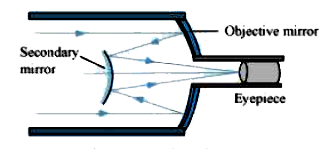 Distance between the objective mirror and the secondary mirror, d=20mm Radius of curvature of the secondary mirror, R1=140mm


Topper's Solved these Questions
Similar Questions
Explore conceptually related problems
NCERT-RAY OPTICS AND OPTICAL INSTRUMENTS-Exercise
- A small telescope has an objective lens of focal length 144 cm and an ...
Text Solution
|
- (i) A giant refracting telescope at an observatory has an objective le...
Text Solution
|
- Use the mirror equation to deduct that : (a) an object between f and...
Text Solution
|
- A small pin fixed on a table top is viewed from above from a distance ...
Text Solution
|
- (a) Fig. shows a cross-section of a 'light pipe' made of a glass fiber...
Text Solution
|
- Answer the following questions : (a) You have learnt that plane and ...
Text Solution
|
- The image of a small electric bulb fixed on the wall of a room is to b...
Text Solution
|
- A screen is placed 90 cm from an object. The image of the object on th...
Text Solution
|
- a) Determine the effective focal length of the combination of the two ...
Text Solution
|
- At what angle should a ray of light be incident on the face of a prism...
Text Solution
|
- A card sheet divided into squares each of size 1 mm^(2) is being viewe...
Text Solution
|
- (i) At what distance should the lens be held from the card sheet in or...
Text Solution
|
- What should be the distance between the object and magnifying glass i...
Text Solution
|
- a) The anlge subtended at the eye by an object is equal to the angle s...
Text Solution
|
- An angular magnification (magnifying power) of 30 X is desired using a...
Text Solution
|
- A small telescope has an objective lens of focal length 140 cm and an ...
Text Solution
|
- (a) For the telescope described what is the separation between the obj...
Text Solution
|
- A Cassegrainian telescope uses two mirrors as shown in Fig. Such a tel...
Text Solution
|
- Light incident normally on a plane mirror attached to a galvanometer c...
Text Solution
|
- Fig. shows an equiconvex lens (of refractive index 1.5) in contact wit...
Text Solution
|