Home
Class 12
PHYSICS
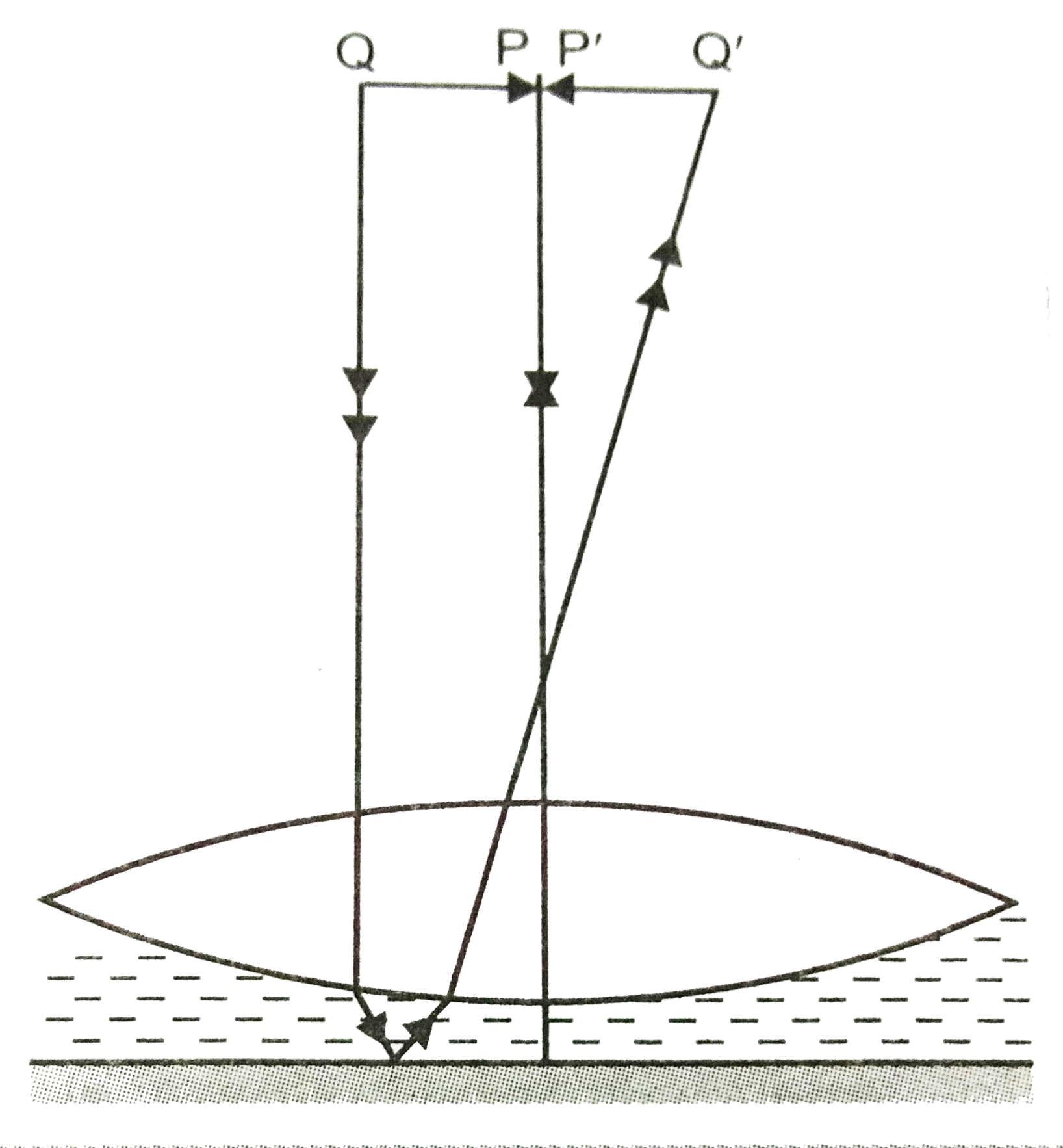
Fig. shows an equiconvex lens (of refrac...

Fig. shows an equiconvex lens (of refractive index `1.5`) in contact with a liquid layer on top of a plane mirror. A small needle with its tip on the principal axis is moved along the axis until its inverted image is found at the position of the needle. The distance of the needle from the lens is measured to be `45.0 cm`. The liquid is removed and the experiment is repeated. The new distance is measured to be `30.0 cm`. What is the refractive index of the liquid ?

Text Solution

Verified by Experts

Focal length of the convex lens, f1=30cm
The liquid acts as a mirror. Focal length of the liquid = f2
Focal length of the system (convex lens+liquid), f=45 cm
For a pair of optical systems placed in contact, the equivalent focal length is given as:
`1/f= 1/f_(1)+1/f_(2)`
`1/f_(2)=1/f-1/f_(1)`
= `1/45-1/30=-1/90`
`therefore f_(2)=-90cm`
Let the refractive index of the lens be `mu_(1)` and the radius of curvature of one surface be R. Hence, the radius of curvature of the other surface is -R
R can be obtained using the relation:
`1/(f_(1))=(mu_(1)-1)(1/R+1/-R)`
`1/30=(1.5-1)(2/R)`
`therefore R=(30)/(0.5 xx 2) = 30cm`

Let the refractive index of the liquid.
Radius of curvature of the liquid on the side of the lens, R=-30cm
The value of `mu_(2)` can be calculated using the relation.
`1/f_(2)=(mu_(2)-1)[1/-R-1/infty]`
`1/90 = (mu_(2)-1)[1/30-0]`
`mu_(2)-1 = 1/3`
`therefore mu_(2)=4/3=1.33`
Hence, the refractive index of the liquid is 1.33.
Promotional Banner

Topper's Solved these Questions

  • RAY OPTICS AND OPTICAL INSTRUMENTS

    NCERT|Exercise Exercise|32 Videos
  • NUCLEI

    NCERT|Exercise Exercise|31 Videos
  • SEMICONDUCTOR ELECTRONICS MATERIALS DEVICES AND SIMPLE CIRCUITS

    NCERT|Exercise Exercise|15 Videos

Similar Questions

Explore conceptually related problems

An equiconvex lens with radii of curvature of magnitude R each is put over a liquid layer poured on top of a plane mirror. A small needle, with its tip on the principal axis of the lens, is moved along the axis until its inverted real image coincides with the needle itself. The distance of the needle from the lens is measured to be 'a'. On removing the liquid layer and repeating the experiment the distance is found to be 'b'. Given that the two values of distances measured represent the focal length values in the two cases, obtain a formula for the refractive index of the liquid.

A synunetdc bionvex fens of radius of curvature Rand made of glass of refractive index 1.5, is placed on a placed on top of a plane mirror as shown in the figure.An optical needle with with its tip on the principal axis of the lens is moved along the axis until its real, inverted images conicides with the needle itself. The distance from the lens in measured to be x. On removing the liquid layer and repeating the experiment, the distance is found to be y . Obtain the expression for the refractive index of the liquid in terms of x and y.

A needle 10 cm long is placed along the axis of a convex lens of focal length 10 cm such that the middle point of the neddle is at a distance of 10 cm from the lens. Find the length of the image of the neddle.

An object 50 cm tall is placed on the principal axis of a convex lens. Its 20 cm tall image is formed on the screen placed at a distance of 10 cm from the lens. Calculate the focal length of the lens.

NCERT-RAY OPTICS AND OPTICAL INSTRUMENTS-Exercise
  1. A small telescope has an objective lens of focal length 144 cm and an ...

    Text Solution

    |

  2. (i) A giant refracting telescope at an observatory has an objective le...

    Text Solution

    |

  3. Use the mirror equation to deduct that : (a) an object between f and...

    Text Solution

    |

  4. A small pin fixed on a table top is viewed from above from a distance ...

    Text Solution

    |

  5. (a) Fig. shows a cross-section of a 'light pipe' made of a glass fiber...

    Text Solution

    |

  6. Answer the following questions : (a) You have learnt that plane and ...

    Text Solution

    |

  7. The image of a small electric bulb fixed on the wall of a room is to b...

    Text Solution

    |

  8. A screen is placed 90 cm from an object. The image of the object on th...

    Text Solution

    |

  9. a) Determine the effective focal length of the combination of the two ...

    Text Solution

    |

  10. At what angle should a ray of light be incident on the face of a prism...

    Text Solution

    |

  11. A card sheet divided into squares each of size 1 mm^(2) is being viewe...

    Text Solution

    |

  12. (i) At what distance should the lens be held from the card sheet in or...

    Text Solution

    |

  13. What should be the distance between the object and magnifying glass i...

    Text Solution

    |

  14. a) The anlge subtended at the eye by an object is equal to the angle s...

    Text Solution

    |

  15. An angular magnification (magnifying power) of 30 X is desired using a...

    Text Solution

    |

  16. A small telescope has an objective lens of focal length 140 cm and an ...

    Text Solution

    |

  17. (a) For the telescope described what is the separation between the obj...

    Text Solution

    |

  18. A Cassegrainian telescope uses two mirrors as shown in Fig. Such a tel...

    Text Solution

    |

  19. Light incident normally on a plane mirror attached to a galvanometer c...

    Text Solution

    |

  20. Fig. shows an equiconvex lens (of refractive index 1.5) in contact wit...

    Text Solution

    |
