

Home
Class 11
PHYSICS
Fig.(a) and (b) depict two circular moti...

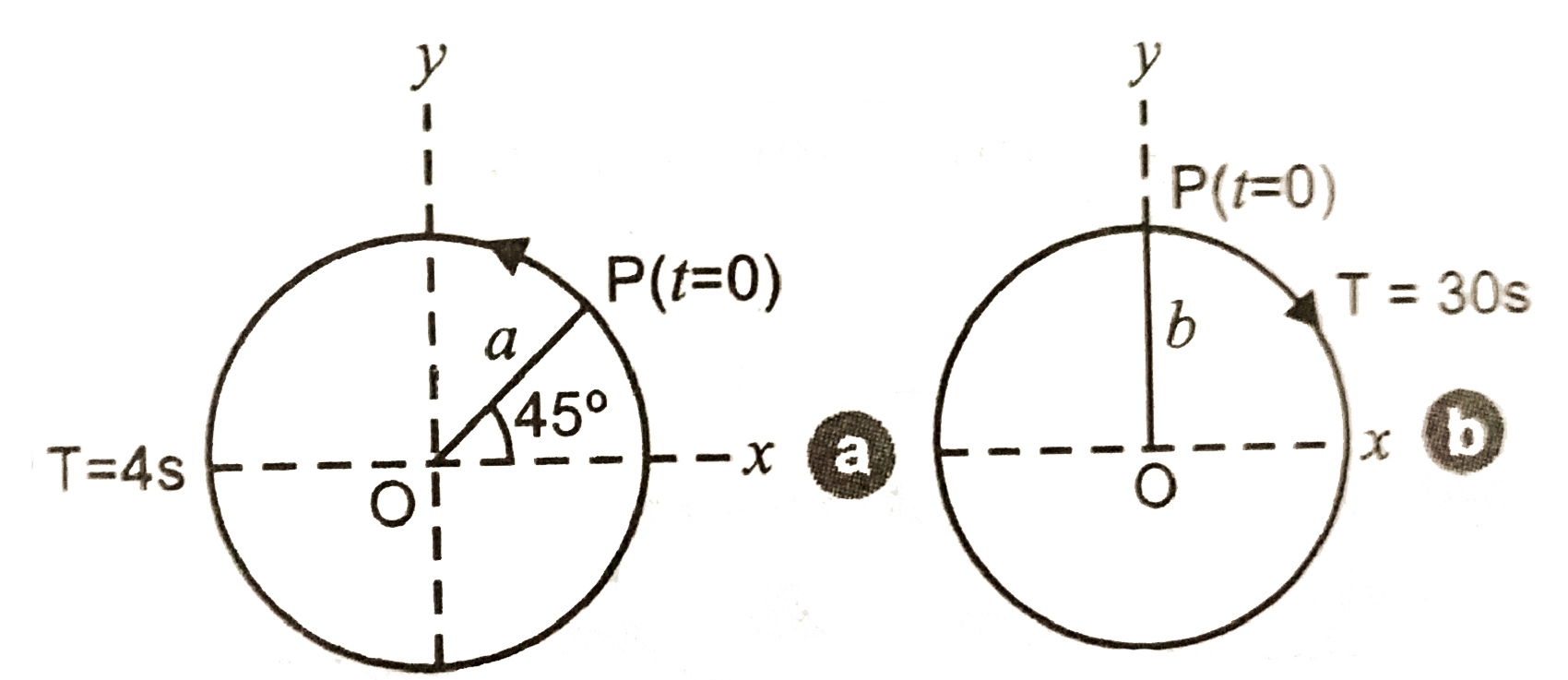
Fig.(a) and (b) depict two circular motions. The radius of the circle, the period of revolution, the initial position and sense of revolution are indicated in the figures. Obtain the simple harmonic motions of the x-projection of the radius vector of the rotating particle P in each case.

Text Solution

Verified by Experts

(a) At `t=O, OP` makes an angle of `45^(@) = pi//4` rad with the (positive direction of) x-axis. After time t, if covers an angle `(2pi)/(T)t` in the anticlockise sense, and makes an angle of `(2pi)/(T)t+(pi)/(4)` with the x-axis
The projection of OP on the x-axis at time t is given by,
`x(t) = A cos ((2pi)/(T)t+(pi)/(4))`
For `T=4s`
`x(t)=A cos ((2pi)/(4)t+(pi)/(4))`
which is a SHM of amplitude A, period 4 s, and an initial `"phase"^(**) = (pi)/(4)`.
(b) In this case at t = O, OP makes an angle of `90^(@)=(pi)/(2)` with th x-axis. After a time t, it covers an angle of `(2pi)/(T)t` in the clockwise sense and makes an angle of `((pi)/(2)-(2pi)/(T)t)` with the x-axis. The projection of OP on the x-axis at time t is given by
`x (t)=B cos ((pi)/(2)-(2pi)/(T)t)`
`= B sin ((2pi)/(T)t)`
For `T = 30 s`
`x(t)=B sin ((pi)/(15)t)`
Writing this as `x(t) = B cos ((pi)/(15)t-(pi)/(2))`, and comparing with Eq. (14.4) We find that this represents a SHM of amplitude B, period 30 s, and an initial phase of `-(pi)/(2)`.
Promotional Banner

Topper's Solved these Questions

Similar Questions

Explore conceptually related problems

depict two circulat mothions. The radius of the circle, the period of revolution, the initial position and sense of revolution are indicated in the figures. Obtain the simple harmonic motinosof the x-projection of the radius vector of the rotating particle P in each case.

The following figure depicts two circular motions. The radius of the circle, the period of revolutin the initial position and the sense of revolution are indicated on the figure. Obtain the simple harmoic motion of the x-projection of the radius vector of the rotating particle P in each case.

Figure depicts two circular motions. The radius of the circle, the period of revolution, the initial position and the sense of revolution are indicated on the figure. Obtain the SHMs of the x-projection of the radius vector of the rotating particle P in each case.

the circular motion of a particle. The radius of the circle, the period, sense of revolution and the initial position are indicated on the figure. The simple harmonic motion of the x-projection of the radius vector of the rotating particle P is

From the figure, obtain the equation of simple harmonic motion of the y-projection of the radius vector of the revolving particle P in each case.

Figure shows the circular motion of a particle. The radius of the circle, the period, sense of revolution and the initial positionn are indicated in the figure. The simple harmonic motion off the x-projection of the radius vector of the rotating particle P is

Figure shows the circular motion of a particle. The radius of the circle, the period, sense of revolution and the initial position are indicated in the · figure. The simple harmonic motion of the X-projection of the radius vector of the rotating particle Pis

Figure shows the circular motion of a particle. The radius of the circle, the period, same of revolution and the initial position are indicated on the figure. The simple harmonic motion of the x-projection of the radius vector the rotating particle P is

Figure below correspond to two circular motions. The radius of the circle, the period of revolution, the initial position, and the sense of revolution (i.e. clockwise or anticlockwise) are indicated on each figure. Obtain the corresponding simple harmonic motions of the x-projection of the radius vector of the revolving particle P in each case.

NCERT-OSCILLATIONS-EXERCISE
  1. Fig.(a) and (b) depict two circular motions. The radius of the circle,...

    Text Solution

    |

  2. Which of the following examples represent periodic motion? (a) A swi...

    Text Solution

    |

  3. Which of the following examples represent (nearly) simple harmonic mot...

    Text Solution

    |

  4. Fig. 14.23 depicts four x-t plots for linear motion of a particle. Whi...

    Text Solution

    |

  5. Which of the following functions of time represent (a) simple harmonic...

    Text Solution

    |

  6. A particle is in linear S.H.M. between two points A and B, 10 cm apart...

    Text Solution

    |

  7. Which of the following relationship between the acceleration, a and t...

    Text Solution

    |

  8. The motion of a particle in S.H.M. is described by the displacement fu...

    Text Solution

    |

  9. A spring balance has a scale that reads from 0 to 50kg. The length of ...

    Text Solution

    |

  10. A spring of force constant 1200Nm^(-1) is mounted on a horizontal tabl...

    Text Solution

    |

  11. In Exercise 14.9, let us take the position of mass when the spring is ...

    Text Solution

    |

  12. Figures,. Correspond to two circular motions. The radius of the circle...

    Text Solution

    |

  13. Plot the corresponding reference circle for each of the following simp...

    Text Solution

    |

  14. Figure a) shows a spring of force constant k clamped rigidly at once e...

    Text Solution

    |

  15. The piston in the cylinder head of a locomotive has a stroke (twice th...

    Text Solution

    |

  16. The acceleration due to gravity on the surface of the moon is 1.7ms^(-...

    Text Solution

    |

  17. Answer the following questions: (a) Time period of particle is S.H.M. ...

    Text Solution

    |

  18. A simple pendulum of length l and having a bob of mass M is suspended ...

    Text Solution

    |

  19. A cylindrical piece of cork of base area A and height h floats in a li...

    Text Solution

    |

  20. One end of a U-tube containing mercury is connected to a suction pump ...

    Text Solution

    |

  21. An air chamber of volume V has a neck area of cross section A into whi...

    Text Solution

    |