Home
Class 12
MATHS
In the adjacent figure the graph of two ...

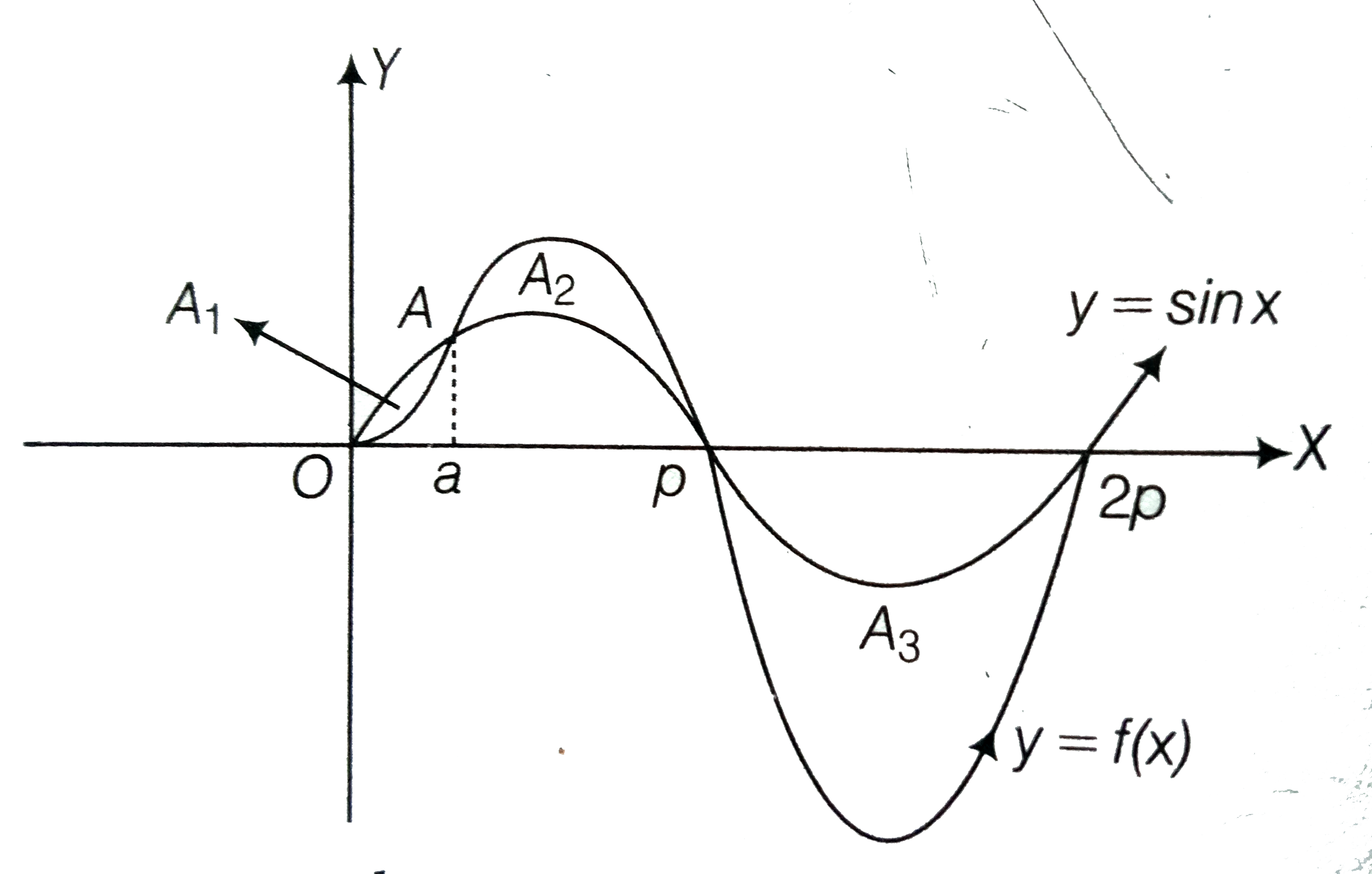
In the adjacent figure the graph of two function `y=f(x)` and `y=sin x` are given y=sin x intersects, y=f(x) at A(a,f(a)),`B(pi,0) and C(2pi,0)`.
`A_(i)(i=1,2,3)` is the area bounded by the curves `y=f(x) and y=sin x` between x=0 and x=a,i=1 between x=a and `x=pi, i=2` between `x=pi` and `x=2pi,i=3`. If `A_(1)=1-sin a+(a-1)` cos a, determine the function f(x). Hence, determine a and `A_(1)`. Also, calculate `A_(2) and A_(3)`.
.

Text Solution

Verified by Experts

The correct Answer is:

` f(x) = x sin x, a = 1 ; A_(1) = 1 – sin 1 ; A_(2) = pi – 1 – sin 1 ; A_(3) = (3pi - 2) `sq. units
Promotional Banner

Topper's Solved these Questions

  • AREA UNDER THE CURVE

    MOTION|Exercise EXERCISE - 4 LEVEL - I|11 Videos
  • AREA UNDER THE CURVE

    MOTION|Exercise EXERCISE - 4 LEVEL - II|14 Videos
  • AREA UNDER THE CURVE

    MOTION|Exercise EXERCISE - 2 (LEVEL-II)|4 Videos
  • BASIC MATHEMATIC & LOGARITHM

    MOTION|Exercise Exercise - 4|4 Videos

Similar Questions

Explore conceptually related problems

The area bounded by the curve y=sin x between x=(pi)/(2) and x=(3 pi)/(2)

The area bounded by the curves y=cos x and y=sin x between the ordinates x=0 and x=(3 pi)/(2) is

The area bounded by the curves y = cos x and y = sin x between the ordinates x = 0 and x = (3pi)/(2) , is

In the adjacent figure, the graphs of y = f(x) and y = sinx are given. The graphs of two equations intersect at P(a, f(a),Q(T, 0) and R(2pi, 0). Let S_1, S_2 and S_3 represent areas bounded by the curves y-f(x) and y = sinx between x = 0 and x = a between x = a and x = pi and between x = pi and x=2pi respectively. It is given that S =1-sint + (t-1)cos t AA t le a represents the area bounded between y = f(x) and y =sinx.4.

Find the area of the figure bounded by the curve y=sin^-1x , the lines x=0 and y=pi/2 .

(i) Make a rough sketch of the graph of the function y = sin x, 0 le x le (pi)/(2) and determine the area enclosed between the curve, the x-axis and the line x = (pi)/(2). (ii) Find the area bounded by the curve: (I) y = sin x" "(II) y = cos x bewtween x =0 and x =2pi.

If A_(1) is the area bounded by the curve y = cos x and A_(2) is the area bounded by y = cos 2 x along with x - axis from x = 0 and x = (pi)/(0) , then

MOTION-AREA UNDER THE CURVE-EXERCISE -3
  1. For what value of 'a' is the area bounded by the curve y=a^2x^2 +ax+...

    Text Solution

    |

  2. Consider the collection of all curve of the form y = a – bx^(2) that p...

    Text Solution

    |

  3. For the curve f(x) = 1/(1+x^(2) , let two points on it are A(alpha, f(...

    Text Solution

    |

  4. Let ‘c’ be the constant number such that c gt 1. If the least area ...

    Text Solution

    |

  5. If y=f(x) is a monotonic function in (a,b), then the area bounded by t...

    Text Solution

    |

  6. For what values of a in [0, 1] does the area of the fiqure bounded by ...

    Text Solution

    |

  7. A figure is bounded by the curves y =|sqrt2 sin((pix)/4)|,y=0, x=2&x=4...

    Text Solution

    |

  8. The line 3x +2y=13 divides the area enclosed by the curve, 9x^2+4y^2-1...

    Text Solution

    |

  9. Find the area bounded by the curve y = xe^(-x^2) , the x-axis, and the...

    Text Solution

    |

  10. A polynomial function f(x) satisfies the condition f(x+1)=f(x) + 2x + ...

    Text Solution

    |

  11. Find the equation of the line passing through the origin and dividing ...

    Text Solution

    |

  12. Consider the curve y=x^n where n > 1 in the 1^st quadrant. Ifthe areab...

    Text Solution

    |

  13. In the adjacent figure the graph of two function y=f(x) and y=sin x ar...

    Text Solution

    |

  14. If An be the area bounded by the curve y=(tanx^n) ands the lines x=0,\...

    Text Solution

    |

  15. Find the whole area included between the curve x^2)y^(2) = a^(2)(y^(2)...

    Text Solution

    |

  16. Let C(1 )and C(2) be two curves passing through the origin as shown in...

    Text Solution

    |

  17. Consider the two curves y = 1//x^(2) and y = 1//[4(x-1)]. At what v...

    Text Solution

    |

  18. If A = [[ln(a-1),0],[0,ln(b-1)]], then A^(-1) is :

    Text Solution

    |

  19. If z is a complex number such that z = ln(a – 1) + iln (b – 1) then ar...

    Text Solution

    |

  20. {:(,"Column - I", "Column - II"),("(A)" ,"The area bounded by curve","...

    Text Solution

    |
