Home
Class 12
MATHS
Let C(1 )and C(2) be two curves passing ...

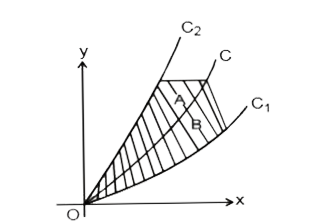
Let `C_(1 )and C_(2)` be two curves passing through the origin as shown in the figure. A curve C is said to ‘‘bisect the area’’ the region between `C_(1) and C_(2)`, if for each point P of C, the two shaded regions A and B shown in the figure have equal areas. Determine the upper curve `C_(2)`, given that the bisecting curve C has the equation`y = x^(2)` and that the lower curve `C_(1)` has the equation `y = x^(2)//2.`

Text Solution

Verified by Experts

The correct Answer is:

`(16/9)x^(2)`
Promotional Banner

Topper's Solved these Questions

  • AREA UNDER THE CURVE

    MOTION|Exercise EXERCISE - 4 LEVEL - I|11 Videos
  • AREA UNDER THE CURVE

    MOTION|Exercise EXERCISE - 4 LEVEL - II|14 Videos
  • AREA UNDER THE CURVE

    MOTION|Exercise EXERCISE - 2 (LEVEL-II)|4 Videos
  • BASIC MATHEMATIC & LOGARITHM

    MOTION|Exercise Exercise - 4|4 Videos

Similar Questions

Explore conceptually related problems

If the curve y=ax^(2)+bx+c passes through the point (1, 2) and the line y = x touches it at the origin, then

In the following figure, four curves A,B, C and D are shown. The curves are

A curve passing through (1,2) has its slope at any point (x,y) equal to (2)/(y-2) then the area of the region bounded by the curve and the line y=2x-4 is

The area of the region bounded by the curve C :y=(x+1)/(x^(2)+1) nad the line y=1 , is

A curve C has the property that if the tangent drawn at any point P on C meets the co- ordinate axis at A and B, then P is the mid- point of AB. The curve passen through the point (1,1). Determine the equation of the curve.

If the curve C in the xy plane has the equation x^(2)+xy+y^(2)=1, then the fourth power of the greatest distance of a point on C from the origin is

Let C be a curve passing through M(2,2) such that the slope of the tangent at any point to the curve is reciprocal of the ordinate of the point. If the area bounded by curve C and line x=2 is A, then the value of (3A)/(2) is__.

Consider the curves C_(1) = y - 4x + x^(2) = 0 and C_(2) = y - x^(2) + x = 0 The raio in which the line y = x divide the area of the region bounded by the curves C_(1) = 0 and C_(2) = 0 is

The equation of a circle C_(1) is x^(2)+y^(2)=4 The locus of the intersection of orthogonal tangents to the circle is the curve C_(2) and the locus of the intersection of perpendicular tangents to the curve C_(2) is the curve C_(3), Then

MOTION-AREA UNDER THE CURVE-EXERCISE -3
  1. For what value of 'a' is the area bounded by the curve y=a^2x^2 +ax+...

    Text Solution

    |

  2. Consider the collection of all curve of the form y = a – bx^(2) that p...

    Text Solution

    |

  3. For the curve f(x) = 1/(1+x^(2) , let two points on it are A(alpha, f(...

    Text Solution

    |

  4. Let ‘c’ be the constant number such that c gt 1. If the least area ...

    Text Solution

    |

  5. If y=f(x) is a monotonic function in (a,b), then the area bounded by t...

    Text Solution

    |

  6. For what values of a in [0, 1] does the area of the fiqure bounded by ...

    Text Solution

    |

  7. A figure is bounded by the curves y =|sqrt2 sin((pix)/4)|,y=0, x=2&x=4...

    Text Solution

    |

  8. The line 3x +2y=13 divides the area enclosed by the curve, 9x^2+4y^2-1...

    Text Solution

    |

  9. Find the area bounded by the curve y = xe^(-x^2) , the x-axis, and the...

    Text Solution

    |

  10. A polynomial function f(x) satisfies the condition f(x+1)=f(x) + 2x + ...

    Text Solution

    |

  11. Find the equation of the line passing through the origin and dividing ...

    Text Solution

    |

  12. Consider the curve y=x^n where n > 1 in the 1^st quadrant. Ifthe areab...

    Text Solution

    |

  13. In the adjacent figure the graph of two function y=f(x) and y=sin x ar...

    Text Solution

    |

  14. If An be the area bounded by the curve y=(tanx^n) ands the lines x=0,\...

    Text Solution

    |

  15. Find the whole area included between the curve x^2)y^(2) = a^(2)(y^(2)...

    Text Solution

    |

  16. Let C(1 )and C(2) be two curves passing through the origin as shown in...

    Text Solution

    |

  17. Consider the two curves y = 1//x^(2) and y = 1//[4(x-1)]. At what v...

    Text Solution

    |

  18. If A = [[ln(a-1),0],[0,ln(b-1)]], then A^(-1) is :

    Text Solution

    |

  19. If z is a complex number such that z = ln(a – 1) + iln (b – 1) then ar...

    Text Solution

    |

  20. {:(,"Column - I", "Column - II"),("(A)" ,"The area bounded by curve","...

    Text Solution

    |
