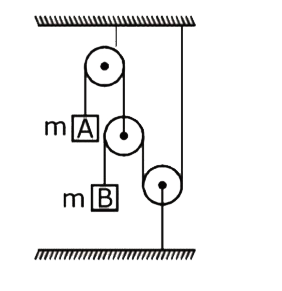
A
B
C
D
Text Solution
Verified by Experts
The correct Answer is:



Topper's Solved these Questions
NLM & FRICTION
MOTION|Exercise EXERCISE-2(Level-II)|25 VideosNLM & FRICTION
MOTION|Exercise EXERCISE-3(Level-I)|18 VideosNLM & FRICTION
MOTION|Exercise EXERCIS-1|80 VideosNEWTON'S LAWS OF MOTION & FRICTION
MOTION|Exercise Exercise - 3 Section-B|12 VideosONE DIMENSION MOTION
MOTION|Exercise Exercise - 3 |Section - B Previous Year Problems | JEE MAIN|12 Videos
Similar Questions
Explore conceptually related problems
MOTION-NLM & FRICTION-EXERCISE-2
- Find the acceleration of C w.r.t. ground.
Text Solution
|
- Find the acceleration of B.
Text Solution
|
- In the arrangement shown, the pulleys and the strings are ideal.The ac...
Text Solution
|
- Blocks A and B have masses of 2 kg and 3 kg. respectively. The ground ...
Text Solution
|
- Two blocks are in contact on a frictionless table one has a mass m and...
Text Solution
|
- A man getting down a running bus, falls forward because -
Text Solution
|
- If the tension in the cable supporting an elevator is equal to the wei...
Text Solution
|
- When a body is stationary :
Text Solution
|
- A spherical ball of mass m =5kg rests between two planes which make an...
Text Solution
|
- Beads A and B each of mass m , are connected by a light inextensible c...
Text Solution
|
- Two masses m and M are attached to the strings as shown in the figure....
Text Solution
|
- A flexible chain of weight W hangs between two fixed points A and B at...
Text Solution
|
- Which graph shows best the velocity-time graph for an object launched ...
Text Solution
|
- Adjoining figure shows a force of 40N acting at 30^(@) to the horizont...
Text Solution
|
- A block is kept on a frictionless inclined surface with angle of incli...
Text Solution
|
- A cylinder rests in a supporting carriage as shown. The side AB of car...
Text Solution
|
- In the arrangement shown below, pulleys are mass-less and friction-les...
Text Solution
|
- Two masses m and 2m are connected by a massless string, which passes o...
Text Solution
|
- In the figure, the blocks A,B and C of mass m each have accelerations ...
Text Solution
|
- A student calculates the acceleration of m(1) in figure shown as a(1) ...
Text Solution
|