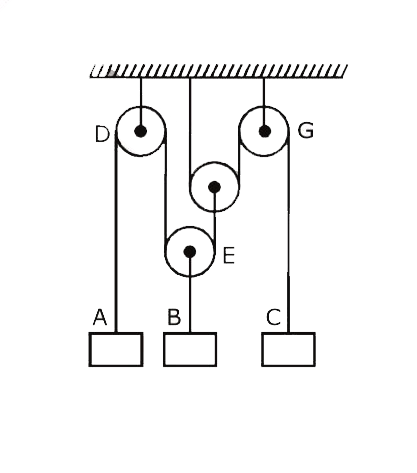
Text Solution
Verified by Experts
The correct Answer is:



Topper's Solved these Questions
NLM & FRICTION
MOTION|Exercise EXERCISE-4 ( LEVEL-I)|13 VideosNLM & FRICTION
MOTION|Exercise EXERCISE-4 ( LEVEL-II)|15 VideosNLM & FRICTION
MOTION|Exercise EXERCISE-3(Level-I)|18 VideosNEWTON'S LAWS OF MOTION & FRICTION
MOTION|Exercise Exercise - 3 Section-B|12 VideosONE DIMENSION MOTION
MOTION|Exercise Exercise - 3 |Section - B Previous Year Problems | JEE MAIN|12 Videos
Similar Questions
Explore conceptually related problems
MOTION-NLM & FRICTION-EXERCISE-3(Level-II)
- In the situation given all surfaces are frictionless, pulley is ideal ...
Text Solution
|
- Pulleys shown in the system of the figure are massless and friction le...
Text Solution
|
- If mass M is 2 kg what is the tension in string AC ?( in N ) Answer a...
Text Solution
|
- Tow men of masses m(1)and m(2) hold on the opposite ends of a rope pas...
Text Solution
|
- In figure shown, pulleys are ideal m(1)gt 2m(2). Initially the system ...
Text Solution
|
- A block of mass mlies on wedge of mass M as shown in figure. Answer fo...
Text Solution
|
- A long plank begins to move at t=0 and accelerates along a straight tr...
Text Solution
|
- The masses of the block A and B are m and M Between A and B there is a...
Text Solution
|
- Two block of masses m and M are connected by a chord passing around a ...
Text Solution
|
- In figure , find the acceleration of m assuming that there is friction...
Text Solution
|
- A block B is m kept on an inclined plane. Anotherblock A is inserted i...
Text Solution
|
- In figure the tension in the rope (rope is light) is (coeff of fricti...
Text Solution
|