Home
Class 11
PHYSICS
A bead of mass m is fitted on to a rod a...

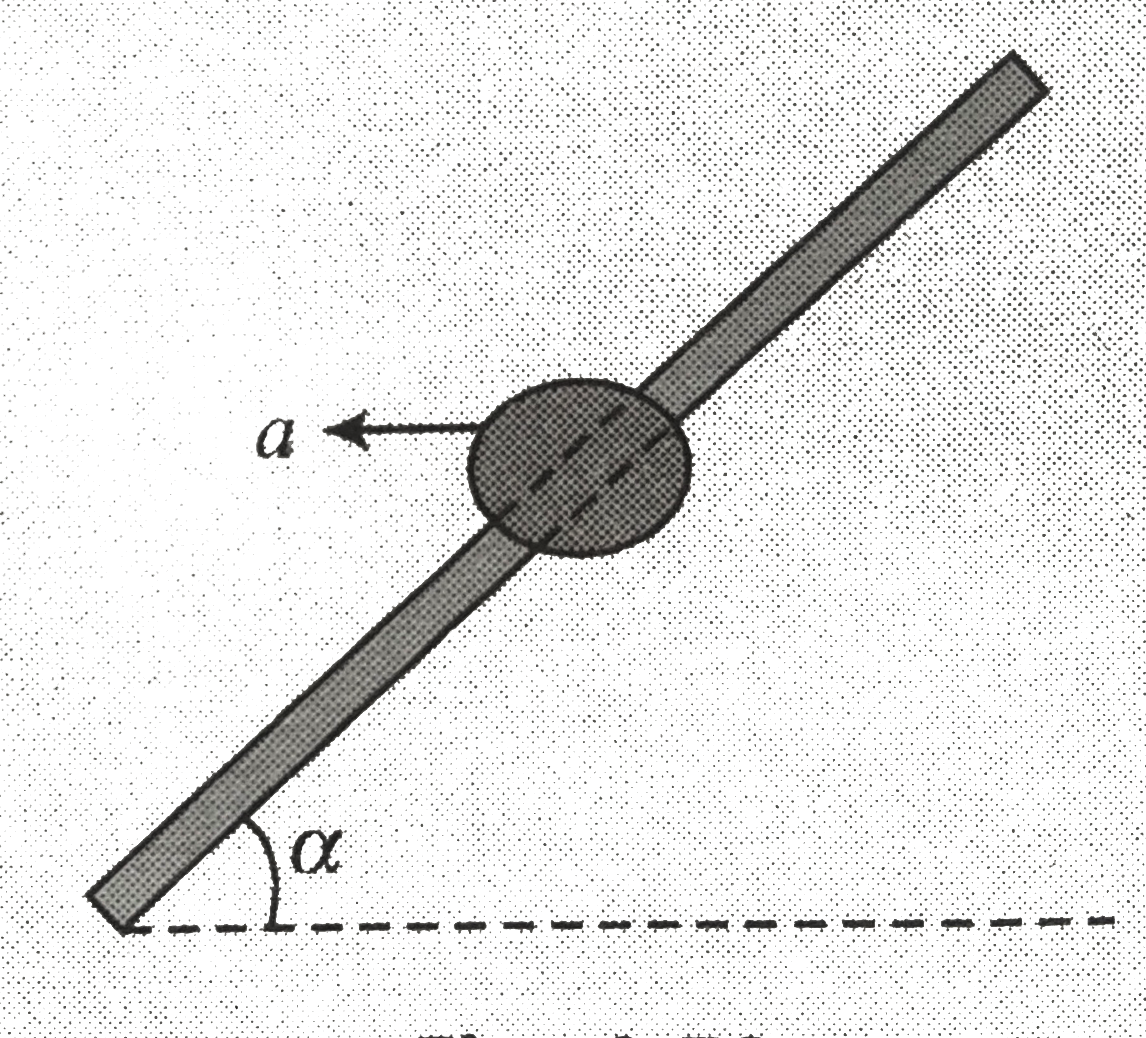
A bead of mass m is fitted on to a rod and can move on it without friction. At the initial moment the bead is in the middle of the rod. The rod moves translationally in a horizontal plane with an acceleration a in a direction forming an angle `alpha` with the rod. Find the acceleration of the bead relative to the rod.

A

g sin `alpha`

B

`(g + a_(0)) sin alpha`

C

`g sin alpha + a_(0) cos alpha`

D

`g sin alpha - a_(0) cos alpha`

Text Solution

Verified by Experts

The correct Answer is:
D


mg sin `alpha` - m`a_(0) "cos" alpha = ma`
Promotional Banner

Topper's Solved these Questions

  • FRICTION AND CIRCULAR MOTION

    GRB PUBLICATION|Exercise More than one correct|18 Videos
  • FRICTION AND CIRCULAR MOTION

    GRB PUBLICATION|Exercise Assertion - Reason|12 Videos
  • FRICTION AND CIRCULAR MOTION

    GRB PUBLICATION|Exercise Problem For Practice|23 Videos
  • FORCE AND NEWTONS LAWS OF MOTION

    GRB PUBLICATION|Exercise Comprehension|12 Videos
  • MOTION IN A STRAIGHT LINE

    GRB PUBLICATION|Exercise Comprehension type Queston|14 Videos

Similar Questions

Explore conceptually related problems

A bead of mass m is fitted on a rod and can move on it without friction. Initially the bead is at the middle of the rod moves transitionally in the vertical plane with an accleration a_(0) in direction forming angle alpha with the rod as shown. The acceleration of bead with respect to rod is: z

A bead of mass m moves on a rod without friction. Initially the bead is at the middle of the rod and the rod moves translationally in a vertical plane with an acceleration a_(0) in a direction forming angle theta with the horizontal as shown in the given figure. The acceleration of bead with respect to rod is

A rod touches a disc kept on a smooth horizontal plane. If the rod moves with an acceleration a , the disc rolls on the rod without acceleration a , the disc rools on therod without slidding. Then , the acceleration of the disc w.r.t the rod is

A rod of mass 'm and length L is attached to a L shaped plank at 'A'. rod can move freely about A. A string is tied between rod and plank as shown in figure. Whole system is moving with a constant acceleration g in x-direction If string is cut at any instant then the angular acceleration of rod (with respect to the plank) at that instant is

In the arrangement shown in fig., mass of the rod M exceeds the mass m of the ball. The ball has an opening permitting it to slide along the thread with some friction. The mass of the pulley and the friction in its axle are negligible. At the initial moment, the ball was located opposite the lower end of the rod. When set free, both bodies began moving with constant accelerations. Find the friction force between the ball and the thread if t seconds after the beginning of motion, the ball got opposite to the upper end of the rod. The rod length equals l.

A uniform rod of length l and mass M pivoted about its end as shown in Fig. and is free to rotate in the vertical plane about the pivot. The rod is released from rest in the horizontal position. (a) What is the initial angular acceleration of the rod? (b) Find the initial acceleration of the right end of the rod? ( c) Find normal contact force due to hinge when rod has rotated through angle theta as shown in Fig.

A ring of radius R lies in vertical plane. A bead of mass 'm' can move along the ring without friction. Initially the bead is at rest the bottom most point on ring. The minimum horizontal speed v with which the ring must be pulled such that the bead completes the vertical circle.

A unifrom rod of length l and mass m is free to rotate in a vertical plane about A as shown in Fig. The rod initially in horizontal position is released. The initial angular acceleration of the rod is

GRB PUBLICATION-FRICTION AND CIRCULAR MOTION -OBJECTIVE QUESTIONS ( only one choice is correct )
  1. A block A is placed over a long rough plank B same mass as shown below...

    Text Solution

    |

  2. A composite inclined plane has three different inclined surfaces AB, B...

    Text Solution

    |

  3. A bead of mass m is fitted on to a rod and can move on it without fric...

    Text Solution

    |

  4. The figure shows th velocity and acceleration of a point like body at ...

    Text Solution

    |

  5. A stone is thrown horizontally with a velocity of 10m//sec. Find the r...

    Text Solution

    |

  6. A small coin of mass 80g is placed on the horizontal surface of a rota...

    Text Solution

    |

  7. Two partical tied to different strings are whirled in a horizontal cir...

    Text Solution

    |

  8. A particle moves in a circle of radius 4.0 cm clockwise at constant sp...

    Text Solution

    |

  9. A small bead of mass m is carried by a circular hoop having center at ...

    Text Solution

    |

  10. Two identical particle are attached at the ends of a light string whic...

    Text Solution

    |

  11. For the arrangement in the Figure, the particle M(1) attached to one e...

    Text Solution

    |

  12. A bead of mass m is located on a parabolic wire with its axis vertica...

    Text Solution

    |

  13. A mass 1kg attached to the end of a flexible rope of diameter d = 0.25...

    Text Solution

    |

  14. A disc of radius R has a light pole fixed perpendicular to the disc at...

    Text Solution

    |

  15. A particle is moving in a circle of radius R in such a way that at any...

    Text Solution

    |

  16. A car is moving in a circular horizontal track of radius 10 m with a c...

    Text Solution

    |

  17. A long horizontal rod has a bead which can slide along its length and ...

    Text Solution

    |

  18. A particle 'P' is moving on a circular path under the action of only o...

    Text Solution

    |

  19. In Fig. 7.149 , coefficient of friction between the block and the floo...

    Text Solution

    |

  20. In Q.48 , the block can be made to slide on the floor only if theta is...

    Text Solution

    |

