Home
Class 11
PHYSICS
A small bead of mass m is carried by a c...

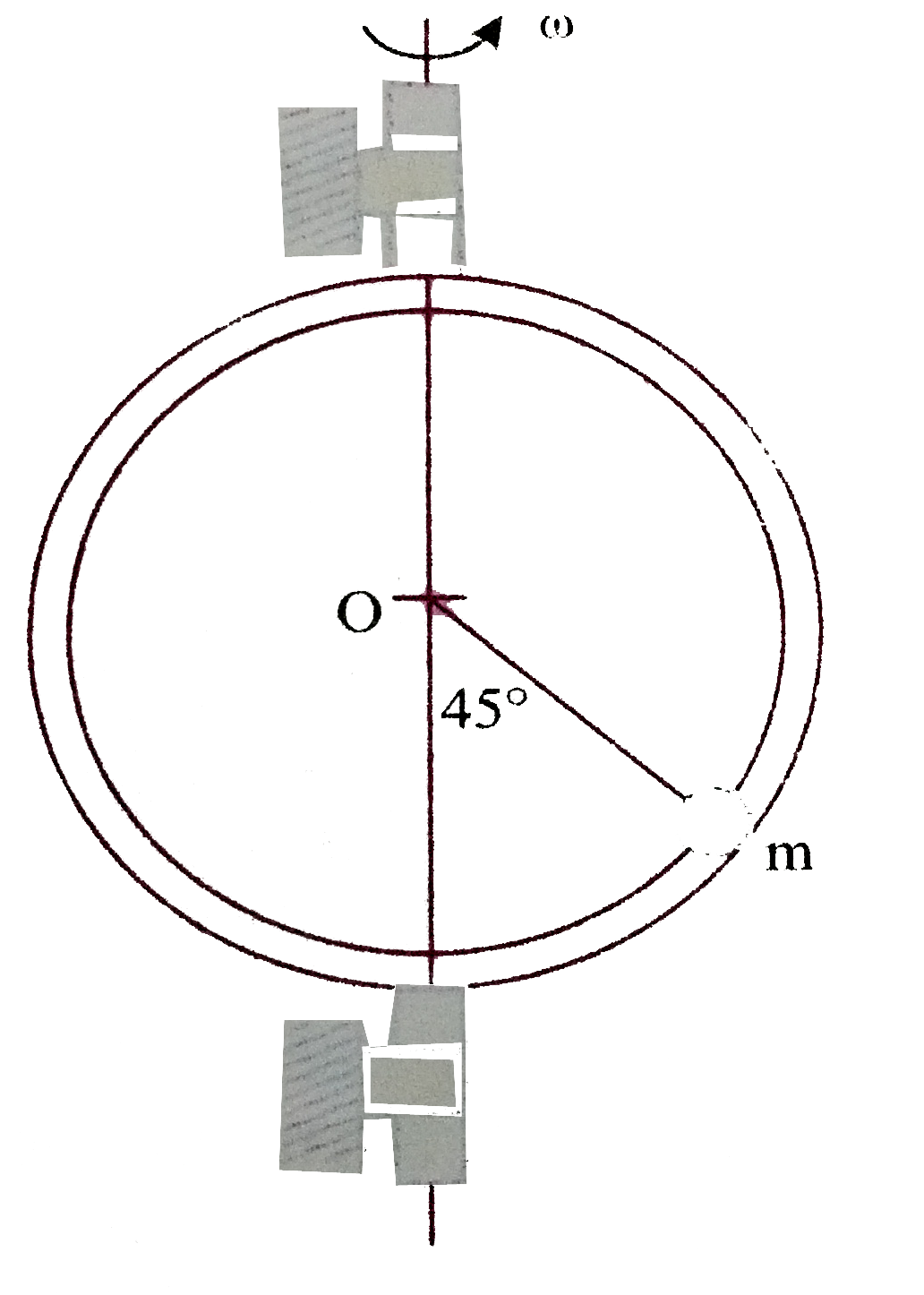
A small bead of mass `m` is carried by a circular hoop having center at `O` and radius `sqrt 2m` which rotates about a fixed vertical axis. The coefficient of friction between beed and hoop is `mu=0.5`. The maximum angular speed of the hoop for which the bead does not have relative motion with respect to hoop. `(g=10m//s^(2))`

A

`sqrt5`

B

` sqrt10`

C

`sqrt15`

D

`sqrt30`

Text Solution

Verified by Experts

The correct Answer is:
D

The maximum angular speed of the hoop corresponds to the situations when the bead is just about to slide upwards . For the bead not to slide upwards .

cos `45^(@) = (x)/(r) implies x = "r cos" 45^(@)`
`m omega^(2) ("r sin" 45^(@) + m omega^(2) ( "r sin" 45^(@) ) "sin" 45^(@)`
On solving , `omega le sqrt((1 + mu ) g)/((1 - mu) " r sin" 45^(@))`
Promotional Banner

Topper's Solved these Questions

  • FRICTION AND CIRCULAR MOTION

    GRB PUBLICATION|Exercise More than one correct|18 Videos
  • FRICTION AND CIRCULAR MOTION

    GRB PUBLICATION|Exercise Assertion - Reason|12 Videos
  • FRICTION AND CIRCULAR MOTION

    GRB PUBLICATION|Exercise Problem For Practice|23 Videos
  • FORCE AND NEWTONS LAWS OF MOTION

    GRB PUBLICATION|Exercise Comprehension|12 Videos
  • MOTION IN A STRAIGHT LINE

    GRB PUBLICATION|Exercise Comprehension type Queston|14 Videos

Similar Questions

Explore conceptually related problems

A small bead of mass m = 1 kg is free to move on a circular hoop. The circular hoop has centre at C and radius r = 1 m and it rotates about a fixed vertical axis. The coefficient of friction between bead and hoop is mu=0.5 . The maximum angular speed of the hoop for which the bead does not have relative motion with respect to hoop, at the position shown in figure is : (Take g = 10 m//s^(2) )

The coefficient of friction between the tyres and the road is 0.1. The maximum speed with which a cyclist can take a circular turn of radius 3 m without skidding is ("Take g"=10ms^(-2))

A circular road of radius 1000 m has banking angle 45^@ . IF the coefficient of friction is between tyre and road is 0.5, then the maximum safe speed of a car having mass 2000 kg will be

A body moves along a circular path of radius 5m . The coefficient of friction between the surface of the path and the body is 0.5 . The angular velocity in rad//s with which the body should move so that it does not leave the path is (g-10m//s^(-2))

The coefficient of friction between block of mass m and 2m is mu=2tantheta . There is no friction between block of mass 2 m and inclined plane. The maximum amplitude of the two block system for which there is no relative motion between both the blocks is

L shaped rod whose one end is horizontal and other is vertical is rotating about a vertical axis as shown with angular speed omega .The sleeve has mass m and friction coefficient between rod and sleeve is mu .The minimum angular speed omega for which sleeve cannot slip on rod is?

Find the maximum speed at which a car can turn round a curve of 30 m radius on a level road if coefficient of friction between the tyress and road is 0.4. Take g = 10 m//s^(2) .

A car is moving on a horizontal circular road of radius 0.1 km with constant speed. If coefficient of friction between tyres of car and road is 0.4, then speed of car may be (g=10m//s^(2))

The maximum speed with which a car driven round a curve of radius 18 m without skidding (where , g=10ms^(-2) and the coefficient of friction between rubber tyres and the roadway is 0.2)is

GRB PUBLICATION-FRICTION AND CIRCULAR MOTION -OBJECTIVE QUESTIONS ( only one choice is correct )
  1. Two partical tied to different strings are whirled in a horizontal cir...

    Text Solution

    |

  2. A particle moves in a circle of radius 4.0 cm clockwise at constant sp...

    Text Solution

    |

  3. A small bead of mass m is carried by a circular hoop having center at ...

    Text Solution

    |

  4. Two identical particle are attached at the ends of a light string whic...

    Text Solution

    |

  5. For the arrangement in the Figure, the particle M(1) attached to one e...

    Text Solution

    |

  6. A bead of mass m is located on a parabolic wire with its axis vertica...

    Text Solution

    |

  7. A mass 1kg attached to the end of a flexible rope of diameter d = 0.25...

    Text Solution

    |

  8. A disc of radius R has a light pole fixed perpendicular to the disc at...

    Text Solution

    |

  9. A particle is moving in a circle of radius R in such a way that at any...

    Text Solution

    |

  10. A car is moving in a circular horizontal track of radius 10 m with a c...

    Text Solution

    |

  11. A long horizontal rod has a bead which can slide along its length and ...

    Text Solution

    |

  12. A particle 'P' is moving on a circular path under the action of only o...

    Text Solution

    |

  13. In Fig. 7.149 , coefficient of friction between the block and the floo...

    Text Solution

    |

  14. In Q.48 , the block can be made to slide on the floor only if theta is...

    Text Solution

    |

  15. To avoid slipping while walking on ice, one should take smaller steps ...

    Text Solution

    |

  16. A block of mass M slides down a rough inclined surface of inclination ...

    Text Solution

    |

  17. In Fig. 7.150 , coefficient of friction between m(2) and the horizonta...

    Text Solution

    |

  18. In Fig . 7.151 , coefficient of kinetic friction between the 4 kg bloc...

    Text Solution

    |

  19. A uniform rope of length l lies on a table . If the coefficient of fri...

    Text Solution

    |

  20. Two balls of masses m(1) and m(2) are separated from each other by a p...

    Text Solution

    |

