Home
Class 11
CHEMISTRY
Free radical substitution chalcogenation...

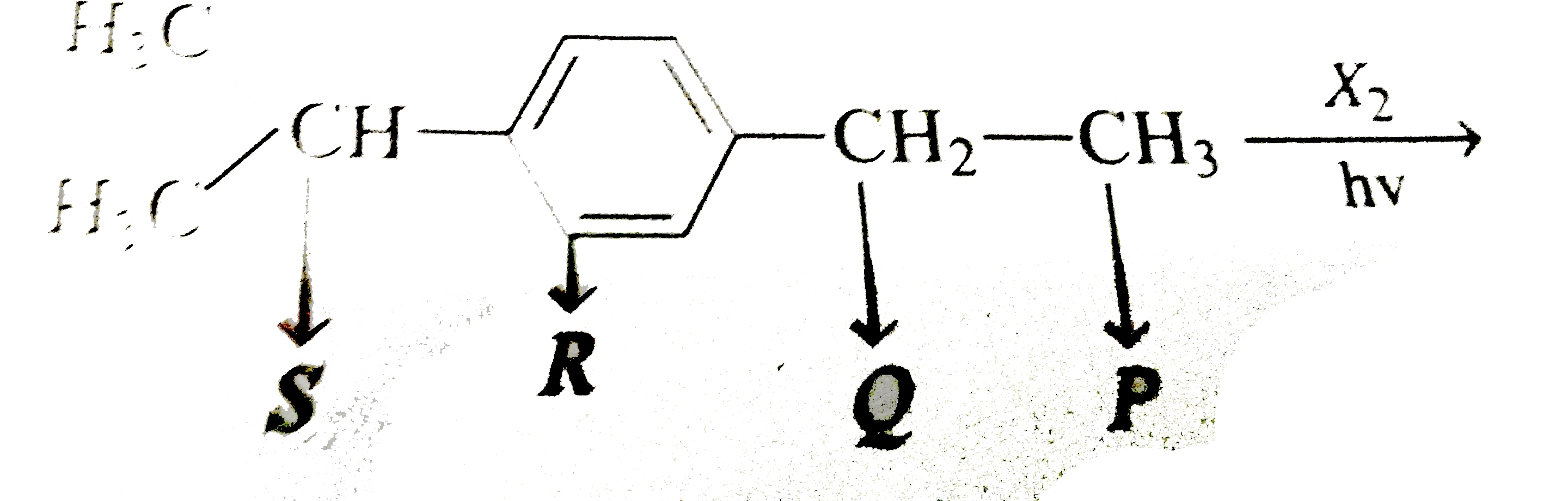
Free radical substitution chalcogenation is hown by the compunds having least one H-atom an `sp^(3)` hyvbridised carbon atom. Here substitution is due to free radical formation in presence of sunlight or heat or peroxide.The abstruction of H-atom is on the basis of staability of free radical flrmed

Which of the above hydrogen can be abstracted easily by halogen in presence of sunlight?

A

P

B

Q

C

R

D

S

Text Solution

Verified by Experts

The correct Answer is:
D

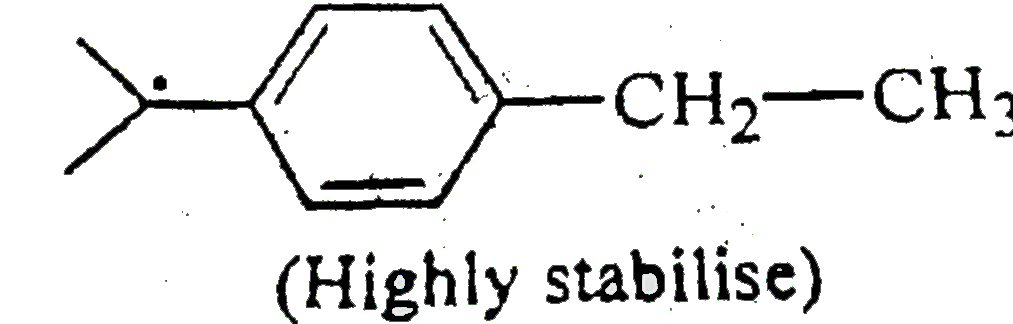
Free radical obtained by removal of `H^(*)` at position 'S' is highly stablise.
Promotional Banner

Topper's Solved these Questions

  • HYDROCARBONS (ALKANE, ALKENE and ALKYNE)

    HIMANSHU PANDEY|Exercise Match The Column|12 Videos
  • HYDROCARBONS (ALKANE, ALKENE and ALKYNE)

    HIMANSHU PANDEY|Exercise Integer Answer Type Problems|10 Videos
  • HYDROCARBONS (ALKANE, ALKENE and ALKYNE)

    HIMANSHU PANDEY|Exercise Linked Comprehension Type (Q.1 To Q.25)|25 Videos

Similar Questions

Explore conceptually related problems

Free radical substitution chalcogenation is hown by the compunds having least one H-atom an sp^(3) hyvbridised carbon atom. Here substitution is due to free radical formation in presence of sunlight or heat or peroxide.The abstruction of H-atom is on the basis of staability of free radical flrmed Which of these H-atom can be substituted to get an optically active lhalide?

Free radical substitution chalcogenation is hown by the compunds having least one H-atom an sp^(3) hyvbridised carbon atom. Here substitution is due to free radical formation in presence of sunlight or heat or peroxide.The abstruction of H-atom is on the basis of staability of free radical flrmed In the above reaction how many monobrominated products are possible?

If the reactivity factor for chlorine substitution through free radical by abstracting a primary H - atom is 1 then the ratio of the amount of product A and B is -

It we see the reaction of methane with halogen, the rate determining step for chlorination is, endothermic reaction of the chlorine atom with methane to form methyl radical and a molecule of HCl. So free radical is the intermediate of the reaction. Formation of free radical depends upon the energy required to break a bond between a hydrogen atom and a carbon atom. Chlorination of propane and Bromination of propane. when compared it is found that bromination is more selective than chlorination. The probability factor for 3^(@),2^(@),1^(@)H atom is 5.0:3.8:1.0 at 25^(@)C for chlorination. Isobutane when reacts with chlorine in presence of ultra violet radiations yield 2 products primary hydrogen substituted and 3^(@) hydrogen substituted Find their % in product mixture

Free radical halogenation takes place in the presence of light or at high temperature (abov 773K.) Formation of halogen free radical intermediate takes place in first step called chain initiation step. CI_(2)overset(hv)(to)2CI This reaction is mainly given by those compound which have atleast one hydrogen atom present at sp^(3)- hybrid carbon. Reactivity of sp^(3)- hybrid carbon depends on the reactivity of reaction intermediate. The relative rate of formation of alkyl radicals by a chlorine radical is : underset((5))("Tertiary") gt underset((3.8))("Secondary") gt underset((1))("Primary") " Percentage yield of the prodcut "=("Relative amount"xx100)/("Sum of relative amounts") Relative amount = Number of hydrogen atoms on the respective carbon xx relative reactivity. NBS (N-bromo succinimide) is used for bromination at allylic and benzylic carbon, whereas Br_(2)//hv gives bromination at benzylic allylic and alkyl carbon. Select most reactive compound for chlorination in presence of light :

Free radical halogenation takes place in the presence of light or at high temperature (abov 773K.) Formation of halogen free radical intermediate takes place in first step called chain initiation step. CI_(2)overset(hv)(to)2CI This reaction is mainly given by those compound which have atleast one hydrogen atom present at sp^(3)- hybrid carbon. Reactivity of sp^(3)- hybrid carbon depends on the reactivity of reaction intermediate. The relative rate of formation of alkyl radicals by a chlorine radical is : underset((5))("Tertiary") gt underset((3.8))("Secondary") gt underset((1))("Primary") " Percentage yield of the prodcut "=("Relative amount"xx100)/("Sum of relative amounts") Relative amount = Number of hydrogen atoms on the respective carbon xx relative reactivity. NBS (N-bromo succinimide) is used for bromination at allylic and benzylic carbon, whereas Br_(2)//hv gives bromination at benzylic allylic and alkyl carbon. which one of the following compounds will react with NBS?

