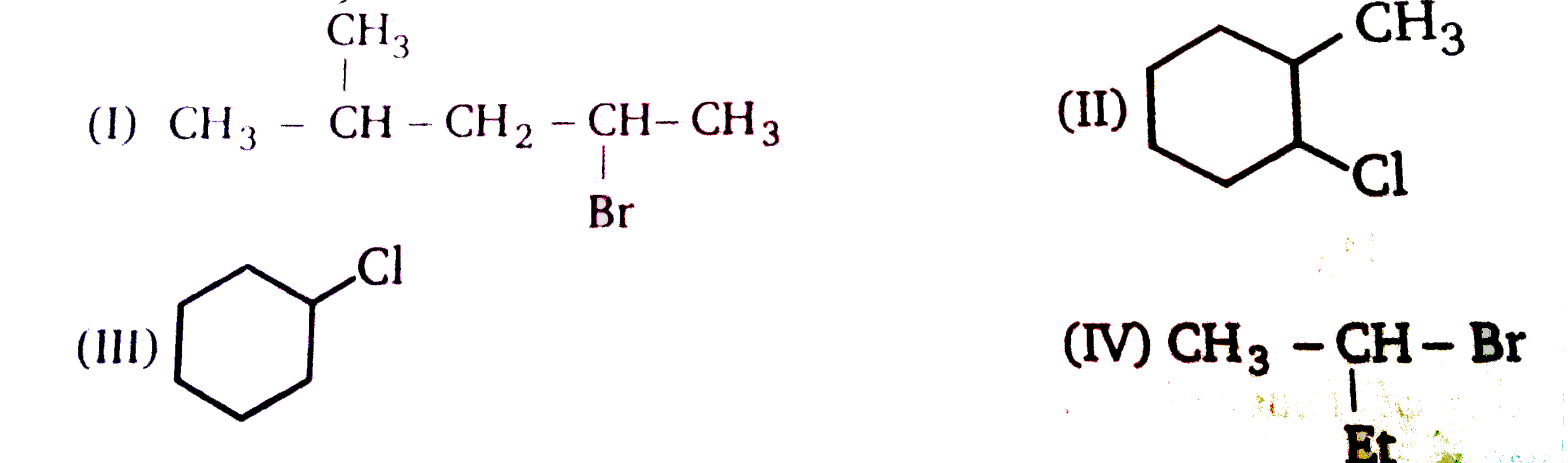
Among the given halides , which one will give same product in both `S_(N^(2))`and `S_(N^(2))`reaction
A
III only
B
I & II
C
III & IV
D
I, III & IV
Text Solution
Verified by Experts
The correct Answer is:
d
`S_(N^(2))and S_(N^1))` same ,if `C^(O+)` not rerrange.
Topper's Solved these Questions
ALKYL HALIDES
MS CHOUHAN|Exercise Level 2 (Q.1 To Q.10)|11 Videos
ALKYL HALIDES
MS CHOUHAN|Exercise Level-2|30 Videos
HYDROCARBONS (ALKANES)
MS CHOUHAN|Exercise Level 1 (Q.31 To Q.50)|1 Videos
Similar Questions
Explore conceptually related problems
S_(N^(1))and S_(N^(2)) reactions are
What is the product of the following S_(N^(2)) reaction ?
Which one of the lodine atoms will be more reactive in the S_(N)1 and S_(N)2 reaction ?
Consider the following statements : (1)Brideherated halides are inert towards both S_(N^(1)) and S_(N^(2)) reaction till one of the ring size is eoght member ring ) (2) The first step in both S_(N^(1)) and E_(1) reactions is the same (3) S_(N^(2)) reactions proceed with total retention of configuration (4) E_(2) elimination s are by the use of a solvent of low polarity and high concentration of a stromng base Which of the above statements are correct?
The correct decreasing order of reactivity for a given (R) group in both S_(N^(1)) " and " S_(N^(2)) reaction mechanism is :
Identify number of substrate those can give S_(N^(1))" and "S_(N^(2)) reaction both .
What is the product of the following S_(N)2 reaction ? .
Which of the major product expected from the following S_(N^2)) reaction ?