Home
Class 11
CHEMISTRY
Under the specifed condition s ,subastan...

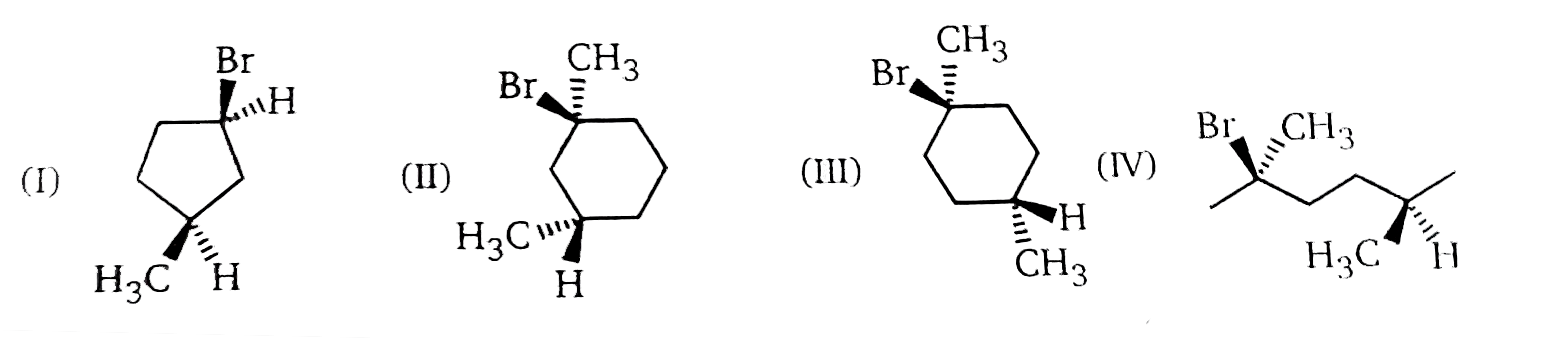
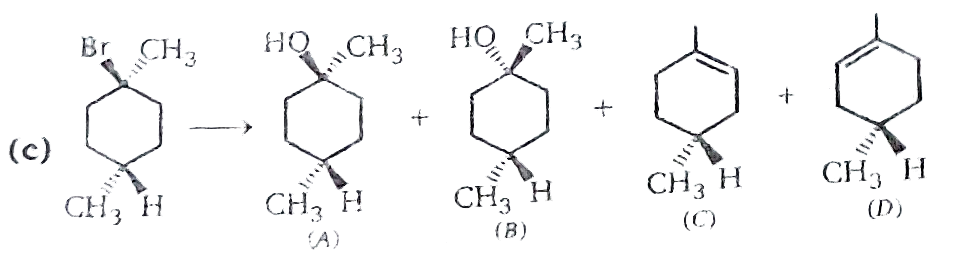
Under the specifed condition s ,subastan e X undergoes subition ans elimination eaction sto give products A-D ,Aand B stererisomers ,bu not enantiomers C and D are to enantiomers A is not an isomer of C which ofhte following could be the starting material X?

Text Solution

Verified by Experts

The correct Answer is:
c

Promotional Banner

Similar Questions

Explore conceptually related problems

In the set X = {a, b, c, d}, which of the following functions in X?

Give the majore and minor products of the following reactions. a. b. c. d. e. f.

If a^x = c^q = b and c^y = a^z = d then which one of the following is correct?

State whether the following statements are true or false. a. D and L stereoisomers are enantiomers. b. D enantiomer rotates the plane-polarised light to the right and L enantiomer to the left. c. Conversion of an erythro to a threo stereoisomer always occur by inversion at one chiral C . d. A racemate can be distinguished from a meso or a chiral compound by an attempted resolution. e. Racemisation of an enantiomer can only occure by breaking of at least one bond to the chiral centre. f. A reaction catalysed by an enzyme always gives an O.A product. g. When an achiral molecule reacts to give achiral molecule, the product is always racemic h. In chemical reactions, the change from an S reactant to an R product always signals an inversion of configuraion. i. An optically inactive substance must be achiral. j. An achiral compound can have chiral centres. K. A compound with S configuration is the (-) enantiomer.

A, B, C, D, E, F and G are playing cards sitting around a circular table. D is not the neighbour of C or E. A is the neighbour of B and C.G, who is second to the left of D, is the neighbour of E and F. Which of the following will be D’s position after E and D interchange their places? 1) On the immediate left of C 2) On the immediate right of F 3) Neighbour of C and A 4) Neighbour of G and C 5) None of these

(A), (B) and (C ) are three non-cylic funtional isomers of a carbonyl compound with molecular formula C_(4)H_(8)O . Isomers (A) and (C ) give positive Tollen's test whereas isomer (B) does not give Tollens' test but gives positive iodoform test. Isomers (A) and (B) on reduction with Zn(Mg) | conc. HCl give the same product (D). (a) Write the structures of (A), (B) ,(C) and (D). (b) Out of (A), (B) and (C ) isomers, which one is least reactive towards addition of HCN ?

" A pair of steroisomer might be classified in various ways depending upon their exact nature" How many following terms could properly be applied to a pair of stereoisomers, assuming their nature permits? (a)They might be meso isomers. (b) They might be tautomers. (c ) They might be enantiomers. (d) They might be diastereomers. ( e) They might be comformational isomers. (f) They might be costitutional isomers. (g) They might be configurational isomers. (h)None of the above statements are true.

(a) How do you convert the following (i) Ethanal to propanone (ii ) Toluene to benzoic acid (b) (A),(B ) and (C ) are three non cyclic functional isomers of a carbonyl compound with molecular formula C_4H_8 O . isomers (A) and (C) give positive Tollen's test whereas isomers (B) does not give Tollen's test but gives positive iodoform test , isomers (A) and (B) on reduction with Zn(Hg) /conc. HCl gives the same product (D) (i) Write the structures of (A), (B), (C) and (D) (ii) out of A,B and (C) isomers which one is least reactive towards additions of HCN

