Home
Class 12
PHYSICS
A ray of light from a denser medium stri...


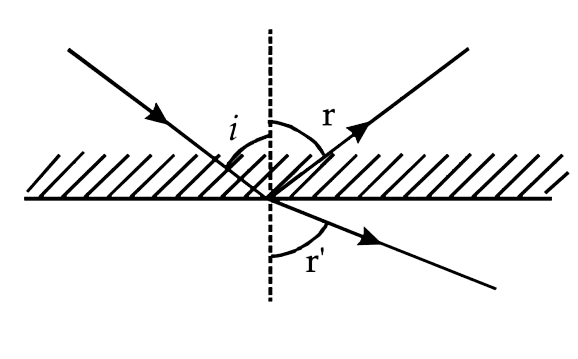
A ray of light from a denser medium strike a rarer medium at an angle of incidence I (see Fig). The reflected and refracted rays make as angle of 90degrees with each other. The angles of reflection and refraction are r and `r` The critical angle is

Text Solution

Verified by Experts
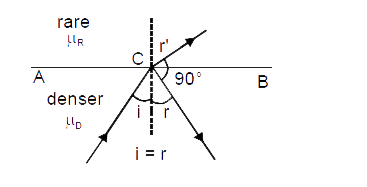
The situation in accordance with given problem is shown in figure .

Applying Snell's law at the boundary at C
`mu _(D ) ` sin I = `mu_(R )` sin r
`rArr mu= (mu_(D))/( mu_(R )) = (sin r ')/( sin i)`
But according to given problem r' +90 + r = 180
`r'+ r = 90 i.e, r= 90 - r`
or r= 90 - i `[as /_ r = /_i]`
So equation (i ) reduces to
`mu = (sin (90- i))/( sin i ) = (cos i)/( sin i ) = cot i`
But by definition ` theta_(c ) sin^(-1) . (1)/(mu)`
and from equation (ii) `mu cot i`
So `theta = sin ^(-1) [ (1)/(cot i)] = sin^(-1) (tan i )`
Promotional Banner

Topper's Solved these Questions

  • RAY OPTICS

    MOTION|Exercise Questions For Practice|29 Videos
  • RAY OPTICS

    MOTION|Exercise Exercise-1|102 Videos
  • RADIOACTIVITY & NUCLEAR PHYSICS

    MOTION|Exercise Exercise-3|81 Videos
  • ROTATIONAL MOTION

    MOTION|Exercise Exercise - 3 ( Section-B )|24 Videos

Similar Questions

Explore conceptually related problems

A ray of light from a denser medium strikes a rarer medium at an angle of incidence I (see figure ). The reflected and refracted rays make an angle of 90^(@) with each other. The angles of reflection and refraction are r and r^() . The critical angle is

A ray of light from a denser medium strikes a rarer medium at angle of incidence i . The refrected and the refracted rays make an angle of 90^@ with each other. The angles of reflection and refraction are r and r^' respectively. The critical angle is (i) sin^-1(tanr) (ii) sin^-1(tani) (iii) sin^-1(tanr) (iv) tan^-1(tani)

A ray of light passes from a denser medium to a rarer medium at an angle of incidence i. The reflected and refracted rays make an angle of 90^@ with each other. The angle of reflection and refraction are resepectively r and r'. The critical angle is given by :

A ray of light from a denser medium strikes a rarer medium at an angle of incidenc i. The reflected and refracted rays make an angle of pi//2 with each other. If the angles of reflection and refraction are r and r^(') , then the criticall angle will be

A ray of light from a denser medium strikes a rarer medium at an angle of incidence i. if the reflected and the refracted rays are mutually perpendicular to each other, what is the value of the critical angle ?

If a ray of light in a denser medium strikes a rarer medium at an angle of incidence i, the angles of reflection and refraction are respectively, r and r' If the reflected and refraction rays are at right angles to each other, the critical angle for the given pair of media is

A ray of light from a denser medium strikes a rarer medium at an angle of incidence i = tan^( -1)(1//2) . If the reflected and the refracted rays are mutually perpendicular to each-other, what is the value of the critical angle in degree?

A ray of light from a rarer medium strikes a denser medium at angle of incidence 60°. The reflected and refracted rays are perpendicular to each other. The refractive index of denser medium and angle of deviation respectively are

A ray of light is incident at an angle i from denser to rare medium. The reflected and the refracted rays are mutually perpendicular. The angle of reflection and the angle of refraction are respectively r and r'. Then the critical angle will be:

MOTION-RAY OPTICS-Exercise-4
  1. A ray of light from a denser medium strike a rarer medium at an angle ...

    Text Solution

    |

  2. Assertion : Refractive index of material of a prism depends on angle o...

    Text Solution

    |

  3. Assertion : Two convex lenses joined together cannot produce an achrom...

    Text Solution

    |

  4. Assertion : When the object moves with a velocity vec(v ) , its i...

    Text Solution

    |

  5. Assertion : As the temperature of a medium increases the refractive in...

    Text Solution

    |

  6. Assertion : Critical angle is minimum for violet colour Reason : Be...

    Text Solution

    |

  7. Assertion : If the angle between the two plane mirror is 72^(@)and the...

    Text Solution

    |

  8. Assertion : For given system ( theta = 72^(@)), number of images forme...

    Text Solution

    |

  9. Assertion : The power of a converging lens is positive and that of a d...

    Text Solution

    |

  10. Assertion :– For a plane mirror the focal length is infinite and magni...

    Text Solution

    |

  11. Assertion :– As light travels from one medium to another, the speed of...

    Text Solution

    |

  12. Assertion : In a concave mirror if X and Y are the distance of ...

    Text Solution

    |

  13. Assertion : A star will appear to twink le if seen from free spa...

    Text Solution

    |

  14. Assertion : A beam of white light when passed through a hollow ...

    Text Solution

    |

  15. Assertion :- The twinkling of stars is due to the fact that refractive...

    Text Solution

    |

  16. Assertion :- Critical angle is maximum for red colour in water-air sy...

    Text Solution

    |

  17. Assertion :- The minimum distance between a real object and its real i...

    Text Solution

    |

  18. Assertion :- Chromatic aberration occur in simple lenses but not in mi...

    Text Solution

    |

  19. Assertion : In a compound microscope, the intermediate image is real, ...

    Text Solution

    |

  20. Assertion :- 11 english alphabets donot show lateral inversion. Rea...

    Text Solution

    |

  21. Assertion :- Sky appears blue. Reason :- Sensitivity of eye is high...

    Text Solution

    |

