Home
Class 12
PHYSICS
A force F acts on a particle kept on a r...

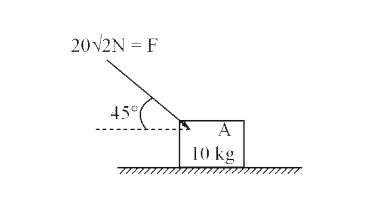
A force F acts on a particle kept on a rough surface as shown in the figure. The particle is at rest. Find the net force applied by ground on the particle.

A

120 N

B

20 N

C

100 N

D

`20sqrt(37)`N

Text Solution

Verified by Experts

The correct Answer is:
d


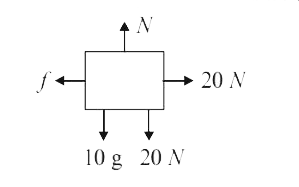
N=120 N f=20 N
Total force by ground =`sqrt(120^(2)+20^(2))=sqrt(1400+400)=sqrt(4800)=10sqrt(4xx37)=20sqrt(37N)`
Promotional Banner

Similar Questions

Explore conceptually related problems

The force F acting on a particle is moving in a straight line as shown in figure. What is the work done by the force on the particle in the 4 m of the trajectory?

The figure showns the force versus time graph for a particle. Find the average force acting on the particle

Force acting on a particle varies with displacement as shown in figure. Find the total work done by the force.

Two forces of magnitude F are acting on a uniform disc kept on a horizontal rough surface as shown in the figure. Friction force by the horizontal surface on the disc is nF . Find the value of n .

Two forces act on a particle simultaneously as shown in the figure. Find net force in milli newton on the particle. [Dyne is the CGS unit of forces ]

A force F acting on a particle varies with the position x as shown in the graph. Find the work done by the force in displacing the particle from x =-a to x = +2a . .

A block of mass 5kg is resting on a rough surface as shown in the figure. It is acted upon by a force of F towards right. Find frictional force acting on block when 25N.

A block of mass 1 kg in kept on a rough horizontal surface with mu_(s)=0.1 . A force of 0.5 N is applied as shown in the figure. What is the frictional force applied by ground on the block?

Force acting on a particle moving along x-axis as shown in figure. Find points of stable and unstable equlibrium. .

When a force F acts on a particle of mass m, the acceleration of particle becomes a. now if two forces of magnitude 3F and 4F acts on the particle simultaneously as shown in figure, then the acceleration of the particle is

