Home
Class 12
PHYSICS
The block A in the given figure is of ma...

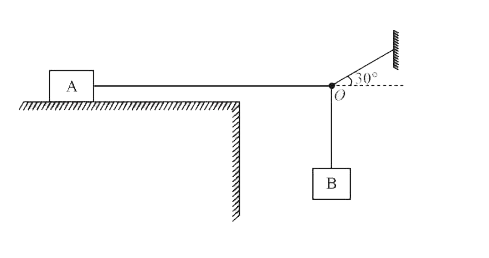
The block A in the given figure is of mass `10sqrt(3)` kg The coefficient of friction between the block and the surface on which it rests is 0.5. Find maximum mass of block B possible such that the system will be in equilibrium is.

A

5 kg

B

10 kg

C

`(10)/sqrt(3)` kg

D

7 kg

Text Solution

Verified by Experts

The correct Answer is:
a

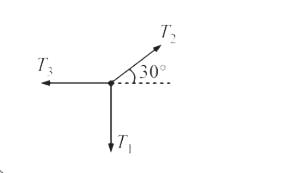
`T_(1)=mg`
`T_(2) sin 30^(@)=T_(1) rarr T_(2)= 2mg`
for equilibrium of A
`T_(3) le f_(max) rarr sqrt(3)mg le mu10sqrt(3)g rarr m le 0.5 10 rarr m le 5 kg`
Promotional Banner

Similar Questions

Explore conceptually related problems

Block A in figure weights 90 N. The coefficient of static friction between the block and the surface on which it rests is 0.3. The weight w is 15N, and the system is in equilibrium. Find the friction force exerted on block A.(b) Find the maximum weight w for which the system will remain in equilibrium.

A block A of mass 3kg and another block B of mass 2kg are connected by a light inextensible string as shown in figure. If the coefficient of friction between the surface of the table and A is 0.5 What maximum mass C is to be placed on A so that the system is to be in equlibrium .

Block A of mass M in the system shown in the figure slides down the incline at a constant speed. The coefficient of friction between block A and the surface is 1 3 3 . The mass of block B is-

a. Block A , as shown in figure weight 60.0 N The coefficient of static friction between the block and the surface on which it rest is 0.25 .The system is in equlibrium .Find the friction for excerted on block A b. Find the maximum weight w for which the system will remain in equlibrium

A block of mass 2kg is placed on the surface of trolley of mass 20kg which is on a smooth surface.The coefficient of friction between the block and the surface of the trolley is 0.25 .If a horizontal force of 2 N acts on the block, the acceleration of the system in ms^(-2) is (g=10ms^(-2))

A block is kept on a rough horizontal surface as shown. Its mass is 2 kg and coefficient of friction between block and surface (mu)=0.5. A horizontal force F is acting on the block. When

Two blocks A and B of respective masses 6 kg and 4 kg are connected with a string passing over a light friction less pulley as shown in the figure . The coefficient of friction between the block A and horizontal surface is 0.4 . Then the minimum mass of block C which should be placed over A to prevent it from moving is :

Mass of upper block and lower block kept over the table is 2 kg and 1 kg respectively and coefficient of friction between the blocks is 0.1. Table surface is smooth. The maximum mass M for which all the three blocks move with same acceleration is (g = 10 m/s2) -

In the figure shown, the coefficient of static friction between the block A of mass 20 kg and horizontal table is 0.2. What should be the minimum mass of hanging block just beyond which blocks start moving?

