Home
Class 12
PHYSICS
In the figure shown, the string and pull...

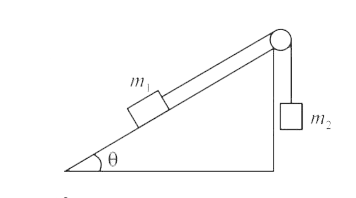
In the figure shown, the string and pulley are massless. The inclined plane is fixed and has coefficients of friction `mu_(s)=0.25` and `mu_(k)=0.2` . Consider two cases:
Case I : `m_(1)=2kg m_(2)=1.5 kg theta=37^(@) , "Case II":m_(1)=3kg m_(2)=2 kg theta =53^(@)`
Take `g=10 m//s^(2), sin 37^(@)=3/5, sin 53^(@)=4/5`

A

In case I, both blocks are in equilibrium

B

In case I, friction on is 3 N, acting down the plane

C

In case II, both blocks are in equilibrium

D

In case II, friction on `m_(1)` is 3.6 N, acting up the plane

Text Solution

Verified by Experts

The correct Answer is:

abc

Assuming equilibrium `T=m_(2)g`
Taking friction up the plane , `T+f=m_(1) g sin theta ` and `N= m g cos theta`
put ` f=mu_(s)N` to get minimum allowed value of `m_(2) m_(2) ge m_(1) sin theta - mum_(1) cos theta `
reverser direction of friction to get maximum allowed value of `m_(2)m_(2)le m_(1)sin theta mum_(1) cos theta`
`rarr` again `m_(2)` is in the right range `rarr` static friction acts as `m_(2)ltm_(1) sin theta` friction acts up the plane
`rarr T+F =m_(1)g sin theta rarr T+F=m_(1) g sin theta -T = m_(1) g sin theta -m_(2) g =24 -20 =4N`
Promotional Banner

Similar Questions

Explore conceptually related problems

The coefficient of friction between m_(2) and inclined plane is mu (shown in the figure). If (m_(1))/(m_(2))=sin theta then

In fig. both pulleys and the string are massless and all the surfaces are frictionless. Given m_(1)=1kg, m_(2)= 2kg, m_(3)=3kg . Find the tension in the string

In the figure shown, if friction coefficient of block 1 kg and 2kg with inclined plane is mu_(1) = 0.5 and mu_(2) = 0.4 respectively, then

In fig. both pulleys and the string are massless and all the surfaces are frictionless. Given m_(1)=1kg, m_(2)= 2kg, m_(3)=3kg . The acceleration of m_(1) is

In fig. both pulleys and the string are massless and all the surfaces are frictionless. Given m_(1)=1kg, m_(2)= 2kg, m_(3)=3kg . The acceleration of m_(3) is

The block of mass m_(1) is placed on a wedge of an angle theta , as shown. The block is moving over the inclined surface of the wedge. Friction coefficient between the block and the wedge is mu_(1) , whereas it is mu_(2) between the wedge and the horizontal surface. if mu_(1)=1/2, theta=45^(@), m_(1)=4 kg, m_(2)=5 kg and g=10 m//s^(2) , find minimum value of mu_(2) so that the wedge remains stationary on the surface. express your answer in multiple of 10^(-3)

Two masses m_(1) and m_(2) which are connected with a light string, are placed over a frictionless pulley. This set up is placed over a weighing machine, as shown. Three combination of mass m_(1) and m_(2) are used, in first case m_(1) =6kg and m_(2)=2 kg , in seconds case m_(1)=5 kg and m_(2)=3 kg and in third case m_(1)=4 kg and m_(2)= 4 kg . masses are held stationary initially and then released. if the reading of the weighing machine after the release in three cases are W_(1),W_(2) and W_(3) respectively then:

In the arrangement shown in the figure, friction exists only between the two blocks, A and B. The coefficient of static friction mu_(s)=0.6 and coefficient of kinetic friction mu_(k)=0.4 , the masses of the blocks A and B are m_(1)=20 kg and m_(2)=30kg , respectively. Find the acceleration (in ms^(-2) ) of m_(1) , if a force F=150N is applied, as shown in the figure. [Assume that string and pulleys are massless]

In the figure shown, m_(1) = 10kg, m_(2) = 6kg, m_(3) = 4kg. If T_(3) = 40 N, T_(2) = ?
