Home
Class 12
PHYSICS
Three forces start acting simultaneously...

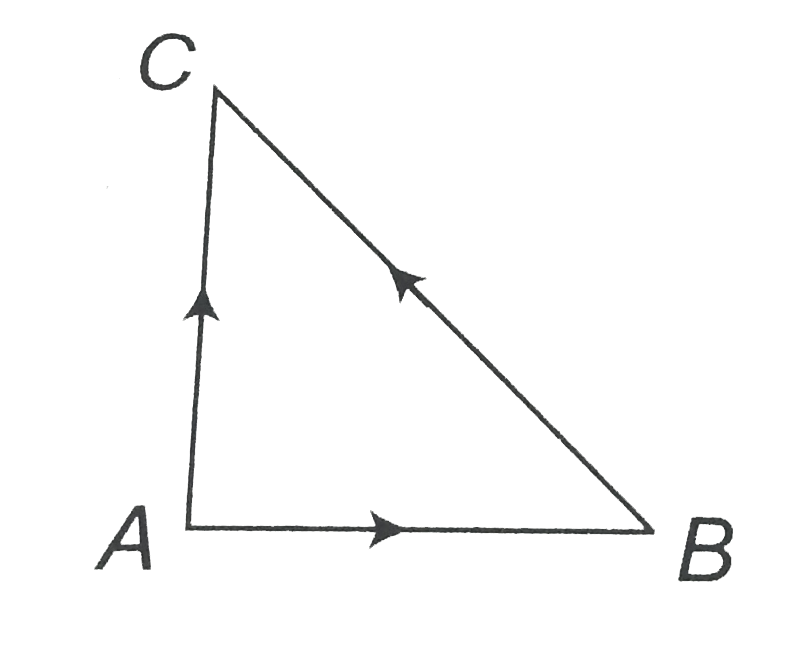
Three forces start acting simultaneously on a particle moving with velocity `vec(v)`. These forces are represented in magnitude and direction by the three sides os a triangle ABC (as shown). The particle will now move with velocity.

A

`overset(rarr)v` remaining unchanged

B

less than `overset(rarr)v`

C

greater than `overset(rarr)v`

D

`|overset(rarr)v|` in the direction of the largest force BC

Text Solution

Verified by Experts

The correct Answer is:

a

From polygon law of vector addition we know if the vectors are arranged along the sides of a polygon the resultant of vector becomes zero. Here in this case the forces are represented by the sides of a triangle taken in same order, so their resultant is zero. It means the acceleration of the particle should be zero, hence velocity remains constant.
Promotional Banner

Similar Questions

Explore conceptually related problems

Three forces start acting simultaneously on a particle moving the velocity vecV . The forces are represented in magnitude and direction by the three sides of a triangle ABC (as shown). The particle will now move with velocity

Three forces start acting simultaneously on a particle moving with velocity, barv . These forces are respresented in magnitude and direction by the three sides of a triangle ABC. The particle will now move with velocity

Three forcesstart acting simultaneously on a particle moving with a velocity overset rarr v . These forces are represented in magnitude and direction by three sides of a triangle taken in the same order. What now will be the velocity of the particle ?

The path of a particle moving under the influence of a force fixed in magnitude and direction is [

The force acting on a particle of charge q moving in a uniform magnets field with velocity v is

What is the direction of the force acting on a charged particle q, moving with a velocity vec(v) a uniform magnetic field vec(B) ?

Forces proportional to AB, BC & 2 CA act along the sides of triangle ABC in order, their resultant represented in magnitude and direction as:
