Home
Class 12
PHYSICS
An insect craws up a hemispherical surfa...

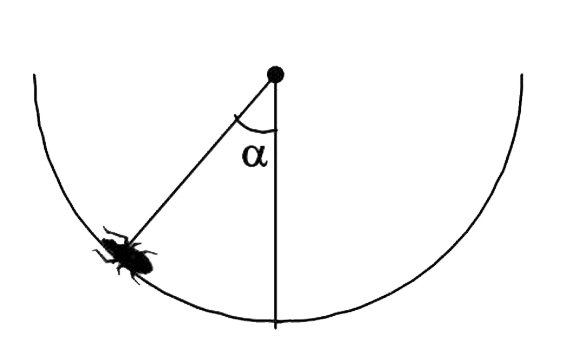
An insect craws up a hemispherical surface very slowly (see fig.). The coefficient of friction between the insect and the surface is `1//3`. If the line joining the center of the hemispherical surface to the insect makes an angle `alpha` with the vertical, the maximum possible value of `alpha` is given by

A

`cot alpha =3`

B

`tan alpha =3`

C

`sec alpha =3`

D

`cosec alpha =3`

Text Solution

Verified by Experts

The correct Answer is:
a

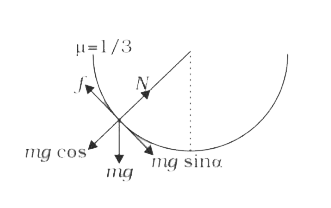
The three forces acting on the insect are mg, N and friction f. Let us resolve mg into two components: `m g cos alpha` balance N
`m g sin alpha` is balanced by the frictional force
`N=m g cos alpha f =m g sin alpha` but `f=muN =mu m g cos alpha`
`rarr cot alpha=1 / mu rarr cot alpha =3`
Promotional Banner

Similar Questions

Explore conceptually related problems

An insect crawls up a hemispherical surface very slowly (see the figure). The coefficient of friction between the insect and the surface is 1/3. If the line joining the centre of the hemispherical surface to the insect makes an angle alpha with the vertical, the maximum possible value of alpha is given by

The coefficient of friction between a hemispherical bowl and an insect is sqrt(0.44) and the radius of the bowl is 0.6m . The maximum height to which an insect can crawl in the bowl will be .

An insect of mass m, starts moving on a rough inclined surface from point A. As the surface is vert sticky, the corfficient of fricion between the insect and the incline is mu=1 . Assume that it can move in any direction, up the incline or down the incline then

A uniform hemisphere placed on an incline is on verge of sliding. The coefficient of friction between the hemisphere and the incline is mu = 0.3 . Find the angle phi that the circular base of the hemisphere makes with the horizontal. Given sin (tan^(-1) 0.3) cong 0.29 " and "sin^(-1) (0.77) cong 50^(@)

A crate is pulled along a horizontal surface at constant velocity by an applied force F that makes an angle theta with the horizontal. The coefficient of kinetic friction between the crate and the surface is mu . Find the angle theta such that the applied force is minimum to slide the block. Also find the minimum value of this force.

A rectangular block is kept on a rough horizontal surface and given some initial velocity. The coefficient of friction between the block and the surface is constant. The block will topple O either at the very beginning or not at all just before coming to rest only if the coefficient of friction at the ground O is > 1 only if some external force acts on it in addition to the frictional force

