Home
Class 12
PHYSICS
Three identical large plates are fixed a...

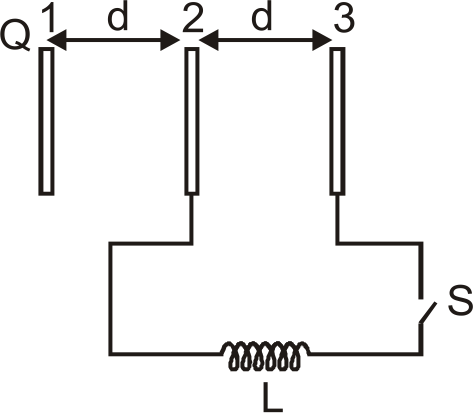
Three identical large plates are fixed at separation of d from each other as shown in figure. The area of each plate is A. Plate 1 is given charge `+Q` while plates 2 and 3 are neutral and are connected to each other through coil of inductances L and switch S. If resistance of all connected wires is neglected the maximum current flow through coil after closing switch is (`C=epsilone_0 A/d`) (neglect fringe effect)

A

`(Q)/(sqrtLC)`

B

`(Q)/(2sqrtLC)`

C

`(V_(a)-V_(b))=ZERO

D

`(Q)/(2sqrtLC)`

Text Solution

Verified by Experts

The correct Answer is:

C
Promotional Banner

Similar Questions

Explore conceptually related problems

Three very large plate are given charges as shown in the figure, if the cross -sectional area of each plate is the same the final charge distribution on plate C is

The two identical parallel plates are given charge as shown in figure. If the plate area of either face of each plate is A and seperation between plates is d , then find the amount of heat liberate after closing the switch.

Three identical large metallic plates are placed parallel to each other at a very small separation as shown in. The central plate is give a charge Q. What amount of charge will flow to earth when the key is pressid? .

Force between two conducting large plates , with charges Q and Q/2 as shown in the figure, is (Area of each face of plate =A)

Find the charge on each plate given area of each plate is A and separation between two consecutive plates is d.

The capacitor of capacity C is given charge Q and then connected to the coil of inductance L by closing the switch S . The maximum current flowing in the circuit at any later time will be

Five identical plates each of area A are joined as shown in the figure. The distance between the plates is d. The plates are connected to a p.d. of V volts . The charges on plates 1 and 4 will be

Five identical metal plates each of area A are placed at equal separation d as shown in figure and are connected with conducting wires. The equivalent capacitance across points A and B is
