Home
Class 12
PHYSICS
A car travelling at a speed of 30 ms^(-1...

A car travelling at a speed of `30 ms^(-1)` due north along the highway makes a left turn on to a sied road which heads towards due west. It takes `40 s` for the car to complere the turn. At the end of `40 s`, the caar has a speed of `20 ms^(-1)` along the side road. Derermime the magnitude of average acceleration over the `40 second` interval.

Text Solution

Verified by Experts
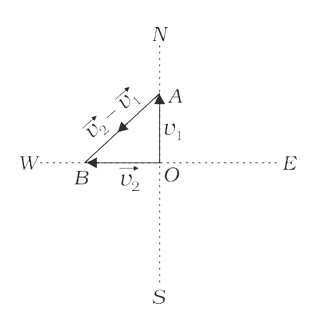
Refer to figure, initial velocity, `vecv_(1)=overset(-)(OA)=30ms^(-1)`, due north. Final velocity `vecv_(2)=overset(-)(OB)=20ms^(-1)` due west.
Change in velocity `vecv_(2)-vecv_(1)=overset(-)(OB)-overset(-)(OA)=overset(-)(AB)`
`|vec_(2)-vecv_(1)|=AB sqrt((OA)^(2)+(OB)^(2))`
`=sqrt(30^(2)+20^(2))=sqrt(1300)=36ms^(-1)`
Average acceleration `a_(av)=(|vecv_(2)-vecv_(1)|)/(t)=36/40=0.9 ms^(-2)`
Promotional Banner

Similar Questions

Explore conceptually related problems

A car travelling a 20 ms^(-1) due north along the highway makes a right turn on to a side road that heads due east. It takes 50s for the car to complete the turn. At the end of 50 second, the car has a speed of 15 ms^(-1) along the side road. Determine the magnitude of average acceleration over the 50 second interval.

A car moving with a speed of 25 ms^(-1) takes a U-turn in 5 seconds, without changing its speed. The average acceleration during these 5 seconds is

A car moving with a speed of 30 ms^(-1) takes a U-turn in 6 seconds, without changing its speed. What is the average acceleration during these 6 seconds?

A body moving with a speed 10ms^(-1) due north takes a left turn through 60^(@) and continues at the same speed.The change in its velocity is

A train has a constant speed of 40 ms^(-1) on a level road against resistive force of magnitude 3xx10^(4) N . Find the power of the engine.

A cr travelling at 36 km h^(-1) due North turns West in 5 secpmds and maintaind the same speed, What is the acceleration of the car ?

