Home
Class 12
PHYSICS
In a projectile motion the velocity...

In a projectile motion the velocity

A

is always perpendicular to the acceleration

B

is never perpendicular to the acceleration

C

is perpendicular to the acceleration for one instant only

D

is perpendicular to the acceleration for two instant

Text Solution

Verified by Experts

The correct Answer is:
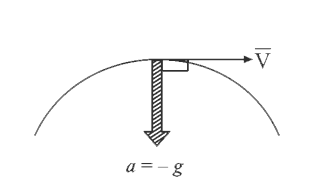
C

`vecv bot overset(-)a` at the Top.
Promotional Banner

Similar Questions

Explore conceptually related problems

In a projectile motion, velocity at maximum height is

In ain oblique projectile motion if the velocity of projection is increased by 2% , the percentage increase in horizontal range will be

Projectile motion theory

Assertion: In projectile motion, the vertical velocity of the particle is continoulsy decreased during its ascending motion. Reason: In projectile motion downward constant acceleration is present in vertical direction.

Assertion In case of projectile motion, the magnitude of rate of change of velocity is variable. Reason In projectile motion, magnitude of velocity first decreases and then increases during the motion.

Projectile motion is a combination of two one-dimensional motion: one in horizontal and other in vertical direction. Motion in 2D means in a plane. Necessary condition for 2D motion is that the velocity vector is coplanar to the acceleration vector. In case of projectile motion, the angle between velocity and acceleration will be 0^@ltthetalt180^@ . During the projectile motion, the horizontal component of velocity ramains unchanged but the vertical component of velocity is time dependent. Now answer the following questions: A particle is projected from the origin in the x-y plane. The acceleration of particle in negative y-direction is alpha . If equation of path of the particle is y = ax - bx^2 , then initial velocity of the particle is

Projectile motion is a combination of two one-dimensional motion: one in horizontal and other in vertical direction. Motion in 2D means in a plane. Necessary condition for 2D motion is that the velocity vector is coplanar to the acceleration vector. In case of projectile motion, the angle between velocity and acceleration will be 0^@ lt theta lt 180^@ . During the projectile motion, the horizontal component of velocity ramains unchanged but the vertical component of velocity is time dependent. Now answer the following questions: An object is projected from origin in x-y plane in which velocity changes according to relation vecv = a hati + bx hatj . Path of particle is

Projectile motion is a combination of two one-dimensional motion: one in horizontal and other in vertical direction. Motion in 2D means in a plane. Necessary condition for 2D motion is that the velocity vector is coplanar to the acceleration vector. In case of projectile motion, the angle between velocity and acceleration will be 0^@ltthetalt180^@ . During the projectile motion, the horizontal component of velocity ramains unchanged but the vertical component of velocity is time dependent. Now answer the following questions: A body is projected at angle of 30^@ and 60^@ with the same velocity. Their horizontal ranges are R_1 and R_2 and maximum heights are H_1 and H_2 , respectively, then A body is projected at angle of 30^@ and 60^@ with the same velocity. Their horizontal ranges are R_1 and R_2 and maximum heights are H_1 and H_2 , respectively, then

