Home
Class 12
PHYSICS
At the initial moment three points A, B ...

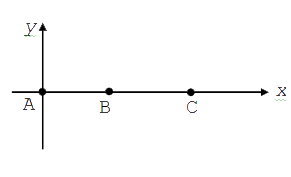
At the initial moment three points A, B and C are on a horizontal straight line at equal distances from one another. Point A begins to move vertically upward with a constant velocity v and point C vertically downward without any initial velocity but with a constant acceleration a. How should point B move vertically for all the three points to be constantly on one straight line. The points begin to move simultaneously.

A

acceleration a/2 and initial velocity v/2 both upwards

B

retardation a/2 and initial velocity v/2 both upwards

C

zero acceleration and initial velocity v

D

acceleration a/2 and initial velocity v both downwards

Text Solution

Verified by Experts

The correct Answer is:
B

Let the three particles be A, B and C located at (0, 0), `(x_(0),0) and (2x_(0),0)` respectively. Initially end A starts moving along positive y axis with constant velocity and C parallel to negative y axis with initial velocity zero but acceleration a.
After time t, coordinates of points A and C respectively are (0, vt) and `(2x_(0),-1//2 at^(2))` Let initial velocity of B is u and acceleration is b towards +ve y-axis.
its coordinates after time t are . As x-coordinates of B is the mid-point of A & C always so y coordinates should also be midpoint as they lie on a straight line.
`rArr u+(bt)/(2)=v/2-(at)/(4)" is identity in t" rArr u=v//2 & b=-a//2`
Promotional Banner

Similar Questions

Explore conceptually related problems

If three or more points does not lie on the same straight line the points are called -

A light rigid rod is placed on a smooth horizontal surface. Initially the end A begins to move vertically upward with constant velocity v_(0) and centre of the rod upward with a velocity v_(0)//2 having downward acceleration a_(0)//2 , the other end moves downward with

Which of the following three points represent a straight line?

Two particles move in the same straight line starting at the same moment from the same point in the same direction. The first moves with constant velocity u and the second starts from rest with constant acceleralion f . Then

A body A is thrown vertically upwards with initial velocity v_(1) . Another body B is dropped from a height h. Find how the distance x between the bodies depends on the time t if the bodies begin to move simultaneously.

Average velocity of a particle moving in a straight line, with constant acceleration a and initial velocity u in first t seconds is.

A body starts with some initial velocity along a straight line. After 3 s it is found to be a distance of 15 m from the starting point. At 4 s it is at starting point. What is the initial velocity of the body ? (Assume constant acceleration).

The ratio of velocities at points A,B and C in vertical circular motion

A particle is projected vertically upward with velocity u from a point A , when it returns to the point of projection .

