Home
Class 12
PHYSICS
Two paricles A and B start simultaneousl...

Two paricles A and B start simultaneously from the same point and move in a horizontal plane. A has an initial velocity `u_(1)` due east and acceleration `a_(1)` due north. B has an intial velocity `u_(2)` due north and acceleration `a_(2)` due east.

A

Their paths must intersect at some point

B

They must collide at some point

C

They will collide only if `a_1u_1=a_2u_2`

D

If `u_1 gt u_2` and `a_1 lt a_2`, the particles will have the same speed at some point of time

Text Solution

Verified by Experts

The correct Answer is:
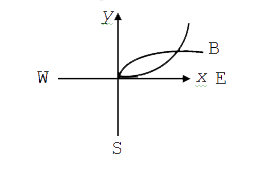
A, C, D

Let Co-ordinate of A and B are `(x_1, y_1) and (x_2, y_2)` respectively at time t \`rArr x_(1)=u_(1)t, y_(1)=1/2 a_(1)t^(2) & x_(2)=1.2 a_(2)t^(2), y_(2)=u_(2)t`
(As acceleration of A is along y-axis, its path is parabola opening towards positive y-axis and of B is parabola opening towards positive x-axis their path will intersect.)
For collision, same position at same time `rArr x_(1)=x_(2) and y_(1)=y_(2)` at same t
`rArr u_(1)t=1/2 a_(2)t^(2) and 1/2 u_(1)t^(2)=u_(2)t rArr t=(2u_(1))/(a_(2)) and t=(2u_(2))/(a_(1))`
`rAr (2u_(1))/(a_(2))=(2u_(2))/(a_(1)) rArr a_(1)u_(1)=a_(2)u_(2)l v_(x_(1))=u_(1),v_(y_(1))=a_(1)t rArr v_(1)=sqrt(u_(1)^(2)+a_(1)^(2)t^(2)).......ie,` speed of at time t.
Similarly speed of B at time t is `sqrt(u_(2)^(2)+a_(2)^(2)t^(2))`, Speed are equal `rArr v_(1)^(2)-v_(2)^(2)=0 rArr u_(1)^(2)-u_(2)^(2)=(a_(2)^(2)-a_(1)^(2))t^(2)` both sides are positive if `u_(1) gt u_(2) and a_(1) lt a_(2)`
Promotional Banner

Similar Questions

Explore conceptually related problems

Two particles A and B start simultaneously from the same point and move in a horizontal plane. A has an initial velocity u_(1) due east and acceleration a_(1) due north. B has an initial velocity u_(2) due north and acceleration a_(2) due east. Then :

Find the resultant of two velocities, on 30 ms^(-1) due east and other 40 ms^(-1) due north.

A particle has initial velocity of 17 ms^(-1) towards east and constant acceleration of 2 ms^(-2) due west. The distance covered by it in 9th second of motion is :

A body is simultanceously given two velocities : one 12 ms^(-1) due East and other 5 ms^(-1) due North. Find the resultant velocity.

A particle has an initial velocity of 5.5 ms^-1 due east and a constant acceleration of 1 ms^-2 due west. The distance covered by the particle in sixth second of its motion is.

A particle has an initial velocity of 9m//s due east and a constant acceleration of 2m//s^(2) due west. The displacement coverd by the particle in the fifth second of its motion is :

A body is simultaneously given two velocities, one 10 ms^(-1) due east and other 20 ms^(-1) due north-west. Calculate the resultant velocity.

The velocity of particle P due east is 4 ms^(-1) and that of Q is 3ms^(-1) due north. What is the relative velocity of P w.r.t. Q.

A man goes 24 m due east and then 10m due north.How far is he away from his initial position?

