Home
Class 12
PHYSICS
An object A is kept fixed at the point ...

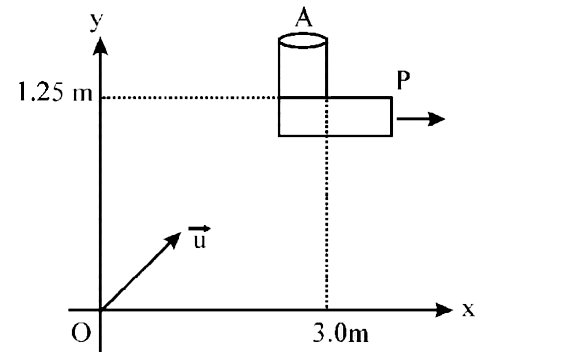
An object `A` is kept fixed at the point ` x= 3 m` and `y = 1.25 m` on a plank `p` raised above the ground . At time ` t = 0 ` the plank starts moving along the `+x` direction with an acceleration ` 1.5 m//s^(2) `. At the same instant a stone is projected from the origin with a velocity `vec(u)` as shown . A stationary person on the ground observes the stone hitting the object during its downward motion at an angle ` 45(@)` to the horizontal . All the motions are in the ` X -Y `plane . Find ` vec(u)` and the time after which the stone hits the object . Take ` g = 10 m//s`

Text Solution

Verified by Experts

The correct Answer is:
1s

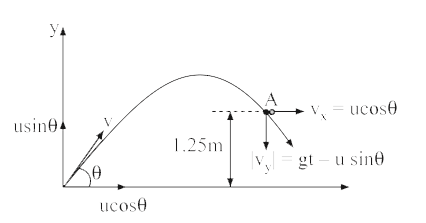
Let after time ‘t’ the stone hits the object and be the angle which the velocity vector makes with horizontal
From question, we have following information Vertical displacement of stone is 1.25 m
Using `s_(y)=u_(y)t+1/2a_(y)t^(2)`
Therefore 1.25 `=(u sin theta)t-1/2 gt^(2) or (u sin theta)t=1.25 +5t^(2) ...(i)`
Horizontal displacement of stone = 3 + displacement of object A.
Therefore `(u cos theta)t=3+1/2 at^(2)`
We have `a=1.5 m//s^(2), "Hence "(u cos theta)t=3+0.75 t^(2) .....(ii)`
Horizontal component of velocity (of stone) = vertical component (because velocity vector is inclined at `45^(@)` with horizontal).
Therefore `(u cos theta)=gt-(u sin theta) ........(iii)`
The right-hand side is written because the stone is in its downward motion. Therefore `gt gt u sin theta`
Multiplying equation (iii) with t can write. `(u cos theta)t+ (u sin theta)t=10t^(2) ......(iv)`
Now doing (iv)-[(iii)+(i)]
It gives `4.25t^(2)-4.25 or t=1s " Substituting t=1 s in (i) and (ii) we get "`
`u sin theta =6.25 m //s or v_(y)=6.25 m and u cos theta=3.75 m//s or u_(x)=3.75 m//s`
Now, we can write `u=u_(x)hati+u_(y)hati or u=(3.75 hati+6.25 hatj)m//s`
Promotional Banner

Similar Questions

Explore conceptually related problems

A body starts from rest from the origin with an acceleration of 3 m//s(2) along the x-axis and 4 m//s^(2) along the y-axis. Its distance from the origin after 2 s will be

A body starts from rest from the origin with an acceleration of 6m//s^(2) along the x-axis and 8m//s^(2) along the y-axis. Its distance from the origin after 4 seconds will be

An object starts from rest at the origin and moves along the x axis with a constant acceleration of 4m//s^(2) . Its average velocity as it goes from x=2 m to x=8 m is :

An object at rest at the origin begins to move in the +x direction with a uniform acceleration of 1 m//s^(2) for 4s and then it continues moving with a uniform velocity of 4 m/s in the same direction. The x-t graph for object's motion will be -

A body starts from rest from the origin with an acceleration of 6m//s^(2) along x axis and 8m//s^(2) along y axis.The distance from origin after 4 seconds will be

The acceleration of a particle moving along x-direction is given by equation a=(3-2t) m//s^(2) . At the instant t=0 and t=6 s , it occupies the same position. (a) Find the initial velocity v_(o) (b) What will be the velocity at t=2 s ?

A stone is allowed to fall from the top of a tower 100m high and at the same time another stone is projected vertically upwards from the ground with a velocity of 25m//s . Calculate when and where the two stone will meet.

A stone is allowed to fall from the top of a tower 100m high and at the same time another stone is projected vertically upwards from the ground with a velocity of 25m/s .Calculate when and where the two stones will meet.

A stone is dropped from a height of 100m .At the same instant another stone is projected vertically upwards with velocity of 50ms^(-1) .If g=10ms^(-2) ,the height from the ground at which the 2 stones meet is

At time t=0 s a car passes a point with velocity of 16 m//s and thereafter slows down with acceleration a=-0.5t m//s^(2) ,where t is in seconds. It stops at the instant t=

