Home
Class 12
PHYSICS
Consider the situation as shown in the f...

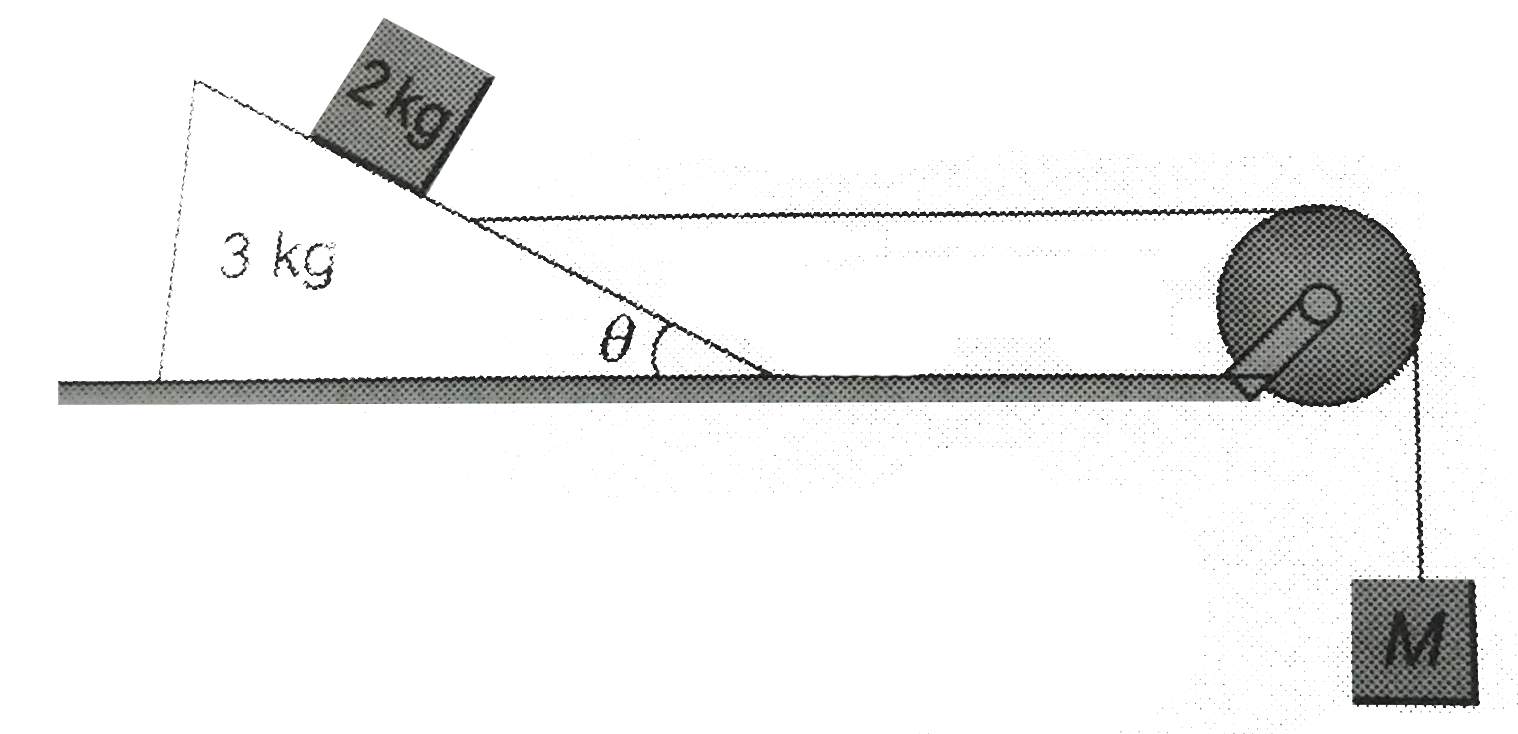
Consider the situation as shown in the figure. All the surface are smooth and the string and pulley are light. Find the mass of the hanging block which will prevent the smaller block form slipping over the triangular block.

A

`(M + m)/(cot theta - 1)`

B

`(M - m)/(cot theta - 1)`

C

`(M + m)/(cot theta + 1)`

D

`(m - n)/(M + m) tan theta`

Text Solution

Verified by Experts

The correct Answer is:

A

`T - N sin theta = Ma`
`N sin theta = ma` and `N cos theta = mg`, mg - T = Ma

Solving for M', we get :
`M' = (M + m)/(cot theta - 1)`
Alternate method
`a = ("net pulling force")/("Total mass") = (M'g)/(M + m + M')`
Since m is not sliding on M , in the absence of friction `a = g tan theta` (as discussed in the class)
by solving
`g tan theta = (M'g)/(M + m + M') implies M' = (M + m)/(cot theta - 1)`
Promotional Banner

Similar Questions

Explore conceptually related problems

Consider the situation shown in the figure. The surface is smooth and the string and the pulley are light. Find the acceleration of each block and tension in the string.

Consider the situation shown in figure. All the surfaces are frictions and the string and the pulley are light. Find the magnitude of the acceleration of the two blocks.

Find the acceleration of each block in the situation shown in the figure. All the surface are smooth and the pulleys and sttings are light.

In figure m_(1)= 1 kg and m_(2)= 4 kg Find the mass m of the hanging block which will provent the smaller block from slipping over the triangular block .All the surface are frictionless and the string and the pulleys are light

Consider the situation shown in the figure. The wall is smooth but the surface of blocks A and B in contact are rough. The friction of B due to A in equilibrium

find the acceleration of the block of mass M in the situation shown in figure. All the surfaces are frictionless and the pulleys and the string are light.

Consider the situation shown in figure .Both the pulleys and the string and light and all the surfaces are smooth. (a) Find the acceleration of 1kg block. (b) Find the tension in the string. (g = 10 m//s^(2)) .

Consider4 the situation shown in figure. Bothe the pulleys and the string are light and all the surfaces are friction less. a. Find the acceleration of the mass M. b. Find the tension in the string c. Calculate the force exerted by the clamp on the pulley A in the figure.

Find the mass M of the hanging block in figure which will prevent the smaller block from sliping over the triangular blcok. All the surfaces are frictions and the strings and the pulleys are light.

Find the acceleration of the 6 kg block in the figure. All the surfaces and pulleys are smooth. Also the strings are inextensible and light. [Take g = 10 m//s^(2) ] .

