Home
Class 12
PHYSICS
You are designing an elevator for a hosp...

You are designing an elevator for a hospital. The force exerted on a passenger by the floor of the elevator is not to exceed 1.60 times the passenger's weight. The elevator accelerates upwards with constant accelerates upwards with constant acceleration for a distance of 3.0 m and then starts to slow down. What is the maximum speed (in `ms^(-1)`) of the elevator?

Text Solution

Verified by Experts
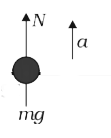
Consider the forces on the person:
`sum F_(y) = m a_(y)`
N - mg = ma, N = 1.6 mg
So, `a = 0.60g = 6 ms^(-2)`
`v^(2) = u^(2) + 2as = 0^(2) + 2 xx 6 xx 3 implies v = 6 ms^(-1)`
Promotional Banner

Similar Questions

Explore conceptually related problems

You are designing an elevator for a hospital. The force exerted on a passenger by the floor of the elevator is not to exceed 1.60 times the passenger's weight. The elevator accelerates upwards with constant acceleration for a distance of 3.0 m and then starts to slow down. What is the maximum speed (in ms^(-1) ) of the elevator?

An elevator is accelerating upwards with a constant acceleration a ms^-2 . If a coin is dropped in it by a passenger, then.

Consider an elevator moving downwards with an acceleration a, the force exerted by a passenger of mass m on the floor of the elevator is :

The upwards normal force exerted by the force of an elevator on a passenger who weighs 600 N is 570 N. The acceleration of passanger is

An elevator is moving vertically up with a acceleration a the force exerted on the floor by a passenger of mass m is

A man of mass m is standing in an elevator moving downward with an acceleration (g)/(4) . The force exerted by the bottom surface of the elevator on the man will be

A 1500-kg elevator moves upward with constant speed through a vertical distance of 25 m. How much work was done by the tension in the elevator cable ?

In an elevator moving vertically up with an acceleration g, the force exerted on the floor by a passanger of mass M is

