Home
Class 12
PHYSICS
Three blocks A,B and C of equal mass m a...

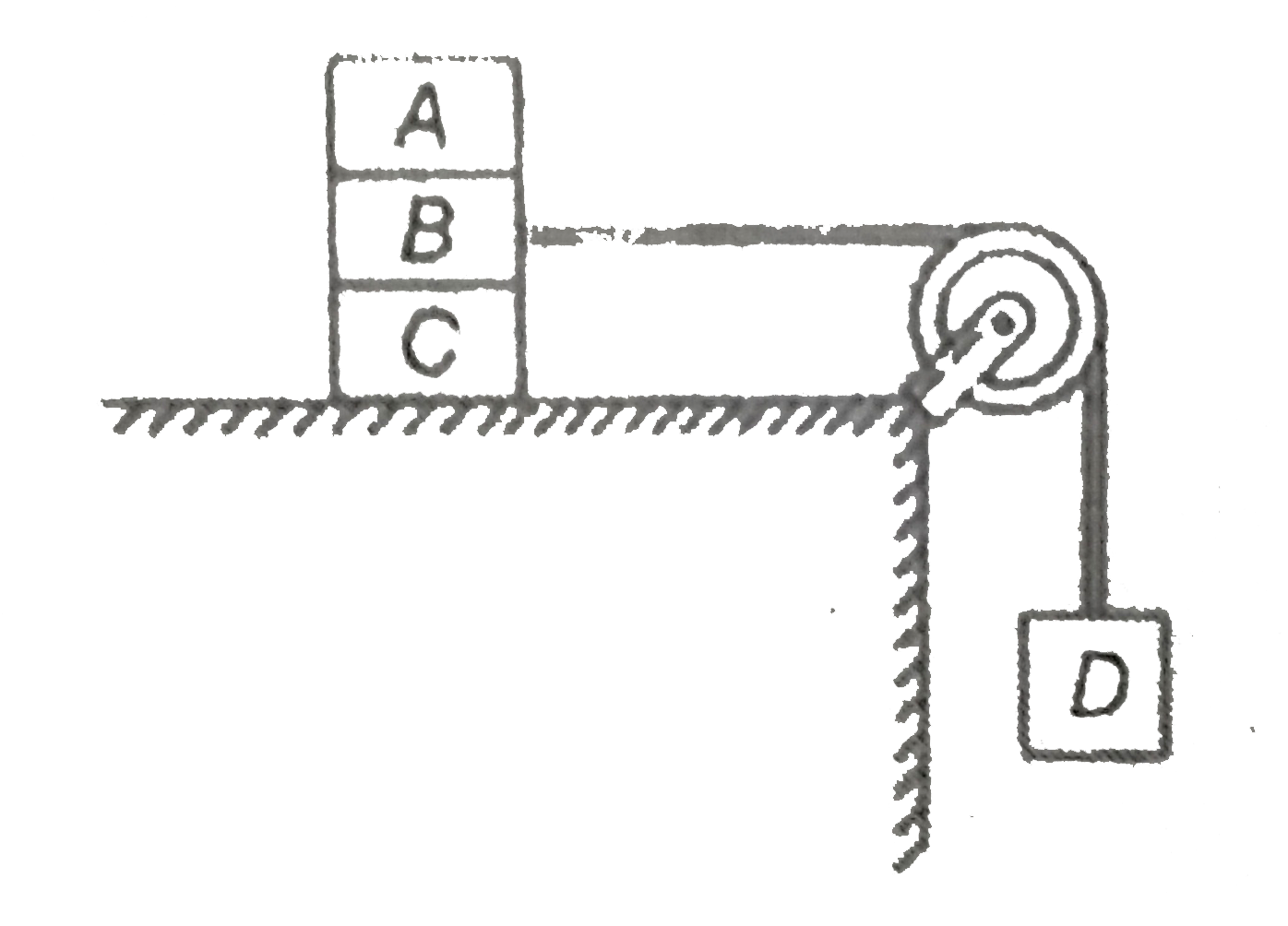
Three blocks A,B and C of equal mass m are placed one over the other on a smooth horizontal ground as shown in figure. Coefficient of friction between any two blocks of A,B and C is 1/2. the maximum value of mass of block D so that the blocks A,B and C move without slippping over each other is

A

6m

B

5m

C

3m

D

4m

Text Solution

Verified by Experts

The correct Answer is:

C

`f_("max")` between A and B is mg/2, can provide acceleration = g//2 to A and `f_("max")` between B and C is 2mg/2, can provide acceleration = g to c
`implies` max acceleration if they move together as on body = g/2
`implies T = 3m. (g)/(2)` and `Mg - T = (Mg)/(2) implies M = 3m`
Promotional Banner

Similar Questions

Explore conceptually related problems

Three blocks of A, B and C of equal mass m are placed one over the other on a smooth horizontal ground as shown in figure. Cofficient of friction between any two blocks of A,B and C is 1/2. The maximum value of mass of block D so that the blocks A,B and C move without slipping over each other is-

There block A B ,and C of equal mass m are placed one over the other on a frictionless surface (table) as shown in figure The coefficient of friction between any blocks A ,B and C is mu The maximum value of mass of block D so that the blocks A,B and C move without slipping over each other is

Three blocked A,B and C are placed one over the other as shown in figure. Draw free body diagram of all the three blocks.

A block A slides over an another block B which is placed over a smooth inclined plane as shown in figure . The coefficient of friction between the two blocks A and B is mu . Mass of block B is two times the mass of block A . The acceleration of the centre of mass of two blocks is

There are two block as shown in the figure of masses 1kg and 4kg . Friction coefficient between any two surfaces are 0.2 then find maximum value of horizontal force F so that both blocks moves together.

Three blocks A,B and C of mass 10 kg each are hanging on a string passing over a fixed frictionless pulley as shown in figure. The tension in the string connecting blocks B and C is (g=10m//s^(2))

Two blocks A and B of respective masses 6 kg and 4 kg are connected with a string passing over a light friction less pulley as shown in the figure . The coefficient of friction between the block A and horizontal surface is 0.4 . Then the minimum mass of block C which should be placed over A to prevent it from moving is :

The coefficient of static friction between the two blocks shown in figure is mu and the table is smooth. What maximum horizontal forced F can be applied to he block of mass M so that the block move together?
